- “Top 8 Wonderful Things You Can Do With A Mango.” Kenyan clickbait. I bought it.
- “Third Call for Project Proposals under the Treaty’s Benefit-sharing Fund.” Seed Treaty clickbait. I’m not qualified.
- “Guacapocalypse” — a headline to reckon with. Here’s the back story to climate change and avocados.
Grapes or rootstocks
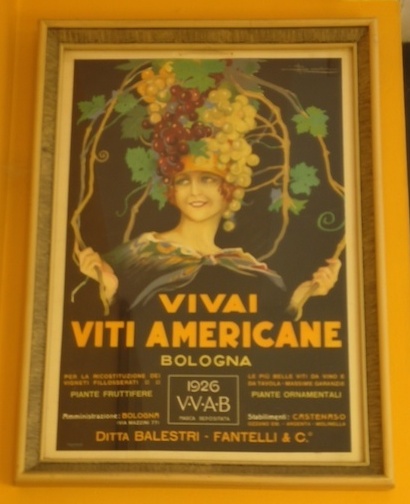
One item of agricultural biodiversity interest from my visit to Bologna last weekend, this rather charming 1926 poster. 1 It offers, as you can see, American vines. And here’s my question: varieties, or Phylloxera-resistant rootstocks?
Nibbles: Plant Guardians, Peruvian Solanum, Sunflower genomics, California drought, Brazil drought, Sri Lankan tea, Minnesota wine, Seed of Hope, Sugarcane engineering, King Cotton, Rubber boom
- Do you want to be a Plant Guardian?
- Some people are already getting busy guarding Solanum in Peru.
- The sunflower family gets a molecular makeover.
- What the California drought means for food.
- And the one in Brazil for coffee.
- And tea in Sri Lanka is also in trouble, though for once drought is not to blame.
- Minnesota has a wine industry thanks to wild relatives. But I won’t hold that against them.
- In today’s Seeds of X story, X=hope and the place is Aceh.
- If sugarcane was a cold-tolerant oil-producing crop, would it still be sugarcane?
- Cotton has a lot to answer for. Or rather, the people who grew it do. Or did. Oh crap.
- Rubber too. Though not as much. I guess. Oh crap.
Brainfood: Weird coconut, Rainforest management, Pollinators and grazing, Pre-Mendel, Italian grapes, Indian fibre species, Cereal relatives, Brazil nut silviculture
- Scope of novel and rare bulbiferous coconut palms (Cocos nucifera L.). Produces bulbils instead of floral parts.
- Holocene landscape intervention and plant food production strategies in island and mainland Southeast Asia. Like the Amazon.
- Grazing alters insect visitation networks and plant mating systems. More outcrossing in grazed birch woods.
- Imre Festetics and the Sheep Breeders’ Society of Moravia: Mendel’s Forgotten “Research Network.” Before peas, there were sheep.
- Genetic Characterization of Grape Cultivars from Apulia (Southern Italy) and Synonymies in Other Mediterranean Regions. About half are also grown somewhere else.
- Fibre-yielding plant resources of Odisha and traditional fibre preparation knowledge − An overview. 146 species, no less.
- Functional Traits Differ between Cereal Crop Progenitors and Other Wild Grasses Gathered in the Neolithic Fertile Crescent. How do cereal progenitors differ from all the other grasses our ancestors used to eat? Adaptation to competition and disturbance. They were weeds, basically.
- Testing a silvicultural recommendation: Brazil nut responses 10 years after liana cutting. Biodiversity bad for Brazil nuts.
Brainfood: Value of Chiloé, Zimbabwe sorghum, Rosa karyotypes, PSM diversity, Pear diversity, Medic clines, Wild rices, Barley adaptation, Coffee agroforesty
- Valuing cultural ecosystem services: Agricultural heritage in Chiloé island, southern Chile. Willingness to pay at US$50.5 per person per year, and not related to distance from site.
- Assessments of genetic diversity and anthracnose disease response among Zimbabwe sorghum germplasm. New sources of resistance (for the US) in even a moderately diverse collection.
- Karyotype Analysis of Wild Rosa Species in Xinjiang, Northwestern China. It’s just amazing to me that people still do karyopypes.
- Explaining intraspecific diversity in plant secondary metabolites in an ecological context. Trait variance in these things is considerable, partly genetic and can evolve, maybe even faster than mean trait values.
- Identifying genetic diversity and a preliminary core collection of Pyrus pyrifolia cultivars by a genome-wide set of SSR markers. Close relationship between China and Japan, and Sichuan a bit of a nexus.
- Genomic Signature of Adaptation to Climate in Medicago truncatula. Found genes associated with position along 3 environmental clines in a set of populations, then were able to predict performance of other populations based on genotype.
- Could abiotic stress tolerance in wild relatives of rice be used to improve Oryza sativa? Yes, and from these particular places.
- An efficient method of developing synthetic allopolyploid rice (Oryza spp.). Should make using those wild relatives a bit easier.
- Can barley (Hordeum vulgare L. s.l.) adapt to fast climate changes? A controlled selection experiment. Maybe not. Not even the landrace.
- Coffee landscapes as refugia for native woody biodiversity as forest loss continues in southwest Ethiopia. “Coffee farms could support a considerable portion, though not all, of the woody biodiversity of disappearing forests.” No word on what it does to the coffee, though.