- From börek to burricche.
- The mother of Georgian cheese. I’m sure they have their version of börek there too. If not, there’s always bread.
- Fancy StoryMap of global livestock production. No wonder there’s lots of cheese in Georgia.
- Bringing back rare Welsh oats. Well, someone has to…
- A short history of cinnamon. Does it go with börek?
- Beautiful apples. And some so ugly they are beautiful.
- Crowd-sourcing Physalis improvement. Very tempting.
- How to conserve in vitro and in cryo. Useful for the three things above, for example.
Culture, Agriculture, Food & Environment, and genebanks
Dr Helen Anne Curry, Peter Lipton Lecturer in History of Modern Science and Technology at the University of Cambridge, guest edited a special issue on “The Collection and Conservation of Plant Genetic Resources” for the journal Culture, Agriculture, Food & Environment in December.
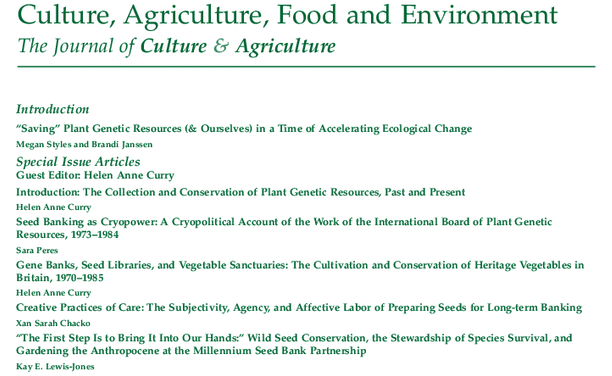
Looks good. A couple of the papers are even open access. I admit I haven’t read them yet, but I will, and report back.
And watch out for Dr Curry’s new project “From Collection to Cultivation: Historical Perspectives on Crop Diversity and Food Security,” which is launching this year with support from a Wellcome Trust Investigator Award.
Ken Richards RIP
Canadian genebank legend Ken Richards sadly passed away late last year.
In 1996 Ken took over management of Canada’s Plant Genetic Resources with its relocation to Saskatoon from Ottawa. Ken supervised the construction of the new Gene Bank attached to Agriculture and Agri-food Canada at the University of Saskatchewan. Ken and Tim Myers divided in half every packet of the 550,000 packet collection of plant seeds for the transfer. Half of the collection was sent by surface trucks and half of the collection was relocated by a Canadian government Hercules airplane. In subsequent years the plant collection was joined in Saskatoon by the microbial, fruit tree and animal collections. Ken assembled and supervised a wonderful team of scientists who worked from P.E.I. to the B.C. Okanagan. He and Linda and Kimberly lived in beautiful Saskatoon for fifteen years.
Sad.
Nibbles: USDA maize genebank, Apple breeding, Seed conservation, Soil map, Scoring supermarkets, DNA barcoding, Stone Age Hypoxis, Hybrid wine, Lost crops, Boswellia, Leucokaso, Species mixtures
- Nice student video on the genebank and breeding programmes at Iowa State.
- Speaking of breeding programmes and videos, here’s Sean Myles on his work on apples in Canada.
- Seed conservation legend Richard Ellis on what climate change is doing to seed quality.
- An amazing new global soil properties map is open for business.
- Scoring supermarkets for the human suffering they represent.
- The future of DNA barcoding…is here.
- Cotton 101.
- Strong evidence of Middle Stone Age tuber cooking in southern Africa.
- French wine growers dip a cautious toe into the grapewine interspecific genepool.
- Yields of mixtures of now “lost” native American crops comparable to those of maize.
- The canonical yearly frankincense story in honour of Epiphany.
- Biblical white olive makes a comeback in Italy.
- Useful update of mixture studies.
Brainfood: Food access, Rare species, Italian landraces, Forest status, CC & production, Myanmar nutrition, Super-pangenome, Plant pest priorities, Peanut resistance, Maize coring, EAT-Lancet costs, Sorghum tannins double, Dutch cattle core
- Food Access Deficiencies in Sub-saharan Africa: Prevalence and Implications for Agricultural Interventions. Income doesn’t necessarily translate into better nutrition, but keeping livestock does. Happy New Year.
- The commonness of rarity: Global and future distribution of rarity across land plants. Rare species are especially vulnerable to climate and land use change.
- Exploring on-farm agro-biodiversity: a study case of vegetable landraces from Puglia region (Italy). High vegetable landrace diversity may be linked to poor soils and distance from urban centres.
- Measuring Forest Biodiversity Status and Changes Globally. Combines biodiversity significance and intactness, and comes up with not that many places.
- Escaping the perfect storm of simultaneous climate change impacts on agriculture and marine fisheries. Business as usual means 90% of world’s population will see declines in both agricultural and fisheries production.
- Potential for smart food products in rural Myanmar: use of millets and pigeonpea to fill the nutrition gap. 2 weeks of inclusion had positive effect on wasting, stunting and underweight.
- Super-Pangenome by Integrating the Wild Side of a Species for Accelerated Crop Improvement. Add up species pangenomes for a whole genepool. Would be cool to grow it.
- Plant Pest Impact Metric System (PPIMS): Framework and guidelines for a common set of metrics to classify and prioritise plant pests. Host crop value, market access, feasibility of management and reversibility are the most important ones.
- A new source of root-knot nematode resistance from Arachis stenosperma incorporated into allotetraploid peanut (Arachis hypogaea). You have to cross it with another wild relative first.
- The impact of sample selection strategies on genetic diversity and representativeness in germplasm bank collections. Different approaches to making cores tested with maize data from Seeds of Discovery.
- Affordability of the EAT–Lancet reference diet: a global analysis. US$2.84 per day, or more than household per capita income for at least 1.58 billion people.
- Allelochemicals targeted to balance competing selections in African agroecosystems. Levels of tannins in sorghum correlated with taste receptor variant in humans and presence of sparrows.
- Genetic Architecture of Chilling Tolerance in Sorghum Dissected with a Nested Association Mapping Population. Chilling tolerance associated with low tannin and short stature. No word on the role of sparrows.
- Characterization of Genetic Diversity Conserved in the Gene Bank for Dutch Cattle Breeds. Almost optimized, at least for bulls.