- Sensitivity of grain yields to historical climate variability in India. Other cereals are less sensitive than rice.
- Monitoring Changes in the Cultivation of Pigeonpea and Groundnut in Malawi Using Time Series Satellite Imagery for Sustainable Food Systems. Pigeonpea cultivation has expanded so much in response to Asian markets you can track it from space. But for how long?
- The relationship between forests and freshwater fish consumption in rural Nigeria. Fish need forests.
- Temporal patterns of seed quality development, decline, and timing of maximum quality during seed development and maturation. “…when maximum quality is first attained, and for how long it is maintained during seed development and maturation, varies with genotype and environment.” Oh, great.
- Modeling Crop Genetic Resources Phenotyping Information Systems. Managing meta-data on characterization and evaluation data.
- In vivo human-like robotic phenotyping of leaf traits in maize and sorghum in greenhouse. Yes, characterization and evaluation data like this.
- Ten quick tips for effective dimensionality reduction. How to analyze all that C&E data.
- Mutation of a bHLH transcription factor allowed almond domestication. A point mutation is all it took.
- Chilling accumulation in fruit trees in Spain under climate change. Some fruit trees, even in generally warm places, need a certain amount of cold to develop properly, and might not get it in the future. Maybe a point mutation will come to the rescue.
- Smart forage selection could significantly improve soil health in the tropics. Could.
- Evaluation of linkage disequilibrium, population structure, and genetic diversity in the U.S. peanut mini core collection. Can’t really use for GWAS. What a tragedy.
- Implications of climate change to the design of protected areas: The case study of small islands (Azores). The current PA system will still be ok on one island, but not on another. Has someone done this globally?
- Urbanisation, dietary change and traditional food practices in Indonesia: A longitudinal analysis. Westernization of diets is limited to Jakarta.
- Orphan crops: their importance and the urgency of improvement. They seem to be doing ok in Indonesia?
- Reconstructing Asian faunal introductions to eastern Africa from multi-proxy biomolecular and archaeological datasets. Chickens and black rats went from Asia to the coast of E Africa in the mid-first millennium CE.
- Archaeological and biometric perspectives on the development of chicken landraces in the Horn of Africa. Or maybe earlier for chicken after all.
Nibbles: Half-Earth, Salmon runs, Melon book, Indian genebanks
- The Half-Earth Map is better than none.
- Repurposing rice fields in the off season to help out California’s Chinook salmon.
- Photogenic melons.
- A famous community seed bank is in trouble.
- While elsewhere in India, a new genebank takes off.
An indicator for the conservation of socioeconomically and culturally valuable plants
The CIAT/CropTrust proposal for the calculation of “Comprehensiveness of conservation of socioeconomically as well as culturally valuable species” is up on the Biodiversity Indicators Partnership website.
Here’s a recent blog post on the indicator, which is relevant for Aichi Target 13 and SDG 2, Target 2.5.
And here’s the underlying paper which described the method in detail: Comprehensiveness of conservation of useful wild plants: An operational indicator for biodiversity and sustainable development targets.
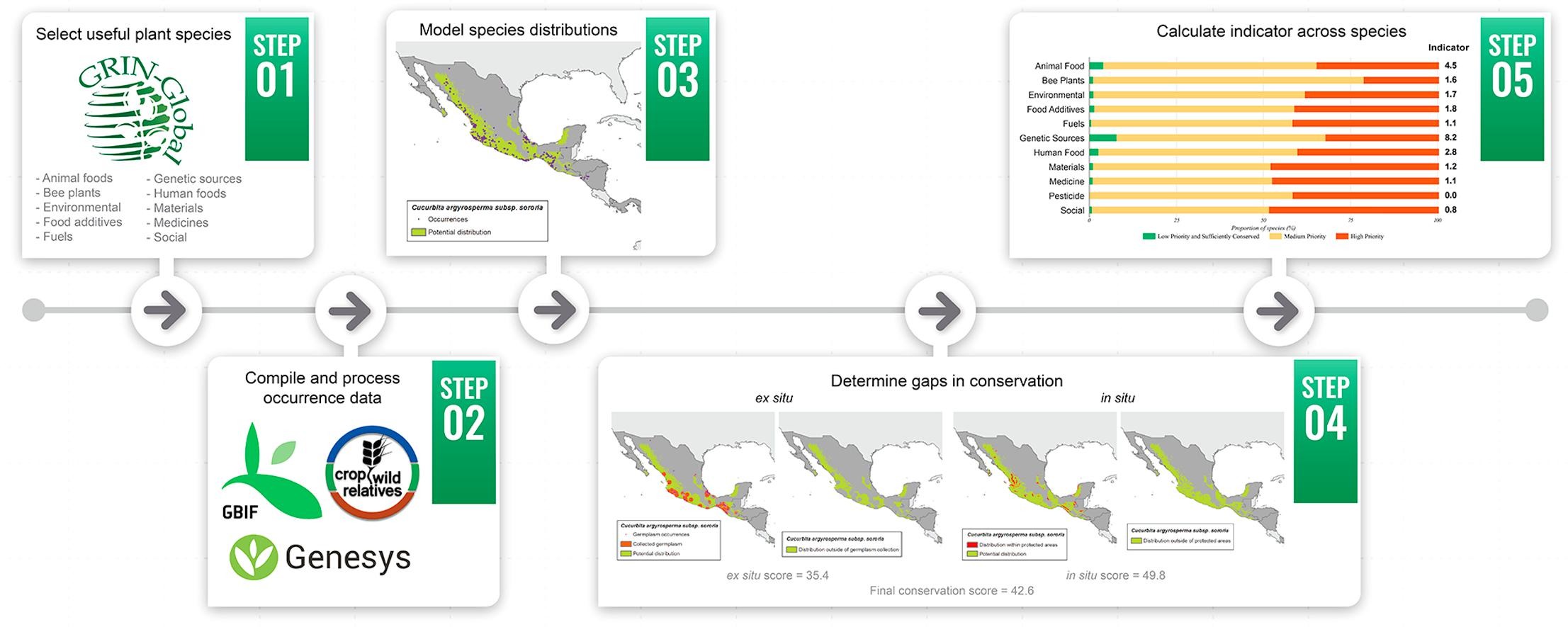
Finally, here’s the website where you can explore the data.
Brainfood: Molecular characterization, Ancient weed, Patagonian berries, Strawberry origins controversy, Potato & nutrition, European potatoes, Extension, Cacao, Maize & wheat breeding history, Rural employment, Production stability, Amazonian Neolithic, Fairtrade wages
- Genebank genomics bridges the gap between the conservation of crop diversity and plant breeding. What do we want? An accurate genotype-to-phenotype map for all seeds stored in the genebank. When do we want it? As soon as we have the money to ensure their conservation.
- The origins of cannabis smoking: Chemical residue evidence from the first millennium BCE in the Pamirs. Well, that’s like your opinion, man. Residues in incense burners used for mortuary rituals, if you must know.
- Patagonian berries as native food and medicine. Good, and good for you.
- Revisiting the Origin of the Octoploid Strawberry. Not 4 separate diploid progenitors, as another paper recently found, but rather 2 extant ones, once you re-do the math.
- The Nutritional Contribution of Potato Varietal Diversity in Andean Food Systems: a Case Study. It’s great, but it’s not enough.
- The origins and adaptation of European potatoes reconstructed from historical genomes. Sequencing of old herbarium specimens, including Darwin’s, shows that early introductions to Europe were from the Andes, and later admixed there with Chilean and wild material, forming a sort of secondary centre of diversity.
- Effect of Intensive Agriculture-Nutrition Education and Extension Program Adoption and Diffusion of Biofortified Crops. Breeding is not enough.
- Morphological characterisation and evaluation of cacao (Theobroma cacao L.) in Trinidad to facilitate utilisation of Trinitario cacao globally. Now we know which ones are the best, for different reasons.
- Evolution of US maize (Zea mays L.) root architectural and anatomical phenes over the past 100 years corresponds to increased tolerance of nitrogen stress. There has been unconscious selection for root traits resulting in better N use efficiency. An old paper, resurrected because of the next one.
- Breeding improves wheat productivity under contrasting agrochemical input levels. Breeding wheat in Europe for good performance under high input levels has not markedly affected its performance under more challenging conditions. Diversity has held up too.
- Positive outcomes between crop diversity and agricultural employment worldwide. Irrespective of input levels and economic growth rates.
- National food production stabilized by crop diversity. Crop diversity is not just good for rural employment (see above), but for year-on-year production stability too.
- Climate change and cultural resilience in late pre-Columbian Amazonia. And it was sort of the same in ancient Amazonia.
- Effects of Fairtrade on the livelihoods of poor rural workers. Fairtrade improves wages of workers in cooperatives, but not on small farms.
Nibbles: Tutwiler interview, Cherokee seeds, Cryo, Bordeaux rules, Oz maize, Food as medicine, In situ CWR
- Ann Tutwiler (ex Bioversity DG) on the importance of agrobiodiversity.
- Cherokee Nation may deposit seeds in Svalbard.
- Millionth sample deposited in USDA livestock genebank.
- New grape varieties to be allowed in Bordeaux because of climate change.
- Hawkesbury heritage maize regenerated.
- Some Filipino rice is medicinal.
- Germany designates first CWR genetic reserves in Europe.