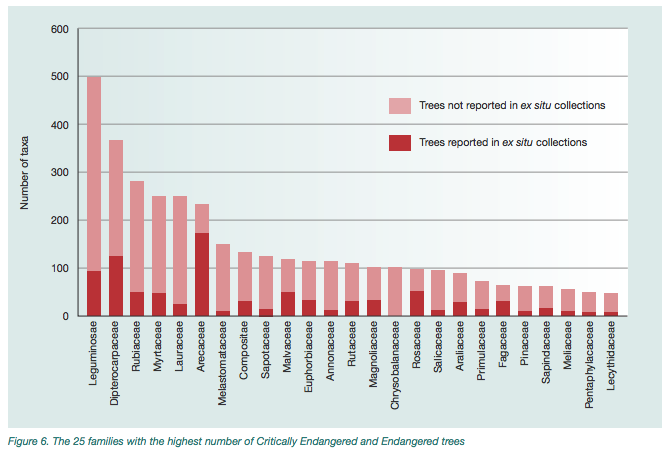
I’m not sure we have ever pointed to the Global Trees Campaign’s set of surveys of ex situ collections. There are individual surveys of ebony, Betulaceae, conifers, Zelkova, Rhododendron, maple, oak and Magnoliaceae, plus “Conserving the World’s Most Threatened Trees: A global survey of ex situ collections.” This came out in 2015 and includes a bunch of crop wild relatives.
Absolutely clear about ABS
Are you a germplasm user? Are you confused about which ABS arrangement applies to you? The International Seed Federation has got you covered, with its Genetic Resources Interactive Tree (GRIT).
Unfortunately, it will only take you so far:
Please note that the Genetic Resources Information Tree (GRIT) does not provide a turnkey solution, and each user will have to check the national legal requirements accessing a genetic resource in a given country.
But I guess it’s a start.
Incidentally, one of the possible sources of germplasm on GRIT is the CG Centres, and most of their distributions are done with the SMTA of the International Treaty. Most, but not all, as a new paper makes clear. ISF, please take note…
Nibbles: Carrot breeding, BIEN, Protected areas databases, Brazilian genebanks, Endangered coconut genebank, DSI, ABS, Climate pix, Botanical pix double, Potatoes galore, Pandanus language, Archaeological double, Palestinian seed saving
- Putting the polyacetylene back into carrots.
- The Botanical Information and Ecology Network gets an upgrade. Any CWRs among its 18,844,855 more observations?
- And any is protected areas? This will tell how well they’re managed. Mash up with this spatial database on indigenous lands?
- Otherwise, there are genebanks, though not enough in Brazil, apparently.
- And not always safe.
- What to do with Digital Sequence Information? Would be nice to be clear on what it is.
- ABS broken down by ISF. And the CGIAR. Not DSI though.
- Need climate visuals? Well, who doesn’t.
- The Columbian Exchange has visuals also.
- And the Royal Horticultural Society too.
- Speaking of Columbian Exchange: frites. And Vavilov, chefs, etc.
- Speaking about nuts in PNG. Comment by Jim Croft, who would know: “Except the species illustrated is the widespread oceanic strand species, Pandanus tectorius, not the endemic highland crop ‘karuka’, Pandanus julianettii.”
- 5000-year-old brewery in Egypt.
- 14,000-year-old bread.
- Fast forward 14,000 years.
Brainfood: Community forests, Pepper CWR, Banana spread, Blight plasticity, VIR wheat
- Research frontiers in community forest management. Trends are for hybrid business models, REDD+ interactions and the use of secondary data.
- Production of embryo rescued hybrids between the landrace “Friariello” (Capsicum annuum var. annuum) and C. baccatum var. pendulum: phenotypic and cytological characterization. Another crop wild relative enters the arena.
- Earliest Musa banana from the late Quaternary sequence at Fahien Rock Shelter in Sri Lanka. People used wild bananas for 40,000 years before domesticated triplods arrived 6000 years ago.
- Gene expression polymorphism underpins evasion of host immunity in an asexual lineage of the Irish potato famine pathogen. “…17 genes are not expressed in one of the two…isolates despite apparent absence of sequence polymorphisms.”
- Novel sources of resistance to Septoria nodorum blotch in the Vavilov wheat collection identified by genome-wide association studies. The collection that keeps on giving.
Brainfood: African rice domestication, Barley evaluation, Al & sorghum, Potato seed systems, Yield trends, Arachis resynthesis, Potato breeding, Lupinus evolution, Helianthus invasiveness, Wild cassava, Beaked maize return, Amaranth breeding, Vegetables, American dogs
- The Rise and Fall of African Rice Cultivation Revealed by Analysis of 246 New Genomes. Domesticated in northern Mali as a result of the decline of wild species due to the drying of the Sahara.
- Unlocking historical phenotypic data from an ex situ collection to enhance the informed utilization of genetic resources of barley (Hordeum sp.). Don’t throw away that historical data from regenerations.
- Exploiting sorghum genetic diversity for enhanced aluminum tolerance: Allele mining based on the AltSB locus. It’s more prevalent in guinea sorghums.
- Unearthing unevenness of potato seed networks in the high Andes: a comparison of distinct cultivar groups and farmer types following seasons with and without acute stress. Potatoes are not just potatoes. And farmers are not just farmers.
- Global patterns of crop yield stability under additional nutrient and water inputs. Higher variability in yield expected under higher fertilizer inputs.
- Segmental allopolyploidy in action: Increasing diversity through polyploid hybridization and homoeologous recombination. Domesticating peanuts, the right way this time.
- Applications of New Breeding Technologies for Potato Improvement. Humble no more?
- Pleistocene glacial cycles drive isolation, gene flow and speciation in the high‐elevation Andes. In Lupinus, phylogeny does not recapitulate orogeny.
- Evolution of invasiveness by genetic accommodation. In a crop wild relative, no less.
- Manihot takape sp. nov. (Euphorbiaceae), a new tuberous subshrub from the Paraguayan Chaco. A crop wild relative too.
- Back to beaked: Zea mays subsp. mays Rostrata Group in northern Italy, refugia and revival of open-pollinated maize landraces in an intensive cropping system. Title of the week. Alternative: Polenta Power.
- From zero to hero: the past, present and future of grain amaranth breeding. Runner up.
- Issues and Prospects for the Sustainable Use and Conservation of Cultivated Vegetable Diversity for More Nutrition-Sensitive Agriculture. Still neglected.
- The evolutionary history of dogs in the Americas. They came over from Siberia with people, rather than evolving from local wolves, but all that’s left of them is a cancer.
