- Genetic Nature of Elemental Contents in Wheat Grains and Its Genomic Prediction: Toward the Effective Use of Wheat Landraces from Afghanistan. Only one significant marker, for Zn.
- Strategies for exchange of coconut germplasm in Brazil. Zygotic embryos in Petri dish containing Y3 culture medium without sucrose can last a couple of days without bacterial infection.
- Phylogenetic relationships within Lactuca L. (Asteraceae), including African species, based on chloroplast DNA sequence comparisons. The African species are probably not Lactuca at all.
- The Pacific yam (Dioscorea nummularia Lam.), an under-exploited tuber crop from Melanesia. It can be improved through crossing with itself, or with other species.
- Eco-geographical assessment of Avena L. wild species at the VIR herbarium and genebank collection. Some more collecting to be done.
- The database of the PREDICTS (Projecting Responses of Ecological Diversity In Changing Terrestrial Systems) project. Including 15,000 plants. No word on whether any of them Avena.
- Your Poison in My Pie—the Use of Potato (Solanum tuberosum L.) Leaves in Sakartvelo, Republic of Georgia, Caucasus, and Gollobordo, Eastern Albania. Only used as first vegetable in spring in isolated high mountain areas in the southern Balkans.
- Toward a taxonomic definition of perennial wheat: a new species ×Tritipyrum aaseae described. Not entirely clear why naming it as a new species is necessary, but it’s still pretty cool.
- Dynamics of variety change on wheat farms in Pakistan: A duration analysis. For marginal farmers, it’s about yield, for others, quality. No word on how perennial wheat might do.
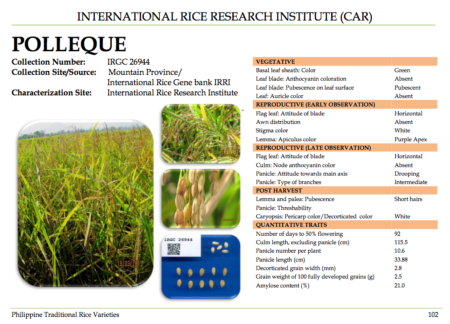
Filipino rice landraces documented
Congratulations to all concerned for the launch of the catalogue of Philippine Traditional Rice Varieties. I’m reliably informed it will be available online soon. In the meantime, I’ve had the privilege of consulting a PDF, and I can confirm that it is really as cool as it sounds.
Nibbles: Trees on farms, Biodiversity hotspots, Coconuts, Banana genebank, Fiddleheads, Hybrid wheat, Buckler prize, ITPGRFA hatchet job
- Trees are good for African farmers.
- A basic universal income for people in biodiversity hotspots. Agrobiodiversity hotspots too?
- Coconut History 101.
- 30 years of bananas in Belgium.
- Eat up all your fiddleheads.
- Hybrid wheat is coming at last.
- Ed Buckler wins big. Unclear if he’ll be allowed to tweet about it.
- Nonsense piece on the ITPGRFA.
Brainfood: Wild peanuts, Salt-tolerance, Melon diversity, Consumption & biodiversity, German veggie fanciers, Oh oh oomycetes, Miscanthus diversity, Urban pollinators, Milpa bees
- Genomic characterisation of Arachis porphyrocalyx (Valls & C.E. Simpson, 2005) (Leguminosae): multiple origin of Arachis species with x=9. At least two distinct origins for the x=9 species.
- Salt Tolerant Varieties: A Biological Intervention to Manage Saline and Sodic Environment and Sustain Livelihoods. Salt-tolerant rice and wheat varieties are being adopted where needed in this bit of Haryana, but not as much as they could be.
- Genotyping-by-sequencing of a melon (Cucumis melo L.) germplasm collection from a secondary center of diversity highlights patterns of genetic variation and genomic features of different gene pools. Three subgroups, and that’s just in Puglia, the heel bit of Italy.
- Quantifying biodiversity losses due to human consumption: a global-scale footprint analysis. Food consumption is the single greatest driver of biodiversity loss, somewhere else.
- Old vegetable varieties: attitude, consumption behaviour and knowledge of German consumers. There’s a consumer segment in Germany that could be labelled “fanciers of old vegetable varieties,” apparently.
- Emerging oomycete threats to plants and animals. Be afraid.
- Ecological characteristics and in situ genetic associations for yield-component traits of wild Miscanthus from eastern Russia. Arctic sugarcane? It could happen.
- The city as a refuge for insect pollinators. It could happen.
- Sweat bees on hot chillies: provision of pollination services by native bees in traditional slash-and-burn agriculture in the Yucatán Peninsula of tropical Mexico. The milpa is pretty good refuge for bees already.
Nibbles: Heirloom collection, Booze, Grape history, CWR training, New perennial wheat species, Brazilian cacao, Smelly durian, CIAT genebank
- “Every heirloom plant seed grown for food has a story…”
- The history of alcohol.
- The history of a particular alcohol-producing plant.
- U. of Minnesota students travel to crop cradle.
- They could just have gone to Washington State University.
- Brazil is back in the cacao game.
- Deconstructing durian’s smell is easier than you thought.
- The CIAT genebank in Scientific (Latin)American.