- Evolving gene banks: improving diverse populations of crop and exotic germplasm with optimal contribution selection. Crop genebanks should learn from livestock breeding.
- Ethiopian wheat yield and yield gap estimation: A spatially explicit small area integrated data approach. You can explain 40% of the variation in wheat yield without leaving your office.
- Land Use, Yield and Quality Changes of Minor Field Crops: Is There Superseded Potential to Be Reinvented in Northern Europe? The CAP has been really bad for minor crops in Finland.
- Navigating international exchange of plant genetic resources amidst biosecurity challenges: experiences of IITA in Africa. Genebanks need to work closely with people who know about phytosanitary rules.
- Rooting for cassava: insights into photosynthesis and associated physiology as a route to improve yield potential. Canopy structure and architecture could do with improvement. No doubt IITA are working on that.
- Genetic variability within accessions of the B73 maize inbred line. Is greater than it should be.
- Using Rare Breeds in Animal-Assisted Activities: A New Model Proposed at the “Animal Farm” in Ladispoli (Rome, Italy). Worthy effort, terrible name.
- Adaptive and non-adaptive evolution of trait means and genetic trait correlations for herbivory resistance and performance in an invasive plant. When plants are released from pressure from natural enemies, they gradually lose resistance to herbivory and perform better, but independently.
- How Can High-Biodiversity Coffee Make It to the Mainstream Market? The Performativity of Voluntary Sustainability Standards (VSS) and Outcomes for Coffee Diversification. Apparently, it can’t, not without changing its flavour.
- Genetic diversity center of cultivated soybean (Glycine max) in China – New insight and evidence for the diversity center of Chinese cultivated soybean. Here. But not only.
- Heritability of Popping Characteristics in Sorghum Grain. You can breed for popping quality, but environment also has an effect.
Nibbles: Cryoconservation, Barley history, Beer in UNESCO, Future crops, Pacific crops, Ag & biodiversity, Sequencing NUS, Market education, Mauritanian camels
- Cryo congress coming.
- Ancient farmers enjoyed a beer…
- …and now we all can.
- Yeah but what’s next in the improvement pipeline?
- CePaCT: The Video.
- Why can’t we all just get along?
- Genetic maps are from Mars, nutrition is from Venus…
- Using markets to teach biodiversity.
- The end of camel herding?
Re-establishing ICARDA’s genebank
One of the reasons I’ve been a bit behind with my blogging in the past month or so is that I’ve been doing a lot of travelling. It shouldn’t matter, you can blog from any hotel room with a half decent wifi connection of course, but the reality is that it can be difficult to find the time, not to mention the energy.
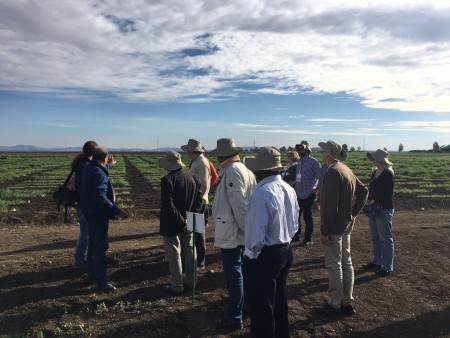
Anyway, just to prove that I was doing some work, here’s some evidence from my visit to the new ICARDA genebank in Morocco. You’ll remember that the collection that used to be just outside Aleppo in Syria is now being re-established in Terbol, Lebanon and Rabat, Morocco with material that was retrieved from the Svalbard Global Seed Vault in late 2015. Earlier this year, we published a shot of the first set of seeds from Svalbard growing in the field at the ICARDA research station in Merchouch, Morocco.
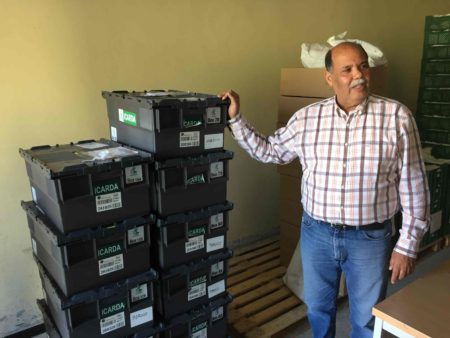
Here’s the second lot ready for planting, guarded by Ahmed Armi, head of the ICARDA Genetic Resources Section.
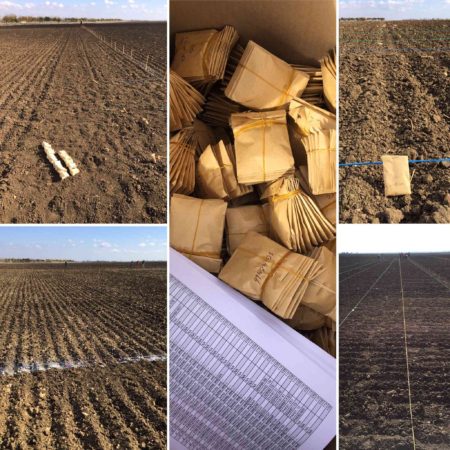
Here is the field being prepared, and the packets of seeds ready for planting.
And here, finally, are Ahmed’s staff actually putting the seed into the ground for multiplication. They did about 4,000 cereal accessions in a couple of days the week before last.
In a few months, rain willing, the field will look like it did above, last February, and the whole thing can be repeated again. A genebank’s work never ends.
Brainfood: Food diversity, Vigna salt tolerance, Medicinal rice, Sustainable intensification, US wild potatoes, Ethiopian potatoes, Temperate rice, Brazilian maize, Soybean cores, Pea cores, Danish cattle viability
- On-Farm Crop Species Richness Is Associated with Household Diet Diversity and Quality in Subsistence- and Market-Oriented Farming Households in Malawi. Correlation is not causation, but one gets one’s victories where one can.
- Agroecology and healthy food systems in semi-humid tropical Africa: Participatory research with vulnerable farming households in Malawi. See above.
- Diversity and Evolution of Salt Tolerance in the Genus Vigna. Salt tolerance has evolved at least 4 times in the genus among coastal species.
- An ethnobotanical study of traditional rice landraces (Oryza sativa L.) used for medical treatment in selected local communities of the Philippines. 19 landraces are used to treat a variety of nutritional and other complaints.
- Is it time for a socio-ecological revolution in agriculture? Sustainable intensification is often neither.
- Core Collections of Potato (Solanum) Species Native to the USA. Only two species, but more collecting needed, though one population of one of the species captures 82% of total AFLP bands. In other news, people still using AFLPs.
- Genetic Diversity and Relationship of Ethiopian Potato Varieties to Germplasm from North America, Europe and the International Potato Center. 15 unique Ethiopian genotypes reflects 2 distinct introductions from Europe.
- Genetic Diversity and Population Structure of Rice Varieties Cultivated in Temperate Regions. 217 varieties from temperate regions show much diversity, structured by grain type and origin.
- Genetic Vulnerability and the Relationship of Commercial Germplasms of Maize in Brazil with the Nested Association Mapping Parents. Brazilian commercial maize hybrids are pretty diverse, but show little overlap with the diversity of the NAM parents.
- Evaluation of resistance to Phytophthora sojae in soybean mini core collections using an improved assay system. Resistant materials made up about a third of the world mini-core, but <10% of the Japanese mini-core.
- Genetic Diversity of Chinese and Global Pea (Pisum sativum L.) Collections. The USDA global core was more diverse than the Chinese core, which was pretty diverse anyway.
- Population viability analysis on a native Danish cattle breed. Jutland cattle has 122 years if nothing is done, but things can be done.
Brainfood: Mate diversity, Species recovery, CC & food, Microbial collections, Chickpea roots, African flora, Bitter gourd diversity, Wild yeast, Cryo double
- Genetic and phytochemical analysis to evaluate the diversity and relationships of mate (Ilex paraguariensis A. St.-Hil.) elite genetic resources in a germplasm collection. Some have low caffeine, which makes them especially useless.
- Genetic factors in threatened species recovery plans on three continents. Are ignored more often than you’d think.
- Climate Change and Food Systems Research: Current Trends and Future Directions. Current research on the effects of climate change on food systems doesn’t pay enough attention to the fact that food production is indeed a system, varies regionally and depends on political structures.
- World data centre for microorganisms: an information infrastructure to explore and utilize preserved microbial strains worldwide. All you need to know about 708 culture collections from 72 countries and >368,000 strains on one website.
- Characterising root trait variability in chickpea (Cicer arietinum L.) germplasm. Core collection of 270 reveals 3 main groups based on root architecture in hydroponics.
- RAINBIO: a mega-database of tropical African vascular plants distributions. Who will fillet out the CWR species?
- Genetic Variability for Yield and Nutritional Quality in Yam Bean (Pachyrhizus sp.). Can’t access the high dry matter material? No problem.
- Diversity Among a Wide Asian Collection of Bitter Gourd Landraces and their Genetic Relationships with Commercial Hybrid Cultivars. 114 accessions fall into 5 geographic groups based on SSRs. Commercial cultivars are all very similar.
- Yeast biodiversity from Vitis vinifera L., subsp. sylvestris (Gmelin) Hegi to face up the oenological consequences of climate change. Yeasts from wild grapes will save our wine. Look, I’ll take anything.
- The Potato Cryobank at the International Potato Center (CIP): A Model for Long Term Conservation of Clonal Plant Genetic Resources Collections of the Future. 70% of over 1000 accessions are considered successfully cryoconserved.
- Probabilistic viability calculations for cryopreserving vegetatively propagated collections in genebanks. Were these used in the above?