- When more is better: how data sharing would accelerate genomic selection of crop plants. It’s the data sharing, stupid.
- Genomic prediction contributing to a promising global strategy to turbocharge gene banks. See what I mean?
- Conservation of Animal Genetic Resources – A New Tact. Yeah, for animals too.
- Indigenous stocks as treasure troves for sustainable livestock production in the 21st century: Insights from small ruminant genomics. See what I mean?
A new dawn in Lebanon, and ICARDA
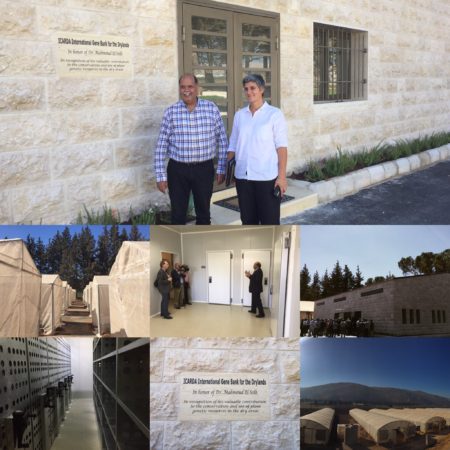
If you’re one of the lucky few who follow me on social media, you’ll know I was in Lebanon last week for the opening of the new ICARDA genebank. It was great to meet the dedicated team of Lebanese and Syrian staff who are re-establishing the active collection at Terbol in the Bekaa Valley, with material obtained from Svalbard late last year. And it was also great to be back in Lebanon after almost 25 years. Some things are still the same. But many have changed, and there’s hope in that.
Brainfood: SE Asia archaeobotany, Avocado cryo, Farm diversity & revenue, DOC cheese, Kenyan agrobiodiversity, Perennial pigeonpea, Algerian sheep diversity, Basil rankings, Wild sunflower
- Rice, beans and trade crops on the early maritime Silk Route in Southeast Asia. At trade crossroads, crops had to audition for inclusion in the local menu.
- Cryopreservation of somatic embryos for avocado germplasm conservation. Still needs work.
- Soil fertility, crop biodiversity, and farmers’ revenues: Evidence from Italy. Diverse farms are more profitable, and can make up for poor soils.
- Native and Non-Native Sheep Breed Differences in Canestrato Pugliese Cheese Quality: a Resource for a Sustainable Pastoral System. Traditional local cheese is better when made with milk from traditional local breeds.
- Agrobiodiversity conservation enhances food security in subsistence-based farming systems of Eastern Kenya. But correlation is not causation.
- Estimating demand for perennial pigeon pea in Malawi using choice experiments. It won’t be liked everywhere.
- Genome-wide analysis highlights genetic dilution in Algerian sheep. Two of the 7 local breeds studied are in trouble due to uncontrolled breeding with a third, but may be doing better in neighbouring countries.
- Multicriteria optimization to evaluate the performance of Ocimum basilicum L. varieties. Fancy maths allows you to pick the best basil variety out of 8.
- The challenges of maintaining a collection of wild sunflower (Helianthus) species. Are many and varied…
Nibbles: European bison, Eucalypts and CC, Flood prevention, Svalbard, Cute animals
- What sort of sick bastard decapitates European bison re-introduced to the wild?
- Might have to introduce eucalypts to different places soon. No doubt that will also end in tears.
- Diversity helps with flooding. But it’s probably too late.
- USDA buys some insurance. Because life.
- Animal portraits are guaranteed to make your day better. Even this day.
Do you like pina colada?
Well, it could be in trouble…
“It’s fair to say that at this pace, the Caribbean is running out of coconuts,” said Compton Paul, coordinator of a regional coconut program at the Trinidad-based Caribbean Agricultural Research and Development Institute.