- There are some really old breweries out there.
- And some really old grape seeds in Sardinia.
- The beauty of hops. New and old.
- Some very photogenic old sheep breeds in the Lake District.
- Someone has discovered some old salt-tolerant rice landraces. Also medicinal and aromatic rices. Well I never.
- Meanwhile, at the other end of the rainbow, the Chinese dip a toe into gourmet GM rice.
- Brit boffins breed flood-proof barley.
- Botanical gin. Two of my favourite things, combined.
- Saving the Pau Brasil is, well, complicated. But what else was it going to be?
- Yet another roundup of the pros and cons of quinoa.
New version of banana genebank information system goes live
Great to see a new version of the Musa Germplasm Information System (MGIS) released. The URL is unchanged. The key improvements are listed as follows (slightly edited):
1. All information on a single accession can be viewed in one page
2. Taxonomic content of each collection is summarized graphically.
3. Easier data filtering and export functions.
4. Users can share comments on any accession.
5. Accessions can be requested online via the Musa Online Requesting system (MORS) with a modified interface.
I particularly like the ability to comment, though you do have to register for that. The data cover 2,281 accessions from six genebanks around the world, 1 including 1,456 in the International Transit Centre (ITC) managed by Bioversity International in Belgium:
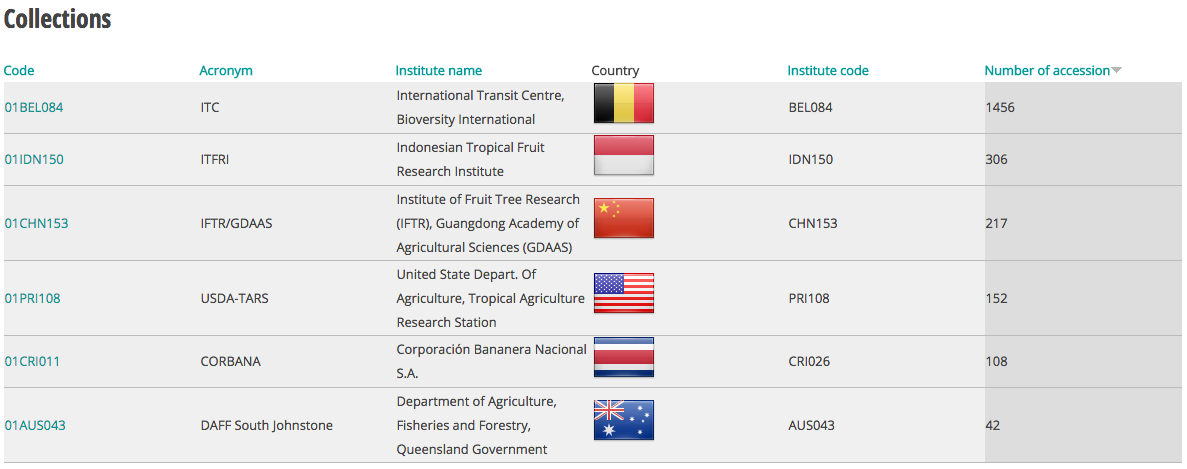
The ITC data are also in Genesys, which shows 1,529 accessions rather than 1,456. I assume MGIS is the more up to date, but I’m unclear why there should be a difference. 2
You can search among the 2,281 accessions on name or number; or by filtering by any combination of genebank, species, subspecies, genome group (AAB, say), subgroup (Cavendish, say), country of origin, ploidy, whether there’s a photo, whether it’s been included in a molecular study, and availability. Searching is pretty fast.
Each accession gets a nice page summarizing all the pertinent information.
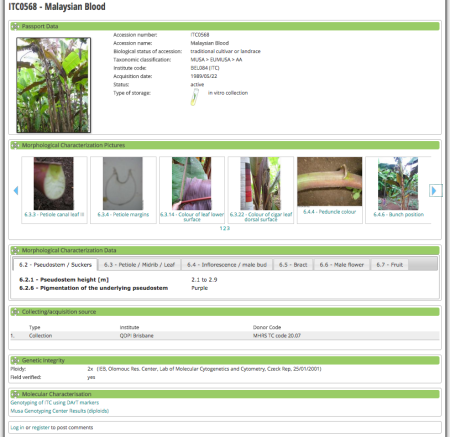
That information can include morphological characterization data, and illustrations, as you can see above, but I could not find a way of searching the database based on a particular descriptor or combination of descriptors. You get a map when collecting locality is known, but you can’t map multiple accessions, as far as I could see. You’d have to do that in Genesys, I guess.
If you want to download data, you have to cut and paste accession numbers into a form on another page, and then you get a CSV or XLS. It didn’t look to me like you could export either morphological characterization data or molecular data. I have to say I was disappointed by the whole export thing.
So, some good things, some not so good things in this new version of MGIS. I’ll be keeping an eye on it for further developments. And continue playing with it, of course. Maybe I missed something.
Brainfood: Cassava descriptors, Core collections, Oat breeding, Indigenous fruits, Sandalwood in Fiji, Eggplant diversity treble, Globally important mushrooms, High amylose rice, Chickpea diversity, Finger millet diversity, Lethal yellowing, Spanish peppers, Local potato experts
- Selection of the most informative morphoagronomic descriptors for cassava germplasm. From 51 to 32. Hardly seems worth it. And dropping descriptors can be dangerous.
- Advances in core collection of plant germplasm resources. In Chinese, alas, but it sounds intriguing.
- Trends in breeding oat for nutritional grain quality – An overview. You want high β-glucan, and you can get it by breeding for high yield, luckily. A. atlantica has high β-glucan.
- Indigenous Fruit Trees of Tropical Africa: Status, Opportunity for Development and Biodiversity Management. Need for “exploiting the under-tapped treasuries of IFT.” Still? People have been saying that for years. They’ve even designated agroforestry systems as globally important and everything.
- Promoting Santalum yasi Seeman (Sandalwood or yasi) in agroforestry systems to reverse agrodeforestation in Fiji. An attempt to introduce a high value species into a threatened agroforestry system. Not just fruit, then.
- Genetic diversity and population structure of wild/weedy eggplant (Solanum insanum, Solanaceae) in southern India: Implications for conservation. Quite a lot of geneflow.
- The potential for crop to wild hybridization in eggplant (Solanum melongena; Solanaceae) in southern India. Transgenes from the crop could spread to the wild relative.
- Variation in Antioxidant Activity and Flavonoid Aglycones in Eggplant (Solanum melongena L.) Germplasm. So, the leaves are good for you. But I suspect they taste like crap.
- The Qingyuan Mushroom Culture System as Agricultural Heritage. Would pay money to see that.
- Selecting High Amylose Rice Germplasm Combined with NIR Spectroscopy at the RDA Genebank Conserved. From 9481 to 14 with high amylose and decent agronomy. But why bother?
- Field response of chickpea (Cicer arietinum L.) to high temperature. There are some heat tolerant lines in the ICRISAT genebank.
- Genetic diversity in East African finger millet (Eleusine coracana (L.) Gaertn) landraces based on SSR markers and some qualitative traits. The diversity is high, mainly within countries, and missing from the ICRISAT minicore. Naughty.
- Analyses based on the 16S rRNA and secA genes identify a new phytoplasma subgroup associated with a lethal yellowing-type disease of coconut in Côte d’Ivoire. The international genebank is threatened.
- New Insights into Capsicum spp Relatedness and the Diversification Process of Capsicum annuum in Spain. Limited genetic diversity has differentiated in Spain into pungent, elongated peppers in the South and Center, and sweet, blocky and triangular types in the North.
- Knowing native potatoes: finding local experts through innovative methods in the Peruvian Andes. Community Biodiversity Register methodology applied to potato landraces. Don’t see anything much new here, but good to have it nicely documented.
Nibbles: Biltong, Coco de mer, PGRFA course, Poplar genebank, IRRI genebank, African agriculture, Hybrid chickens, American food
- Professor wants to copyright the name biltong, should be forced to eat nothing else until he takes it back.
- Getting to the bottom of coco de mer.
- PGRFA course at Wageningen. Expensive, but worth it, and you can apply for a NFP/MENA Fellowship, check on the course overview PDF.
- The IRRI genebank manager has seen the future of genebanks: “…we need to work on building the system to estimate breeding value from genotype, and then we will be able to feed more detailed knowledge to the breeders.” He probably means DivSeek. Now IRRI really need to get a different stock image of him and his genebank.
- The UK now has a National Black Poplar Clone Bank. Not quite as big as the above.
- A different take on Bill’s Big Bet. And more along the same lines.
- Hybrid Kuroiler chickens a big hit in Uganda. Bill may be onto something after all.
- “As American as apple pie” is just the beginning. I want to see Kuroilers at KFC.
Nibbles: Conservation course history, Language and DNA, Entomophagy blog, IPBES help, Phenomics methods database, Sustainable Nestlé, Got other milk?, NCYC
- University of Birmingham conservation course alumnus/a? This one’s for you.
- Phonemes follow human genomes. Kinda. No word on crop and livestock genomes. Yet.
- A whole blog on eating insects.
- Interesting: “Each IPBES assessment must include reference citations to indigenous knowledge, and every review panel must include experts in this.”
- Curated list of methods in Plant Phenotyping and Phenomics.
- Nestlé’s sustainable agriculture guy visits CIAT, plants coconut, talks supply chains.
- Camelcino, anyone?
- UK yeast genebank reaches totally arbitrary milestone.