- CIAT crop wild relatives team announces 3 new papers on gaps in ex situ collections: potato, sweet potato & pigeonpea. Take a break, people, please.
- And CIAT genebank features in nice video on why we need genebanks. So also the IRRI genebank, which is relevant to the next Nibble. We do joined-up nibbling here.
- Fine dining with Filipino rice landraces. Go Manny!
- None of those rice landraces are perennial. Yet. If they ever are, it’ll be due to a wild relative.
- Fusarium head blight resistance in wheat dissected using a synchrotron. Avengers assemble!
- Oxyrhynchus papyrus identifies hangover cure. Or so the Daily Mail says, so, you know…
- Oh wow, the Mail is definitely on a botanical roll, now they’re all over a Kardashian-shaped tuber.
- New Edible Aroids Newsletter. Nothing Kim-shaped about these tubers.
- Wheat and barley replaced millet in E Tibet around 2000 BC after cooling period. This going into reverse now, I wonder?
- Some biodiversity you don’t want, trust me.
- Speaking of unwelcome biodiversity, there’s a new hope in the fight against malaria: hybrid artemisia.
- More on that potato that the Dutch are growing in sea water. Like they have a choice.
- Microbes are part of terroir.
- Q&A with The Triumph of Seeds author.
- The coco-de-mer is a pretty triumphant seed.
- You say ramòn nut, I say Maya nut.
- Kenya needs bamboo. Says the International Network for Bamboo & Rattan. Wow, two active crop networks in today’s Nibbles.
- Yesterday it was arabica that was in trouble, today tea. Damn you, climate change.
- They’re the lucky ones: they may be in trouble, but they’re not going extinct…
- More production does not automatically mean less stunting. Damn you, real world.
Good news from the Nepalese national genebank
We have received news from various people working at the National Agriculture Genetic Resources Center of Nepal, the country’s national genebank, that the staff are all fine and the building suffered only minor damage.
Nepal is in many ways a pioneer in the development of community seedbanks, linked to participatory plant breeding, and the back-up, support and leadership provided by the national genebank is an integral and vital part of the joined-up system of crop diversity conservation that is emerging in that country.
Long may it continue to serve as an example to others.
Cary Fowler receives William L. Brown Award
Congratulations to Cary Fowler for receiving the 7th William L. Brown Award for Excellence in Genetic Resource Conservation.
The William L. Brown Award recognizes the outstanding contributions of an individual in the field of genetic resource conservation and use. It is administered by the William L. Brown Center (WLBC) at the Missouri Botanical Garden and is made possible through a generous endowment from the Sehgal Family Foundation, in cooperation with the family of Dr. Brown.
Dr. Brown was a distinguished, internationally-recognized scientist, businessman, and humanitarian. Over the course of five decades, he devoted himself to the collection, preservation, understanding, and sharing of plant genetic resources in order to help meet the global demand for food. The William L. Brown Award recognizes an individual whose efforts and achievements reflect a concern for those issues that were so important to Dr. Brown.
Cary was presented with the award yesterday during his keynote lecture at the 9th BGCI International Congress on Education in Botanic Gardens, hosted by the Missouri Botanical Garden.
award to Dr Cary Fowler for his contribution to conserving world 's crop diversity #BGCI21015EDU pic.twitter.com/lvb1SXugeL
— Botanic Gardens Conservation International (@bgci) April 30, 2015
Richly deserved.
Genebanks are NOT morgues, and you know it
Are we going to stand for this? Unless of course the point was to say that they’re not, and here’s why :)
Seedbanks = morgues? Collections only useful if can be mobilised tells David Marshall @JamesHuttonInst #monogram2015 pic.twitter.com/vkPi02gHWL
— Jemima Brinton (@JemimaBrinton) April 30, 2015
Setting genebank data free
There’s a strange little article on SciDevNet about the petition lodged with the UN by Norman Warthmann, of the Australian National University, and Claudio Chiarolla, of the Institute for Sustainable Development and International Relations in France, “to create a legal framework requiring governments to make data from the genetic sequencing of plants freely available.”
Strange for three reasons. One, why not make more of an explicit connection with DivSeek, which is trying to work through exactly these issues and was the subject of another article on the same website a few months ago?
Two, why link to a pdf of the text of the International Treaty on Plant Genetic Resources for Food and Agriculture, when said instrument has a perfectly nice website?
And three, somebody should really have checked this chart of germplasm transfers under the International Treaty, because most of the “countries” listed are not countries at all, but in fact the international centres housed by Mexico (CIMMYT), the Philippines (IRRI) etc.
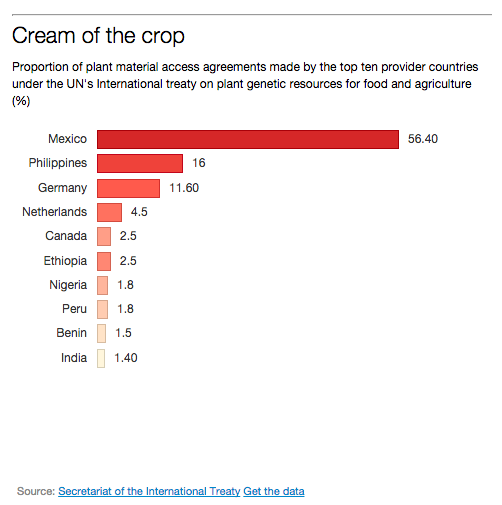
The international genebanks managed by the CGIAR Centres are by far the largest contributors to germplasm flows under the International Treaty, which is not something you’d be able to gather from this without a lot more background and context.