- What is sustainable intensification? Views from experts. Ambiguous term which may not signify a departure from current practice anyway. Ecological intensification instead?
- Intellectual Property Rights Access to Genetic Resources and Indian Shrimp Aquaculture: Evolving Policy Responses to Globalization. I kid you not.
- Patterns of Domestication in the Ethiopian Oil-seed Crop Noug (Guizotia abyssinica). Weirdness, for a domesticated crop, not due to its wild relative messing things up. What it is due to is a “mystery.” Thanks, authors.
- Bio-Banking on Neglected and Underutilized Plant Genetic Resources of Nigeria: Potential for Nutrient and Food Security. Never even heard of some of these.
- Comparison of different Ocimum basilicum L. gene bank accessions analyzed by GC–MS and sensory profile. Among 12 cultivars in the Hungarian genebank, there are 5 distinct smell profiles. That actually seems quite a lot.
- The role of cultural ecosystem services in landscape management and planning. Sometimes, they can hold you back.
- Carbon farming via assisted natural regeneration as a cost-effective mechanism for restoring biodiversity in agricultural landscapes. It can be a viable use of land in parts of Queensland, depending on the price of C.
- Ethnobotany of a threatened medicinal plant “Indravan” (Cucumis callosus) from central India. Cucumber wild relatives also medicinal.
Brainfood: Camelina improvement, School garden impact, Biodiversity rice, Seed networks, Indian wheat geography, Protected areas, Late blight resistance, Peanut biotech
- Camelina as a sustainable oilseed crop: Contributions of plant breeding and genetic engineering. It will help that it’s close to Arabidopsis.
- Sustenance and sustainability: maximizing the impact of school gardens on health outcomes. You need proper experimental design if you’re going to say that such an impact exists. But such an impact probably exists, sometimes.
- Consumer preferences for agricultural products considering the value of biodiversity conservation in the Mekong Delta, Vietnam. Consumers are willing to pay extra for crane-friendly rice. Or at least they say they are.
- An Analysis of Social Seed Network and Its Contribution to On-Farm Conservation of Crop Genetic Diversity in Nepal. Fancy software shows farmers exchange seeds, and it’s important.
- Spatial Distribution of Trait-specific Diversity in Indian Wheat Collections. From 5930, 3973 are geo-referenced, showing where more collections need to be made. Unless of course they are among those 1957 and nobody can tell.
- Walk on the Wild Side: Estimating the Global Magnitude of Visits to Protected Areas. 8 billion visits per year (80% in Europe and North America), generating $600 billion per year in direct in-country expenditure and $250 billion in consumer surplus. Remember that we spent $10 billion per year worldwide in safeguarding protected areas.
- Allele Mining in Solanum Germplasm: Cloning and Characterization of RB-Homologous Gene Fragments from Late Blight Resistant Wild Potato Species. 17 gene fragments from 11 wild potato species could be useful in breeding for late blight resistance.
- Genetic diversity of the world’s largest oil palm (Elaeis guineensis Jacq.) field genebank accessions using microsatellite markers. Extreme West Africa group, West-Central-East Africa group and Madagascar group, with the last quite distinct.
- Progress in genetic engineering of peanut (Arachis hypogaea L.) — A review. Our jetpacks are in the mail.
International Year of Quinoa officially over
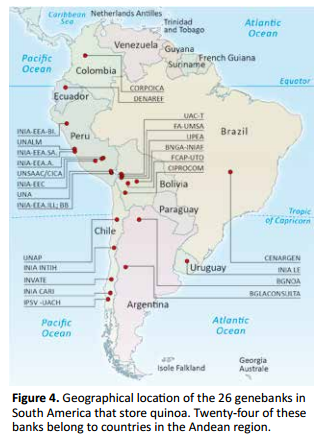 FAO has just published a very glossy volume, somewhat unnecessarily prosaically entitled “State of the art report on quinoa around the world in 2013.” I guess it signals the official end of the International Year of Quinoa. There are chapters on all the things you’d expect, including genetic resources, that one authored by some old friends. That’s where we got the figure. I expect this will be the last word on the subject for some time to come.
Brainfood: Biodiversity and health, Medieval cattle, African livestock sustainability, Filipino rice, Coffee breeding, Land-sparing conundrum, Scrapie resistant goats, Ass-like equid evolution, GS in livestock breeding, Eucalypt diversity & drought, Ecosystem services of organic ag
- Relationships between agrobiodiversity, dietary diversity and nutritional status in Tanzania. It’s really complicated.
- Microsatellite genotyping of medieval cattle from central Italy suggests an old origin of Chianina and Romagnola cattle. DNA from a couple of cattle breeds from central Italy shows remarkable similarities with that from thousand-old bones from an archaeological site in the same area.
- Strategies and approaches to sustainable livestock production in Sub Saharan Africa. It will depend on women.
- Strategies and initiatives on rice genetic resources conservation and research for climate change adaptation. Among the 1506 traditional rice varieties in the Philippines genebank are 3 which could be drought tolerant and 9 collected from really saline areas. They’re being sequenced for gene discovery.
- Next generation variety development for sustainable production of arabica coffee (Coffea arabica L.): a review. Local breeding, plus international networking.
- Why biodiversity declines as protected areas increase: the effect of the power of governance regimes on sustainable landscapes. Modelling shows land-sharing may outperform land-sparing in the long run. Most interesting consequence of the insights derived is that perhaps protected areas should be placed near agricultural frontiers rather than where biodiversity or cost-effectiveness highest.
- Biodiversity and selection for scrapie resistance in goats: genetic polymorphism in “Girgentana” breed in Sicily, Italy. Resistance gene more common in this weird breed than in the one that’s usually used in breeding.
- Reassessing the evolutionary history of ass-like equids: Insights from patterns of genetic variation in contemporary extant populations. I urge you to read the abstract yourselves and marvel at the author’ success in using the word ass-like the maximum possible number of times.
- Opinion paper: emerging markets, emerging strategies under the genomic revolution. Genomic selection is an organizational revolution as much as a technological one. At least in animal breeding.
- Genetic diversity of Eucalyptus camaldulensis Dehnh. following population decline in response to drought and altered hydrological regime. It stayed the same, I guess because of gene flow.
- Significance and value of non-traded ecosystem services on farmland. Value of biological control of pests and nitrogen mineralisation provided by organic agriculture of peas, beans, barley and wheat (extrapolated from 20 fields in NZ to whole of temperate zone) was greater than global costs of insecticides and fertilizers, even if only 10% of global arable area was converted to organic.
Nibbles: Berlin blueberries, Science hubris, Purple tea, Soil, Bushmeat, Maize breeding, Ukranian salo
- Must get myself a blueberry comb come next autumn.
- What do scientists do in response to GMO fears? “Trust us.”
- Purple tea in Kenya? Must look out for it.
- Real farmers do it on the soil.
- Bushmeat can be good for you.
- Private sector uses public sector genebank. You didn’t build that.
- “Salo is when nobody fucks with you and you’ve got a bit of money.”