- Palestinian rooftop gardens. Including crucifers, no doubt.
- Brits support work with rice and wheat wild relatives. Among other things. They’ll probably use some of these genomics things.
- Aussies support sweet potatoes. HarvestPlus rejoices.
- That new Australian genebank. Will it have any sweet potatoes?
- The agricultural legacy of Thomas Jefferson. It doesn’t say here, but I bet he was into sweet potato.
- Hawaiian menus. What, no sweet potato?
- Forget biotech, the road to sexy agriculture is via the supermarket. Where you can buy sweet potato. Maybe even of the organic persuasion.
- Or maybe better tree seeds. Even in the Nordic countries. Or the US. Is cacao a tree?
- Plans for special edition of Sustainability on neglected crops. Like amaranth?
- Geographic targeting reaches roots/tubers. Using this newfangled atlas? Or no?
- Treaty and Consortium love-in filmed. Thanks for sharing. It’s all part of this CGIAR perestroika thing, no doubt.
- What that Kew coffee extinction paper really said.
- Protected areas need work. Especially for coffee (see above).
- Yeah but protected areas is not the only way to go, and Europe now has a bunch of biodiversity indicators for farmland. I guess it’s all part of some big plan.
- Policy brief on sustainable use of PGR. Or, as we used to call it, on farm conservation.
- Which you can kind of see happening here.
More than pawns in the game of crop diversity conservation
There’s a program on the History Channel called Pawn Stars. It’s about a high-end but nevertheless slightly seedy family-owned pawn shop in Las Vegas, and the motley assortment of customers who come through its doors, hoping to trade their property for cash. I’ve developed something of an addiction to this show lately, and family and friends were sufficiently concerned to mount an intervention. Confronted with the truth, I had to think fast. I watch it for work reasons, I improvised. Pawn shops are just like genebanks.
Panicked or not, I may have been onto something. The wonderful thing about pawn shops is that they deal in all manner of weird and unusual stuff. Each item is brought in by someone who has some kind of story about it, needs to be evaluated by an expert, and will eventually catch the fancy of someone else. Just like genebanks. Genebanks typically keep seeds of dozens of different species, and sometimes hundreds if not thousands of different varieties of each. Each lot of seeds has a story – a story about how it got to be what it is, often thanks to generations of farmers –- encoded in its DNA. It was brought into the genebank by someone who more often than not has an interesting story to tell about how they got it. It needs to be taken care of in a particular way, depending on what it is, and its characteristics described. And it will be taken out by someone who needs it because of those characteristics, and will make good use of it, in a breeding programme, or because they remember their grandparents growing it.
Trying to explain what genebanks do can call forth many metaphors. All fall painfully short in some way. Banks only have money. Different currencies, maybe, and different kinds of accounts, but it’s all boring old money in the end. Only you have access to what you put into a safe deposit box. 1 Customers don’t take things into department stores. Museums do have lots of different things in them, but visitors can’t take them out. No genebank manager wants their charge to be described as just a museum. Some people call genebanks morgues, and while that may occasionally be a bit true, it’s just plain rude.
The parallel for pawn shops is better than all these, I think. But it’s not perfect. The idea of pawning the crown jewels, another metaphor that’s sometimes used for genebanks, at least within the CGIAR, is not, ahem, attractive. Anyway, genebanks don’t buy and sell; though maybe they should sometimes. And they deal in resources that are pretty special in being non-exclusive and renewable. Just because you’ve used a particular variety doesn’t mean nobody else can. And if the genebank is careful, it can always make more seeds.
Which in the end is why none of the comparisons is really satisfactory. A genebank is a genebank is a genebank. There’s no substitute for walking into a cold store full of thousands of jars of different varieties of seeds, neatly arranged on floor-to-ceiling shelving, carefully labelled. Or listening to the people in charge of some of the largest genebanks in the world explain their visions, as I’m doing this week. But if you want to see why some people get a thrill when they do that, can’t be in Rome this week, and can’t wait for Genebank Gods to come along on the History Channel, watch Pawn Stars. Just don’t let your family catch you.
Brainfood: Spanish terraces, Flower patches, Population ecology, Maize germplasm use, Seed info system, Maize and CC, Medicago predation, Species richness prediction, Rice salt-tolerance
- The genesis of irrigated terraces in al-Andalus. A geoarchaeological perspective on intensive agriculture in semi-arid environments (Ricote, Murcia, Spain). They were built very early on, on a specific soil type, by first burning the vegetation and then essentially inverting the soil profile.
- Creating patches of native flowers facilitates crop pollination in large agricultural fields: mango as a case study. Sweet.
- The ecology of plant populations: their dynamics, interactions and evolution. A whole special issue. Most intriguing is perhaps review of plant-pollinator interactions on the Galapagos. All very important for in situ conservation of crop wild relatives.
- Diversity in global maize germplasm: Characterization and utilization. Three priorities: phenotyping, phenotyping, phenotyping.
- Phytotracker, an information management system for easy recording and tracking of plants, seeds and plasmids. They could have used GRIN-Global, but I guess that doesn’t track plasmids.
- Increasing influence of heat stress on French maize yields from the 1960s to the 2030s. Any day with maximum temperature above 32°C is bad, and their recent increase has led to yield stagnation. They are going to increase further, which means that the French are going to have to find a 12% increase in base yields by 2035 or eat less maize. Do they in fact eat any maize now? What countries are now like what France will be like in 2035?
- Combined impact of multiple exotic herbivores on different life stages of an endangered plant endemism, Medicago citrina. IUCN says it’s endangered. Rabbits, mice and rats are important parts of the problem.
- Estimating species richness: still a long way off!. Bummer.
- New allelic variants found in key rice salt-tolerance genes: an association study. A couple possibly interesting mutations identified by EcoTILLING bunch of IRRI accessions. We shall see if anything comes of them. Actually, how will we find out if something does? I hope the info will go back into the IRRI genebank documentation system.
Brainfood: Sierra Leone rice, Bean breeding, Cacao geographic diversity, Red fleshed apples, Species richness & productivity, African maize diversity, Human expansion, Barley gaps, Wild coffee and CC, Acacia and CC, Genetic erosion
- Analysis of genetic diversity in farmers’ rice varieties in Sierra Leone using morphological and AFLP markers. Still a lot of diversity in traditional rice after the war, both among and within landraces, mostly among, organized regionally, and recognized by local names.
- Simultaneous selection for resistance to five bacterial, fungal, and viral diseases in three Andean × Middle American inter-gene pool common bean populations. Thanks goodness for multiple independent domestication events. And genebanks.
- Present Spatial Diversity Patterns of Theobroma cacao L. in the Neotropics Reflect Genetic Differentiation in Pleistocene Refugia Followed by Human-Influenced Dispersal. So need to collect in areas at the margins or just outside the refugia if you want high diversity. But of course that may already be ex situ. But wait, didn’t you just do the analysis based on the provenance of ex situ holdings?
- An ancient duplication of apple MYB transcription factors is responsible for novel red fruit-flesh phenotypes. The whole genome got duplicated during evolution of the apple and the red flesh phenotype is controlled by loci in both copies, but in different ways.
- What is the form of the productivity–animal-species-richness relationship? A critical review and meta-analysis. Positive.
- Spatial Structure and Climatic Adaptation in African Maize Revealed by Surveying SNP Diversity in Relation to Global Breeding and Landrace Panels. Distinct Sahelian, Western and Eastern clusters. Some SNPs associated with high temperatures.
- MtDNA analysis of global populations support that major population expansions began before Neolithic Time. Humans needed good weather to thrive, not agriculture.
- Genetic gap analysis of wild Hordeum taxa. Argentina?
- The Impact of Climate Change on Indigenous Arabica Coffee (Coffea arabica): Predicting Future Trends and Identifying Priorities. Generally very bad to disastrous, but some “core localities” will be ok, and therefore could be used for in situ conservation. Interestingly, genebank accession locality data not used.
- The genus Acacia (Fabaceae) in East Africa: distribution, diversity and the protected area network. No such luck for Acacia, I’m afraid.
- Monocropping Cultures into Ruin: The Loss of Food Varieties and Cultural Diversity. Are you sure you want to know what a sociologist and a political scientist have to say on the matter?
Coconut Plan B needed
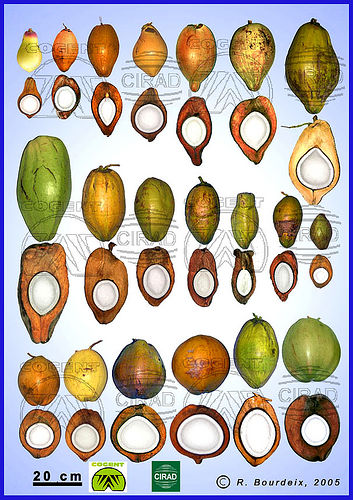 Bogia Coconut Syndrome is threatening the international coconut genebank in Papua New Guinea, one of several established in the 1990s under the International Coconut Genetic Resources Network (COGENT). That’s the warning coming out of a meeting on the Pacific coconut industry taking place in Samoa, as relayed by SciDevNet. Dr Richard Markham, now with the Australian Centre for International Agricultural Research, one of the co-sponsors of the meeting, but formerly of Bioversity, where he had responsibility for COGENT, is being admirably logical, calm and reassuring in his soundbites:
We are supporting research to try to identify the [Bogia Coconut Syndrome] vector and better understand the host range of this disease. Once we have that information, everyone will be better placed to assess the threat — both to coconuts and livelihoods in general.
But surely plans need to be put in place in case the worst happens. What to do? Roland Bourdeix, the current coordinator of COGENT, who’s responsible for the wonderful photo of coconut diversity I’m reproducing here, is talking of rescuing, relocating, duplicating. Possibly on those little isolated islets he’s so fond of. And that is no doubt an approach worth looking into. But there are 57 accessions to deal with from this genebank, and it’s going to take a while to find the necessary number of uninhabited island paradises, even if not all the 57 are unique. In vitro is an option too. COGENT has been working on an in vitro embryo collecting and transfer protocol, but it’s not quite there yet. Time to ramp that work up?
LATER: More reassuring words from Richard Markham on Facebook. No need to panic. But also no room for complacency.