- Vikings got high.
- “How can you and your garden help us find out more about the global biodiversity associated with the plants in gardens?” Here’s how.
- The oldest olive press in Anatolia.
- “The Mistake: Writing a proposal that showcased knowledge rather than addressing the audience’s needs.” Indeed.
- The Solution: cool downloads from Gapminder.
- The only surviving illustrated Old English herbal. And, from several centuries later, a medieval book on how gardens will save you.
- AramcoWorld on my favourite nut.
- Cannibalism is a choice.
- One kick-ass botanist.
- Saving Ethiopia’s coffee forests. Nah, let’s just map the genome.
- Vanilla has dark side.
- The Profit of the Earth: cool new book on seeds, dark side and all.
- Remember my little trip to the Spanish genebank? What they’re doing on brassica.
Mapping the hell out of maize diversity in Mexico
Thanks to a Facebook post, I’ve just come across the “mapoteca digital” of CONABIO, the Comisión Nacional para el Conocimiento y Uso de la Biodiversidad of Mexico. 1 It has point maps of the distribution of both wild and cultivated beans and calabazas, and of wild maize; but most interesting to me were the maps of the distribution of the richness of cultivated maize races, based on collections made at different times in the past. The data were put together by the “Proyecto Global de Maíces” (2006-2010), and the maps are also available in a PDF.
Here’s the map for 1940-1965, based on about 3,000 collections.
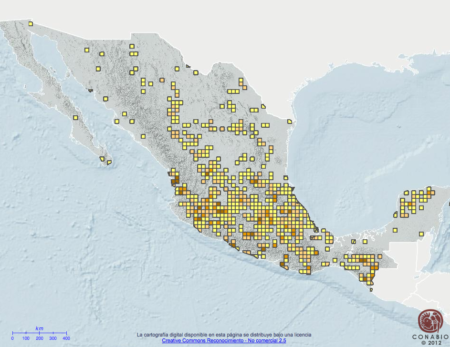
And here’s the map for 1991-2000, based on 12,000 collections.
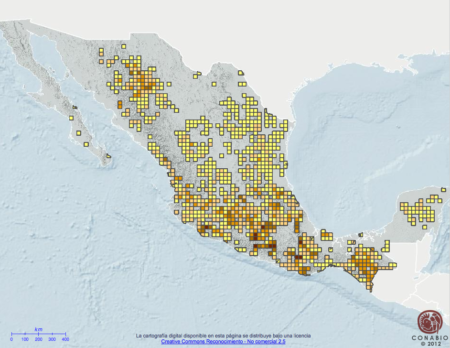
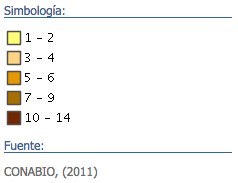 The legend used in both maps is at the left here. Looking at the maps, lots of questions came to mind. Why are we getting higher numbers of races in the 1990’s? Is it that the collecting was more thorough then? Or are races moving around more now? There is lots of information on the individual races on the project website, including actual and potential distribution maps. And you can download the raw data. So another thing that came to mind was that surely someone must have gone through all this stuff in detail. And sure enough, yes someone had indeed gone through all this stuff in detail, Peralta & Golicher in 2014. 2
The high rank correlation between the three collection efforts indicate that relative abundance of races has not changed considerably since 1950. Races that were common in 1950 were also common in 2005, and the same can be said for rare races, none of these were apparently more common in 1950. Correspondingly, the comparison of distribution and richness models for the three sampling efforts does not suggest a general decline in richness nor in distribution for 43 of the 47 races studied, and in the other four cases the declines are relatively minor and require verification. The recent increase in distribution for two races (Tuxpeño and Celaya) may be explained by the outstanding importance these have had as components in commercial cultivars, it is not uncommon to find recycled and creolized landraces that had their origin as commercial seeds. Also, no extinctions were reported for the 47 races studied since all were sampled in the last collection effort between 1997 and 2010. Therefore, in a broad sense, at the race level of classification we do not find signs of substantial genetic erosion between 1943 and 2010. That is not to say no losses of local populations have occurred.
I can’t for the life of me understand why I haven’t blogged about this paper before (or indeed the project that generated the data), bringing together as it does two of my very favourite things, agrobiodiversity and mapping 3, but I’m more than happy to rectify that oversight here and now. I can’t help thinking there’s more to be mined from this dataset yet.
Brainfood: Banana identification, Donkey domestication, Mouse domestication, African cattle, Pig domestication, Biofuels, Biofortification, Genomics for breeding, Species movement, Crop diversity double, N fixation, Ag commercialization models, Wild beans, Brassica domestication, Teaching biodiversity
- Molecular and cytological characterization of the global Musa germplasm collection provides insights into the treasure of banana diversity. 16% of 1500 accessions need taxonomic verification. Could have been much worse.
- Why the Donkey Did Not Go South: Disease as a Constraint on the Spread of Equus asinus into Southern Africa. Gap in distribution between Kenya and southern Africa until colonial times probably down to trypanosomiasis.
- Origins of house mice in ecological niches created by settled hunter-gatherers in the Levant 15,000 y ago. Hunter gatherers inadvertently domesticated the mouse.
- The genome landscape of indigenous African cattle. Now we know where the genes for heat tolerance and tick resistance can be found, and it’s where you’d think.
- Insights into early pig domestication provided by ancient DNA analysis. In northern Europe, around 4000 BC, people started crossing pigs from the south with local wild boars. What were they thinking?
- Recent grassland losses are concentrated around U.S. ethanol refineries. The revenge of geography.
- Provitamin A biofortification of crop plants: a gold rush with many miners. “One crucial aspect that needs further experimentation is whether β-carotene-fortified crops can improve vitamin A status in the main targets of the biofortification efforts, that is, malnourished adults and children.” Just going to leave that out there.
- Genomic innovation for crop improvement. Longer reads needed. Is there no satisfying these gene-jockeys?
- Biodiversity redistribution under climate change: Impacts on ecosystems and human well-being. Species movements affect ecosystem functioning and service provision: “The indirect effects of climate change on food webs are also expected to compound the direct effects on crops.”
- Feeding the Household, Growing the Business, or Just Showing Off? Farmers’ Motivations for Crop Diversity Choices in Papua New Guinea. Some people grow lots of crops because it’s cool. But why wasn’t this done at the intraspecific level?
- To Specialize or Diversify: Agricultural Diversity and Poverty Dynamics in Ethiopia. Forget coolness, crop diversity makes you less poor.
- Biogeography of nodulated legumes and their nitrogen-fixing symbionts. Australia is weird.
- Plantations, outgrowers and commercial farming in Africa: agricultural commercialisation and implications for agrarian change. They all have their place.
- Genomic history of the origin and domestication of common bean unveils its closest sister species. Wild populations from northern Peru and Ecuador are not derived from wild Phaseolus vulgaris which migrated there from Mesoamerica but are actually a different species which predates the evolution of wild common bean.
- Genomic inferences of domestication events are corroborated by written records in Brassica rapa. Five genetic groups, with rapini at the base.
- Walking and talking the tree of life: Why and how to teach about biodiversity. Forget ranks, try clades.
Nibbles: Mango genebank, Japanese elite fruit, Mother Hass, African cattle diversity, New wild ginger, Seed saving, False ivory, ABS, Deforestation, Blight causes, Desert ag, Conserving potatoes, Imperial botany
- Goa to set up a mango genebank. Where do I donate?
- The murky world of really expensive Japanese fruit.
- What is this one avocado tree worth?
- The importance of indigenous African cattle breeds.
- You can never have too many wild ginger species.
- Saving seeds in South Carolina.
- Seeds save elephants.
- IFPRI meeting discusses the increasing complexity of germplasm access and benefit sharing.
- Food giants look to their greenify their value chains. Will they finally decide to secure their genetic base too?
- Irish potato famine: don’t blame the near-fungus.
- Chinese oasis is engineering wonder: and the crops?
- Pachamama and the ever-so-humble potato.
- Review of book on the imperial origins of botany.
Brainfood: Soil biodiversity maps, VIR wheat, Rice worlds, African maize, Cold rice, Saharan history, Oil palm & CC, GM Cavendish
- Assessing soil biodiversity potentials in Europe. The hotspots are the pastures and grasslands of Ireland, Slovenia and Sweden.
- Into the vault of the Vavilov wheats: old diversity for new alleles. VIR has diversity that’s not in CIMMYT and Australian cultivars. No word on where ICARDA fits in.
- Disembedding grain: Golden Rice, the Green Revolution, and heirloom seeds in the Philippines. There are parallel and competing rice worlds, which differ in how they valorize the local. Or, it could be argued, though not by the authors, demonize the “other.”
- Microsatellite DNA marker for molecular characterization of African maize (Zea mays L.) landraces. The Somali material is weird.
- Genetic architecture of cold tolerance in rice (Oryza sativa) determined through high resolution genome-wide analysis. 42 QTLs. Is that a lot? It seems like a lot.
- Humans as Agents in the Termination of the African Humid Period. Damn livestock. Back to hunting and gathering.
- Future climate effects on suitability for growth of oil palms in Malaysia and Indonesia. Well that’s ironic.
- Golden bananas in the field: elevated fruit pro-vitamin A from the expression of a single banana transgene. Gene from Fe’i biofortifies Cavendish. Now to do something about taste, texture, general suckiness etc etc.