- Video of the Canadian genebank.
- First video in series on Indian women farmers: Bowing to No One, by Sarah Khan.
- Whole bunch of coconut videos. See what I did there?
- Good news for cricketers: willow variety catalog out.
- The skinny of what crop models say about the effects of climate change. Spoiler alert: it ain’t good.
- The latest call for a new Green Revolution.
- Safe to say cantaloupes won’t feature much in that, which is a pity.
- Maybe some other weird plants will, though.
- Wild camels are pretty tough. And since we’re on the subject, what’s a heritage animal breed?
- Wait, they solved dog domestication?
- Top 100 development research questions for our SDG world, including ten on food security and agriculture.
Yes, we have bananas
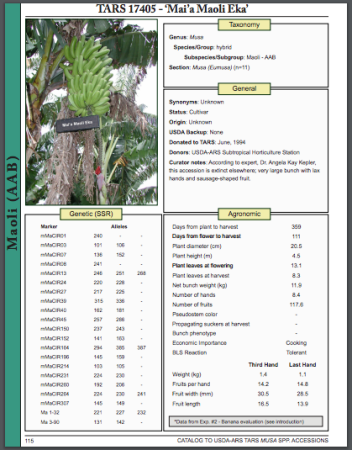 What better way to start the new year than with an attractive catalog of banana accessions from USDA? Especially as, coincidentally, the Musa Germplasm Information System also debuts a new iteration of the website. This from a Facebook post today:
It is now possible to order ITC accessions from MGIS, an online database on genebank accessions of wild and cultivated bananas. The latest release also added information on 1,288 accessions for a total of 3,630 accessions maintained in 11 field and in vitro collections.
That Mai’a Maoli Eka cultivar in the photo from the USDA catalog of course features in MGIS, so you can order it if you like the look of it…
Ah no, wait. According to GRIN, it’s not available. Bummer.
Brainfood: Grazing, Dung beetles, Intensification, Pineapple diversity, Grassland N
- Behavioural Response of Pure Ankole and Crossbred (Ankole x Holstein) Cows to Seasonal Pasture Variations in Southwestern Uganda. The cross-bred cows have to eat for longer than the local breed, which makes for problems during both wet and dry seasons.
- Functionally rich dung beetle assemblages are required to provide multiple ecosystem services. It’s not just about the dung removal. No word on whether cross-bred dung tastier.
- Swiddens under transition: Consequences of agricultural intensification in the Amazon. Intensification without diversification is going to be a problem.
- Developing single nucleotide polymorphism markers for the identification of pineapple (Ananas comosus) germplasm. High redundancy in the USDA collection, and little correspondence between horticultural classifications and genotyping.
- Grassland biodiversity bounces back from long-term nitrogen addition. Pollution bad for grassland biodiversity, stopping pollution good for grassland biodiversity.
DivSeek calling
Do you know of projects genotyping or phenotyping crop germplasm on a massive scale? Well, because the folks at DivSeek are collating that kind of info for a “landscape study.” Leave comments here and I’ll get it to them.
Brainfood: Wild rice database, E Asian wheat diversity, Microbial terroir, Sesame breeding, Agrobiodiversity fairs, AnGR conservation, Rye diversity
- OryzaGenome: Genome Diversity Database of Wild Oryza Species. Well, only 2 species thus far, but it’s a start.
- Evaluation of East Asian landrace wheat revealed by high molecular weight glutenin and maturity period. The Chinese accessions are different to the Japanese-Korean, and 3 of the former have both good gluten composition and early maturity, making them attractive to Korean breeders.
- Sequence-based Analysis of the Vitis vinifera L. cv Cabernet Sauvignon Grape Must Mycobiome in Three South African Vineyards Employing Distinct Agronomic Systems. Even microbes contribute to terroir.
- Genetic Diversity, Population Structure, and Association Mapping of 10 Agronomic Traits in Sesame. Some markers will be really useful in breeding.
- The fairs of agrobiodiversity in the context of participatory plant breeding — Local Agricultural Innovation Program in Cuba. Meaning and impact. Diversity will find a way.
- Biobanking genetic resources: Challenges and implementation at the USDA National Animal Germplasm Program. Everything that’s not cattle and swine is a problem.
- Geography and end use drive the diversification of worldwide winter rye populations. There may have been multiple domestications, and improvement has not led to decrease in diversity.