- Can bison play a role in conserving habitat for endangered sandhills species in Canada? Maybe, hence the recommendation to re-introduce them. Incidentally, there are a few crop wild relatives on the list of threatened plants of Canada.
- Genetic improvement of farmed tilapias: Genetic parameters for body weight at harvest in Nile tilapia (Oreochromis niloticus) during five generations of testing in multiple environments. The 10-year “Genetic Improvement of Farmed Tilapias” (GIFT) project was not a complete waste of time. The GIFT population will respond well to selection for increased body mass, and you dont have to do the evaluation in lots of different environments.
- Mycorrhizal colonization of major banana genotypes in six East African environments. Different banana genotypes had different levels of infection, but environment also plays an important role. Important because arbuscular mycorrhizal fungi may increase production.
- On the use of depth camera for 3D phenotyping of entire plants. An example of this.
- Genetic and phenotypic diversity in a germplasm working collection of cultivated tropical yams (Dioscorea spp.). Should be a good starting point for improvement programmes. Kind of like the GIFT population, then, eh? But starting point? Haven’t people been breeding yams for a while?
- Cytogeography of the Humifusa clade of Opuntia s.s. Mill. 1754 (Cactaceae, Opuntioideae, Opuntieae): correlations with pleistocene refugia and morphological traits in a polyploid complex. The southeastern and southwestern U.S. represent glacial refugia for diploid members of the clade, and a whole bunch of polyploids resulted when the taxa spread out again after glacial episodes. How many of these are eaten is what I’d like to know, and whether ploidy affects that. I suppose climate change will lead to further complications?
- The impact of agricultural intensification and land-use change on the European arable flora. Is significant. Not least because some crop wild relatives are involved, although that’s not really discussed here.
Nibbles: NERICA vs landraces, Asian breeding, Wild wheat threats, Indian agrobiodiversity area, GBIF, Ancient Amazonia
- NERICA shmerica.
- Did you know that the Society for Advancement of Breeding Research in Asia and Oceania (SABRAO) 12th Congress from 13-16 January 2012 in Chiang Mai, Thailand. No, neither did I.
- Whither wild wheat?
- Koraput and its agrobiodiversity, including aus rice, makes it on the Globally Important Agricultural Heritage System (GIAHS).
- GBIF has many duplicates. I’m shocked. Shocked, I tell you.
- Amazonia was densely populated. No it wasn’t. Yes it was. No it wasn’t.
Brainfood: Chestnut restoration, Zoo legislation, Millet landraces, Cassava in Congo, Agroforestry in Philippines, Baobab (again), Silvopastoral system taxonomy
- Modelling chestnut biogeography for American chestnut restoration. As all 7 species have very similar climatic niches, if you could get a blight-resistant hybrid, it would probably be adapted to North American conditions.
- Ex situ conservation programmes in European zoological gardens: Can we afford to lose them? No, and therefore the EU needs to step in. Whoa, talk about a non sequitur.
- The Fine Scale Ethnotaxa Classification of Millets in Southern India. Malayali farmers can consistently recognize more phenotypes than DNA analysis, and some of the cryptic landraces might be really useful.
- Diversity of cassava (Manihot esculenta Crantz) cultivars and its management in the department of Bouenza in the Republic of Congo. High, but decreasing, at least in some villages. But overall? Any collections made?
- Indigenous agroforestry in a changing context: The case of the Erumanen ne Menuvu in Southern Philippines. Despite being divinely-sanctioned, the pengegnewiran swidden system is changing, in response to socio-economic changes. It needs to, and blaming the people because you don’t like the result is not very helpful.
- Variation in biochemical composition of baobab (Adansonia digitata) pulp, leaves and seeds in relation to soil types and tree provenances. Soil has a big effect. At least in Benin.
- Comparing silvopastoral systems and prospects in eight regions of the world. They’re all going to need more active management.
Rice morphological diversity 1, Bloggers 0
Ruaraidh Sackville Hamilton of the IRRI genebank points out we are confusing clustered spikelets with multi-grained spikelets. Sorry.
Clustered spikelets are more common, and are recognized in the rice descriptors. We have 254 such varieties from 26 countries, mostly in S and SE Asia. Spikelets may be borne directly on the long primary branches of the panicle and/or on short secondary branches, in varying proportions. If none are directly on primary branches, or on the short secondary branches, they appear as clusters of three spikelets. See fig. 8 in the 2008 rice descriptors publication.
The multi-grained spikelets noted by Zakir are more unusual – multiple grains in single spikelets.
Old literature on developmental anatomy concludes that rice spikelets are primitively three-grained, of which the two lateral have become vestigial (hence “sterile lemma”). It would be interesting to know if the multi-grained spikelets are a reversion to primitive type, or a new splitting of the central grain.
Triple-grained rice news
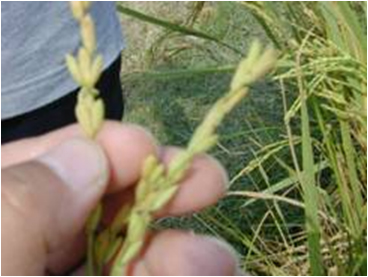
What it is to have friends, especially knowledgeable friends. Bhuwon Sthapit, local rice wallah extraordinaire, 1 responded quickly and in depth when asked what he knew about triple-grained rice.
Unique local rice landraces in Nepal are being lost, replaced by modern varieties. At least two of these are multi-seeded: Laila Majnu (the name refers to a pair of famous lovers, never separated until death) and Amaghauj (which means cluster of mango). Until 1999 Amaghauj was grown by one farmer on 3 katha of land, but was discontinued as the land was sold to another farmer. This local variety has a cluster of spikelets (at least 3 potential grains) originating from the same base; this heritable trait could potentially be used to breed new rice types offering increased yield. It is currently saved in community seed banks.
As Bhuwon also notes:
There is great potential to link community seed bank and national seed bank to harness such untapped and unknown resources.
And if you want even more, another friend, Ruaraidh Sackville Hamilton, Head of the IRRI genebank, points to Morphological Observations on Many Kerneled Grains in Rice. Don’t be scared by the Chinese; English follows.
LATER: For completeness, the name of the Bangladeshi variety which started all this, Biram Sundori, means “beautiful girl from Birampur,” which is the place where it is grown. Thanks to Zakir Sor for leading us all on this journey of discovery.