- Traditional foods fight Native American obesity.
- Round Table on Responsible Soy makes some nice maps.
- The Decade for African Seas and Oceans is off to a blue start.
- Face it, academics, social media are good for you.
- You think Pres. Obama checked out some Nairobi street food?
- Pics of coffee value chain. Wow, that makes it sound really boring.
- Calling bullshit on farm to fork.
- A day in the life of an archeologist of Iron Age horses.
- Kava reaches NYC hipsters.
- Plantae is coming!
- Rice plants colonized by mychorriza express different genes and have more lateral roots.
Brainfood: Pepper tree conservation, Buckwheat diversity, Seed drying, Grape database, Livestock improvement, Soil bacterial diversity, TLB in Nigeria, Humans & diversity double, Faidherbia @ICRAF
- Genetic structure and internal gene flow in populations of Schinus molle (Anacardiaceae) in the Brazilian Pampa. Try to keep what forest patches remain. And link them up somehow.
- Genetic Diversity of Buckwheat Cultivars (Fagopyrum tartaricum Gaertn.) Assessed with SSR Markers Developed from Genome Survey Sequences. Two groups, overlapping in Qinghai, China.
- Increases in the longevity of desiccation-phase developing rice seeds: response to high-temperature drying depends on harvest moisture content. Genebanks may have it wrong for seeds of rice (and perhaps other tropical species) harvested while still metabolically active: these you can dry at higher temperatures than is the norm.
- Vitis International Variety Catalogue (VIVC): A cultivar database referenced by genetic profiles and morphology. Now with added microsatellites.
- Options for enhancing efficiency and effectiveness of research capacity for livestock genetics in, and for, sub-Saharan Africa. Embed in wider rural development, collaborate, and share data. Could apply to more than just livestock improvement.
- Mapping and validating predictions of bacterial biodiversity using European and national scale datasets. It’s the pH.
- Agricultural Extension Roles towards Adapting to the Effects of Taro Leaf Blight (Tlb) Disease in Nsukka Agricultural Zone, Enugu State. Basically, extensionists haven’t done a thing.
- Anthropogenic drivers of plant diversity: perspective on land use change in a dynamic cultural landscape. Abandoning farmland is not good for biodiversity.
- Agricultural landscapes and biodiversity conservation: a case study in Sicily (Italy). Ahem. Abandoning farmland is not good for biodiversity.
- Genetic diversity of Faidherbia albida (Del.) A. Chev accessions held at the World Agroforestry Centre. It’s not enough.
Brainfood: Domestication stats, Apple vulnerability, Himalayan fermentation, Tree diversity, Grasslands double, Shiitake cultivation, Lablab core, Ethiopian sweet potato, Georgian grape
- A domestication assessment of the big five plant families. Half of cultivated plants are legumes, a third grasses.
- The vulnerability of US apple (Malus) genetic resources. Moderate.
- Microorganisms associated with amylolytic starters and traditional fermented alcoholic beverages of north western Himalayas in India. Veritable microbial communities.
- Spatial incongruence among hotspots and complementary areas of tree diversity in southern Africa. It’s not just about the hotspots.
- Integrating Agricultural and Ecological Goals into the Management of Species-Rich Grasslands: Learning from the Flowering Meadows Competition in France. Gotta document the synergies.
- Genetic–geographic correlation revealed across a broad European ecotypic sample of perennial ryegrass (Lolium perenne) using array-based SNP genotyping. Strong structure both with latitude and longitude. Wonder if the Flowering Meadows competition took that into account.
- Interactions of knowledge systems in shiitake mushroom production: a case study on the Noto Peninsula, Japan. Tradition is not always a totally good thing.
- Development of Core Sets of Dolichos Bean (Lablab purpureus L. Sweet) Germplasm. Heuristic is better. But is it PowerCore?
- Genetic Diversity of Local and Introduced Sweet Potato [Ipomoea batatas (L.) Lam.] Collections for Agro-morphology and Physicochemical Attributes in Ethiopia. The improved varieties are not all that great. But there were only two of them. And the local landraces were not necessarily the best.
- Study of genetic variability in Vitis vinifera L. germplasm by high-throughput Vitis18kSNP array: the case of Georgian genetic resources. Some differentiation between wild and cultivated, but significant overlap.
Invisible Angola
Kew botanist David Goyder had a thought-provoking blog post a couple of days back describing the relative lack of floristic data from Angola. Here’s his map of plant collection data for southern Africa, from GBIF:
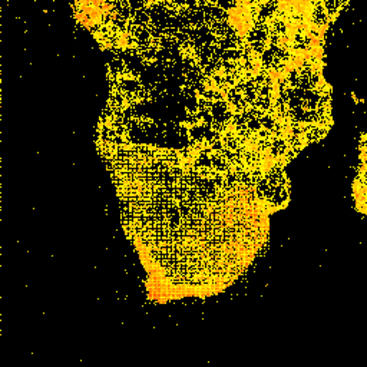
Angola emerges quite clearly as a gap, particularly the interior. There’s lots of reasons for that, not least landmines, as Goyder points out, and there are also efforts underway to redress the situation. But the thought that the map provoked in me was, of course, whether the situation was similar for crops. So here’s what Genesys knows about crop germaplasm collections in southern Africa:
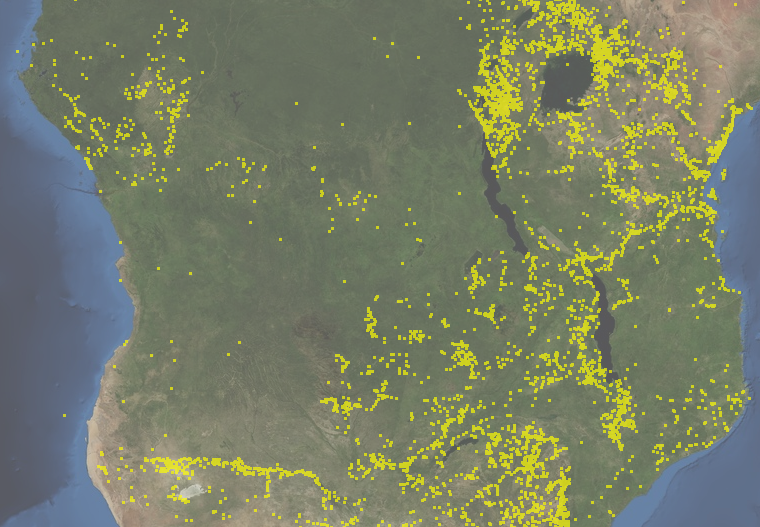
It seems the answer is a pretty resounding yes. Again, you can clearly trace the borders of Angola by where the genebank accessions end. There is, in fact, though, a very active national genebank in Angola, which has been collecting the country’s crop diversity for years, landmines or no landmines:
A total of 441 accessions were collected during a mult-crop collection in Huila province, Namibi province and Malanga province in 2004. With these collections, NPGRC now has a representative sample from 55% of the total number of districts in the country and representing 60% of the recognized agricultural zones (MIIA).
But when will we be able to see the data?
Brainfood: Weed collection, Japan vs China wheat, China wheat, Indian maize, Aromatic rice, African cattle, Food system vulnerabilities, SDGs & nutrition, Suitable days, Setaria phenotyping
- Genetic Resources of Cannabis sativa L. in the Collection of the Gene Bank at INF&MP in Poznan. I’d pay money to see this in the field at evaluation time.
- Specific median flour particle size distribution of Japanese common wheats; Comparison with Chinese common wheats. Japanese diversity is a small fraction of Chinese diversity. Also, can you really have semicolons in titles?
- Association and Validation of Yield-Favored Alleles in Chinese Cultivars of Common Wheat (Triticum aestivum L.). And among Chinese wheats, the modern cultivars are a small subset of the diversity in the mini core collection.
- Diversity among maize landraces in North West Himalayan region of India assessed by agro-morphological and quality traits. I like it when specific accessions are highlighted as being special in some way. But will breeders around the world have access to them?
- Genetic Diversity and Population Structure in Aromatic and Quality Rice (Oryza sativa L.) Landraces from North-Eastern India. More than just basmati. But will breeders around the world have access to them?
- African Indigenous Cattle: Unique Genetic Resources in a Rapidly Changing World. At least 150 breeds, many endangered, all important.
- Sustainable Sourcing of Global Agricultural Raw Materials: Assessing Gaps in Key Impact and Vulnerability Issues and Indicators. We don’t know the vulnerabilities well enough.
- Can the sustainable development goals reduce the burden of nutrition-related non-communicable diseases without truly addressing major food system reforms? No.
- Suitable Days for Plant Growth Disappear under Projected Climate Change: Potential Human and Biotic Vulnerability. Tropical areas are screwed.
- A versatile phenotyping system and analytics platform reveals diverse temporal responses to water availability in Setaria. Fancy equipment picks out differences among genotypes.