We’re trying something new for us this week. Dr Geo Coppens co-authored an interesting paper 1 recently which brings together a number of our concerns: domestication, diversity, crop wild relatives, spatial analysis… He’s written quite a long piece about his research, which we’ll publish here in three instalments. This is the third and final instalment. Here’s the previous one.
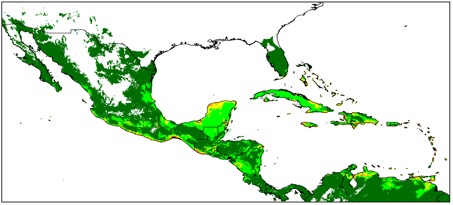
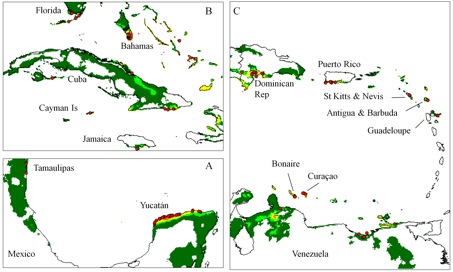
Understanding the causes of the large difference between the distributions of TWC and that of cultivated and feral cottons is crucial for future breeding efforts. On one hand, the strong genetic divergence between wild and feral G. hirsutum that we have found in a sister SSR marker study may be partly related to differential selection and adaptation, and/or to the difficulty for domesticated forms to get established in a hostile environment. On the other hand, there is little doubt that much of the difference lies in the distinct ecological interpretation to be given to their respective models. Indeed, we may consider that the distribution of cultivated cottons approaches that of the fundamental niche of the species (i.e. where abiotic factors are favourable), which is obviously wider than the realized niche (further constrained by biotic factors, including competition).
Indeed, biotic factors are much less important under cultivation. For feral plants, we may refer to another niche concept: source-sink relations between cultivated and feral populations may explain how the latter may be found in unsuitable habitats (Pulliam, 2000). Logically, escapes from cultivation simply persist in the vicinity of cultivated cottons, in recently abandoned fields or along roadsides, benefitting from the open agricultural landscape. Why do feral populations observed further from cotton fields and dooryards, in more developed secondary vegetation (our ‘wild/feral’ category), present a very similar climatic envelope, and not an intermediate one? In fact, once interspecific competition has been avoided or reduced at the seedling stage, ancient escapes may persist for long, even in relatively high secondary vegetation. This is consistent with germplasm collectors’ reports (e.g. Ulloa et al., 2006) that feral populations are morphologically similar to local races of cultivated cotton, and that they are getting rarer as the cultivation of perennial cotton declines in Mexico.
The cotton example shows the relevance of ecological niche concepts even in the seemingly straightforward study of crop plant distribution, and particularly in the context of domestication studies, where it is crucial to distinguish between wild and feral forms. Comparing cultivation areas of domesticated forms with the original distribution of their wild relatives does not allow direct inferences on crop potential for climatic adaptation. Getting back to the tetraploid cotton example, niche conservatism after more than 1 million years of species diversification (the age of the AADD allotetraploid Gossypium genome) should make us more cautious in evaluating the result of 10,000 years of breeding on crop climatic adaptation. While there is no doubt that domestication and cultivation have resulted in widening of crops’ climatic envelopes, we need to understand much better the respective shares of genome and environment in the process. In the face of global climate change, we will need the tools of both genetic improvement and agroecology.
References
Brubaker CL, Wendel JF (1994) Reevaluating the origin of domesticated cotton (Gossypium hirsutum, Malvaceae) using nuclear restriction fragment length polymorphism (RFLP). Am J Bot 81: 1309–1326. doi: 10.2307/2445407
Coppens d’Eeckenbrugge G, Lacape J-M (2014) Distribution and Differentiation of Wild, Feral, and Cultivated Populations of Perennial Upland Cotton (Gossypium hirsutum L.) in Mesoamerica and the Caribbean. PLoS ONE 9(9): e107458. doi:10.1371/journal.pone.0107458
Fryxell PA (1979) The Natural History of the Cotton Tribe (Malvaceae, Tribe Gossypieae): Texas A&M University Press, College Station, TX. 245 p.
Hutchinson JB (1954) New evidence on the origin of the old world cottons. Heredity 8: 225–241. doi: 10.1038/hdy.1954.20
Hutchinson JB, Silow RA, Stephens SG (1947) The evolution of Gossypium and the differenciation of the cultivated cottons: Emprire Cotton Growing Corporation. 160 p.
Miller AJ, Knouft JH (2006) GIS-based characterization of the geographic distributions of wild and cultivated populations of the Mesoamerican fruit tree Spondias purpurea (Anacardiaceae). Am J Bot 93: 1757–1767. doi: 10.3732/ajb.93.12.1757
Pulliam HR (2000) On the relationship between niche and distribution. Ecology Letters 3: 349–361. doi: 10.1046/j.1461-0248.2000.00143.x
Russell J, van Zonneveld M, Dawson IK, Booth A, Waugh R, et al. (2014) Genetic Diversity and Ecological Niche Modelling of Wild Barley: Refugia, Large-Scale Post-LGM Range Expansion and Limited Mid-Future Climate Threats? PLoS ONE 9(2): e86021. doi:10.1371/journal.pone.0086021
Sauer JD (1967) Geographic reconnaissance of seashore vegetation along the Mexican Gulf coast; Mc Intire WG, editor. Baton Rouge. 59 p.
Stephens SG (1965) The effects of domestication on certain seed and fiber properties of perennial forms of cotton, Gossypium hirsutum L. The American Naturalist 94: 365–372. doi: 10.1086/282377
Thomas E, van Zonneveld M, Loo J, Hodgkin T, Galluzzi G, et al. (2012) Present Spatial Diversity Patterns of Theobroma cacao L. in the Neotropics Reflect Genetic Differentiation in Pleistocene Refugia Followed by Human-Influenced Dispersal. PLoS ONE 7(10): e47676. doi:10.1371/journal.pone.0047676
Ulloa M, Stewart JM, Garcia EA, Godoy S, Gaytan A, et al. (2006) Cotton genetic resources in the Western states of Mexico: in situ conservation status and germplasm collection for ex situ preservation. Genet Resour Crop Evol 53: 653–668. doi: 10.1007/s10722-004-2988-0
Wendel JF, Brubaker CL, Seelenan T (2010) The origin and evolution of Gossypium. In: Stewart JM, Oosterhuis DM, Heitholt JJ, Mauney JR, editors. Physiology of cotton. Dordrecht: Spinger, Netherlands. pp. 1–18.