- Are species’ range limits simply niche limits writ large? A review of transplant experiments beyond the range. Meta-analysis shows dispersal constrains geographic distribution but extends altitudinal. Biotic interactions important at low elevations and latitudes.
- Herbivores and nutrients control grassland plant diversity via light limitation. Nutrients bad, herbivores good for grassland diversity.
- Economic and ecological implications of geographic bias in pollinator ecology in the light of pollinator declines. Half the data come from 5 countries. Nuff said.
- Integrated crop and livestock systems in Western Europe and South America: A review. Market logic has driven crops and livestock apart, but it should drive them back together again.
- ARABIDOPSIS THALIANA HOMEOBOX25 Uncovers a Role for Gibberellins in Seed Longevity. Seed longevity gene found. No word on whether giberellin treatment can prolong seed life in genebanks. Yet.
- Molecular-level and trait-level differentiation between the cultivated apple (Malus×domestica Borkh.) and its main progenitor Malus sieversii. Status of M. sieversii as main progenitor confirmed. Always good to have more data.
- Adaptation of Cultivated Amaranth (Amaranthus spp.) and Their Wild Relatives in Mexico. One of the wild species could be a source of adaptation for the cultivated under climate change.
- Eat your orchid and have it too: a potentially new conservation formula for Chinese epiphytic medicinal orchids. Nature reserves and cultivation on farms not enough. What you need is “restoration-friendly cultivation.”
- A continental-scale study of seed lifespan in experimental storage examining seed, plant, and environmental traits associated with longevity. Australian seeds are somewhat longer-lived than those from other regions. But there’s plenty of variation, some of which can be explained by different features of the seeds, plants and the specific environment where they grow.
- Inclusive fitness in agriculture. Plants and their root symbionts can get along even better together, with a little help from human selection.
- Genetic diversity analysis for quantitative traits in lentil (Lens culinaris medik.) germplasm. NBPGR seem to be on an evaluation blitz. More power to them. Hope to see the data online soon.
Iraqi agricultural atlas ready for prime time
Nice to see the first National Atlas of Food and Development launched in Iraq, courtesy of the Ministry of Agriculture and ICARDA. You can find it here. You can map various agricultural and development indicators (although some of them don’t seem to work), including harvested area and yield of a number of crops. Here’s barley yield:
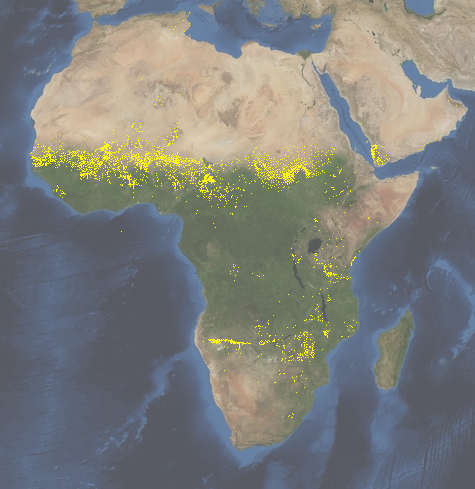
You can export the map as an image (as above) or as a URL, which is good but insufficient. Because one would like to mash it up with other datasets, like for example germplasm holdings, right? You know what’s coming next, and here it is, the locations of Iraqi barley material in Genesys:
And yeah, I know, it takes two to tango, and it’s not exactly easy to share that Genesys data either, less easy than sharing the Iraqi atlas map if we are honest. We’re working on that…
But in the meantime, my colleague Matija and I spent the best part of a day hacking both tools and were eventually able to import image files from the Iraqi atlas and from Genesys into Google Earth. It’s not perfect, not even close, but here’s our first attempt at mashing up barley yield in Iraq (the pinkish squares) with the location of germplasm samples from that country in the world’s genebanks (in yellow).
So, possibly some areas where further collecting might be warranted, conditions permitting. But is there an issue with the barley data in the atlas? You see that horizontal line right in the middle of the image, where barley apparently abruptly disappears south of latitude 33.5°N? That looks a bit suspicious, especially as the Genesys data seems to suggest that barley cultivation extends southwards along the Euphrates.
Nibbles: Food future, Bean breeding 101, Yield gaps, Mitigation strategies, Sparing vs sharing, Diverse diets, Open seeds, Fake seeds, Florida citrus threat, Hot chicks, Nutrition nuggets
- Food? We don’t need no stinking food.
- Bean breeder begs to differ.
- Where we could do with more food.
- Nobody’s talking about mitigation any more. Oh yes they are.
- Land shparing is the answer.
- ICRAF decides to gather evidence for the benefits of agroforestry for nutrition.
- More on those open source seeds. Which I hope nobody will counterfeit.
- Florida needs new grapefruits, whether open source or not.
- Naked neck chickens look weird, but they may be really heat resistant, so get over it. Ghana has.
- Canadian grad students summarize nutrition research in a pithy sentence. Sound familiar?
Nibbles: Global plant cover, Veggies in Africa, Ancient middens, Raspberry fruit colour, Citrus greening, Jordan biodiversity, US nutrition, Subsidies, Seed and voucher fair, Bean diversity, Grape mildew fight
- GIS geeks sort out land cover at last.
- Role of vegetables in combating malnutrition in Africa. Author offers pdf of paper.
- Ancient native American middens just keep on giving.
- Raspberry colour good predictor of various fruit post-harvest characteristics. Good short-cut for breeders.
- Getting to the root of citrus greening. Scary disease.
- Freaky stuff about using frog eggs to figure out the genetics of grapevine’s susceptibility to another scary disease.
- Video of our friend Dr Nigel Maxted on Jordan’s socioeconomically important plants.
- Physician, heal thyself. Indian tells USAID to take care of its own food insecurity.
- How to create subsidies that promote biodiversity, in a model, which is probably highly unrealistic.
- Very realistic notes from a seed and voucher fair in Malawi.
- And anecdotes on the benefits of bean diversity in Uganda.
Nibbles: Extreme aquaculture, GMO ver. 2.0, Wheat genebank, Infrared coffee spectroscopy, Farmer photos, Land grab, Reindeer herder photos, Mapping blight, Food security software, Fragaria moschata
- Farming cobia off Panama. Look it up.
- Gene editing is the future. But is it GM?
- More on the CIMMYT genebank from the Australian press. Get a room already.
- Fancy machine can tell fancy Yemeni coffee from lesser stuff. No, not DNA. Producers of lesser stuff unavailable for comment.
- Some of them may end up being photographed by National Geographic though.
- Before being forced off their land.
- Different sort of land grab in the Gran Chaco. Pity those poor wild Arachis. And here’s a meta-analysis of the drivers of the problem.
- Feeling left out, herders get fancy photos too.
- “The data indicates a broad distribution of this clone from Spain to Russia and Scotland to Cypress.” Good grief. Potato blight, if you’re still interested.
- From household survey data to food security assessment: The software.
- The bubbleberry is increasingly a thing.