As an astute researcher, the doctor grew curious about the Carolina Gold he’d read so much about. And he soon discovered that seed for the original plant was still being banked at the USDA’s Rice Research Institute in Texas. After Schulze made an inquiry with the USDA, an agronomist named Richard Bollock, who shared his curiosity regarding the plant, propagated the seed for him, sending him 14 pounds of the stuff, and he planted it. The following spring, the doctor harvested 64 pounds; by 1988, it was 10,000 pounds. Instead of selling the rice commercially, Schulze donated it to the Savannah Association for the Blind, which sold it to support operations.
Oh, and incidentally, the legendary Carolina Gold turns out to also be the source of a nifty new mechanism of resistance to a serious bacterial disease (h/t Lindsay Triplett).
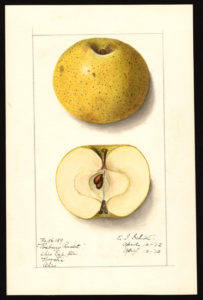
Roxbury Russet (1912), by Ellen Isham Schutt, 1873-1955. U.S. Department of Agriculture Pomological Watercolor Collection. Rare and Special Collections, National Agricultural Library, Beltsville, MD 20705Apples have been a significant part of American culture for centuries. Native Americans used wild species that are native to the U.S., and colonists brought European and Asian apple cultivars with them when they settled. Early apple cultivars were brought to the U.S. from the United Kingdom, France, Russia, Germany, and other European countries. However, most of the historic American apple cultivars originated as seedlings likely grown from seed brought from elsewhere or from the imported cultivars. Some of the earliest named apple cultivars originating in the United States were High Top Sweet, Roxbury Russet, and Rhode Island Greening, all dating from the early to mid-1600s. But how many of them were there, and what has happened to them?
In this work, historic books, publications, and nursery catalogs were used to identify the cultivars that were propagated and grown in the United States prior to 1908. Synonyms, introduction dates, and source country for 891 historic apple cultivars were recorded in total. We then classified them based on their availability over time and popularity in nursery catalogs. We considered the highest priority cultivars for conservation to be those that were actively propagated and sold through multiple nurseries, as well as those that were grown and documented in more than one of the three time periods recorded (pre-1830, 1830-1869, and 1870-1907).
We found that, overall, 90% of the 150 highest priority cultivars are currently available as a result of conservation efforts in genebanks, private collections, and nurseries. Overall, it’s quite remarkable (and likely due in part to the longevity of apple trees) that these trees remain available, since the USDA National Plant Germplasm System Clonal Repository, where apple cultivars are conserved, wasn’t established until the 1980s. Cultivars that are not currently protected within genebanks but considered high priority were identified and suggested for inclusion in genebanks in the future. There were 51 high priority cultivars identified as possible additions to genebank conservation efforts, many of which may be available from the National Fruit Collection in Brogdale, England, and the Temperate Orchard Conservancy in Oregon.
This information will be useful for the many landholders who have historic apple trees on their properties. Identification efforts may make use of lists of historic cultivars to help determine identities based on either DNA fingerprinting or phenotypic traits.