- Podcast double: Georgian kitchen gardens (with pix) and Italian citrus.
- Domestication infographics are now officially a thing.
- Feeding the world with vegetable research, courtesy of AVRDC. Need to register, alas.
- Zambia biofortifies. Maybe they didn’t register for the above.
- Camels as biocultural artifacts.
- European Seed Association breaks down the tumultuous last 18 months of the European seed sector.
- “It takes more than 40 different species to make a simple lunch…”
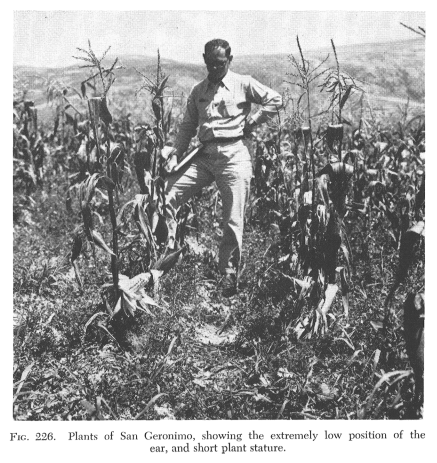
Historical maize information online
The core set of the Races of Maize volumes were a result of investigations by Maize Geneticists and were published by the National Research Council, National Academy of Sciences between 1952 and 1963. The set represents a unique source of information, which characterizes and describes the races of maize and their respective geographic origins. These volumes have been out of print and unavailable to researchers for decades. The Maize Crop Germplasm Committee (CGC) recognized the importance of the availability of this scientific literature and recommended that they be electronically reproduced and distributed via the National Academy Press, Washington, D.C.
And a great idea that is too. I was given a nice CD-ROM by Dr Candy Gardener of the USDA genebank in Ames, Iowa. But you can also access the PDFs online. It’s a real treasure-trove. Happy browsing!
Nibbles: ILRI@40, CIAT cleanup, Breadfruit factsheets, Spice book, Senegalese e-goats, Natural history collections, Seed supplies, Bean breeding, Institution building, Eat This Podcast, Phenotyping, Indian eggplant, GMO Terminator
- ILRI celebrates 40 years with a major conference.
- Keeping the CIAT germplasm collection nice and clean.
- New variety information sheets from the Breadfruit Institute.
- Review of Gary Nabhan’s new book, Cumin, Camels, and Caravans: A Spice Odyssey.
- Buying goats online.
- What would you do with one billion historical biodiversity data points?
- The tools of the seed-saver‘s trade.
- How to stress your beans, and why.
- A place for conservation organizations to hang out and share. You have to register, but this looks interesting.
- Jeremy has a second Twitter home.
- All 115 plant image analysis software solutions…
- Hyderabad’s brinjal obsession.
- A GMO terminator technology?
Brainfood: Ethiopian landuse history, Linum diversity, Chinese melons, Organic cauliflower, Mexican mission citrus, Saline mungbeans, Saving the elm, Future Fusarium, Wheat biofortification, PPB and public value
- Dynamics and driving forces of agricultural landscapes in Southern Ethiopia – a case study of the Chencha and Arbaminch areas. It’s the population pressure, stupid. No word on what expansion of agriculture and decrease in holding size is doing to agricultural biodiversity. Or wild relatives, for that matter.
- The potential of pale flax as a source of useful genetic variation for cultivated flax revealed through molecular diversity and association analyses. Levels of diversity similar in wild and cultivated, but strong differentiation between the two.
- Microsatellite analysis of genetic relationships between wild and cultivated melons in Northwest and Central China. For the true wild melons, go to the NW. Others may be escapes and introgressions.
- Evaluation of cauliflower genebank accessions under organic and conventional cultivation in Southern Germany. Genotype performance differs depending on cultivation method. But if you want to breed specifically for organic conditions, here’s what to use.
- Mission and Modern Citrus Species Diversity of Baja California Peninsula Oases. Lots of unique types in the mission oases and surrounding ranches. For how long? Well, here’s the baseline. I’d like to know about the agritourism potential.
- Evaluation of mungbean genotypes for salt tolerance at early seedling growth stage. From the Indian core collection. Some good stuff found.
- Implementing the dynamic conservation of elm genetic resources in Europe: case studies and perspectives. Genebanks are not enough. But then again, nobody ever said they were.
- Future distributions of Fusarium oxysporum f. spp. in European, Middle Eastern and North African agricultural regions under climate change. Some countries are in big trouble.
- Use of wheat genetic resources to develop biofortified wheat with enhanced grain zinc and iron concentrations and desirable processing quality. CIMMYT has used a range of wild species to increase the Zn and Fe content of high-yielding, high-quality bread wheat lines.
- Expressing the public value of plant genetic resources by organising novel relationships: The contribution of selected participatory plant breeding and market-based arrangements. PPB can help smallholders manage the indirect and option value of agrobiodiversity, but it needs new types of property rights and networked governance. Whatever that is, it can take a variety of forms. All this from China, of all places.
Nibbles: Palms, Walnuts, Gardening game, Measuring biodiversity, Promoting biodiversity, Restoring land, Honeybee evolutions, Amaranth recipes, Cider communication
- Someone you know might need to know the difference between a coconut palm and an oil palm.
- Or between English walnuts and French walnuts (and much more besides).
- Is an interactive game really the best way for children to learn about organic gardening?
- Canadian Cattlemen magazine shares a woman scientist’s deep insights into measuring biodiversity.
- And Indian priests used Konnsanchem fest to urge the revival of agrobiodiversity.
- Other Indians are restoring their land by getting rid of an interloper crop.
- DNA suggests a new ancestral home for the honeybee.
- Now I know what to do with the amaranth blocking every pavement in Rome: how to cook this prolific leafy green.
- Nominally about cider and apples, Pete Brown downs Strongbow’s communications in a few quick drafts.