- Former CIFOR DG interviewed about Global Forest Watch and more. I would have asked why you can’t import your own data or share a map you make.
- A particularly important place to watch the forest is Honduras, because deforestation there is correlated with cocaine trafficking.
- Not clear from this World Bank piece if deforestation in PNG associated with cultivation of another drug, i.e. coffee.
- Better bananas would be good for forests, wouldn’t they?
- Bah, just let them have corridors, they’ll be fine.
- And don’t forget to eat the forest bugs.
- Ok, I can’t figure out how to fit the history of potato breeding into this narrative. Any of it organic, though?
Nibbles: Foley Heinz award, C4 rice history, Fish feeding Africa, Sustainable harvesting, Sorghum death, Carver, Improving crops, Commodity production
- Jonathan Foley, @GlobalEcoGuy, lands well deserved award for his straight-talking on food issues.
- I wonder what he’d say about C4 rice.
- Not sure he’s ever written about fish, but he probably will.
- Sustainable harvesting of Prunus africana maybe not so sustainable after all. Well, I guess that’s science.
- Encomium to the recently-deceased “Father of Sorghum.”
- Shame he missed the round-up on improving abiotic stress tolerance in crops, linked to by AoB Blog.
- Wouldn’t it have been cool if the Father of Sorghum had met the Peanut Man?
- Global production of 10 top commodities has increased 130% since 1960, population by 89%. Draw your own conclusions about world hunger and malnutrition.
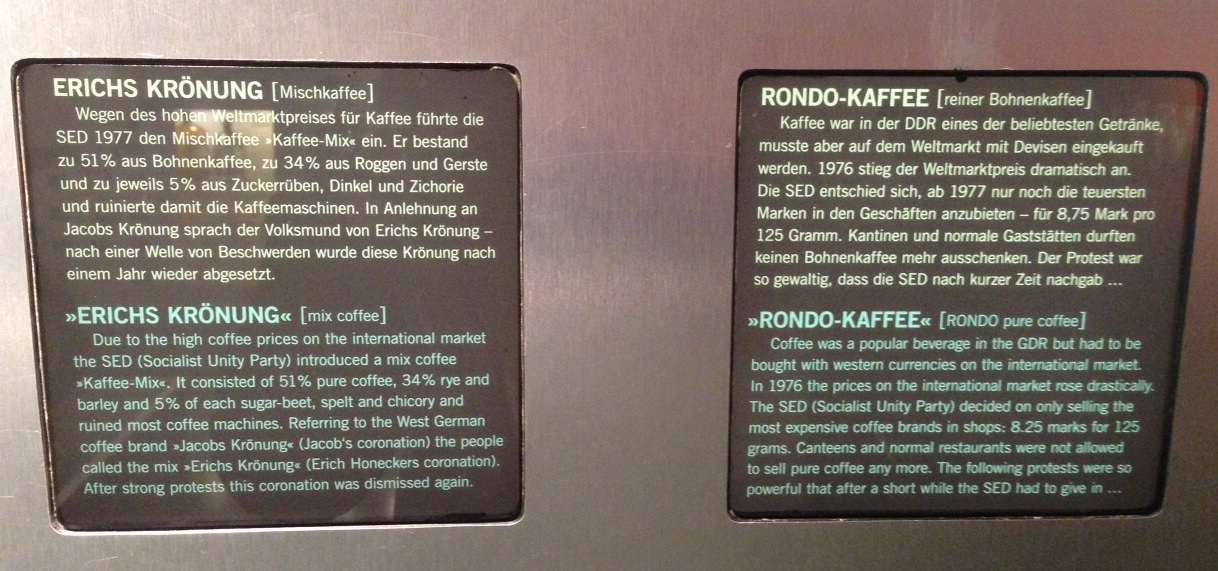
The truth about the DDR’s coffee
Many thanks to my colleague Amanda Dobson for this photo (click to embiggen) from the DDR Museum in Berlin. Sometimes one prefers a little less agricultural biodiversity in one’s food — and beverages — doesn’t one?
Nibbles: Plant Guardians, Peruvian Solanum, Sunflower genomics, California drought, Brazil drought, Sri Lankan tea, Minnesota wine, Seed of Hope, Sugarcane engineering, King Cotton, Rubber boom
- Do you want to be a Plant Guardian?
- Some people are already getting busy guarding Solanum in Peru.
- The sunflower family gets a molecular makeover.
- What the California drought means for food.
- And the one in Brazil for coffee.
- And tea in Sri Lanka is also in trouble, though for once drought is not to blame.
- Minnesota has a wine industry thanks to wild relatives. But I won’t hold that against them.
- In today’s Seeds of X story, X=hope and the place is Aceh.
- If sugarcane was a cold-tolerant oil-producing crop, would it still be sugarcane?
- Cotton has a lot to answer for. Or rather, the people who grew it do. Or did. Oh crap.
- Rubber too. Though not as much. I guess. Oh crap.
The slippery politics of agricultural biodiversity
It happens sometimes. You see a bunch of apparently random, unrelated things, and then after a while suddenly it hits you that there’s a thread of sorts running through them after all. It’s a trick of the mind, of course, but still. Take my reading these past few days. It included a review of an old exhibition on the historical links between Venice and the Orient (an interest of mine), a newspaper article on the latest developments on Cyprus (an old stamping ground of mine) and a paper from the International Institute of Social Studies on food sovereignty (homework). I suppose I should not have been surprised, but the nexus of agrobiodiversity (and its products) and politics turned out to be a point of connection among these, if maybe not an actual thread. Here’s how.
Venice and the Islamic World, 828–1797 was the title of an exhibition held at the Metropolitan Museum of Art, New York in 2007. There was a review of it at the time in the NY Review of Books, which I ran into at the weekend while binge-reading William Dalrymple stuff. Among many great observations, there was this little gem on the diplomatic missions between Venice and Egypt:
The emissaries would have been carrying large numbers of Parmesan cheeses, apparently the diplomatic gifts most eagerly favored by appreciative sixteenth-century Mamluk governors.
I don’t know what it was, maybe the slightly surreal image of a Venetian trireme being unloaded at some slippery Nilotic dock, the sweaty Parmesan wheels hoisted laboriously onto richly baldaquined camels as turbaned dragomans look on, but the sentence stuck with me. 1 And so did the following, this morning, while scanning a piece in the International Herald Tribune on the latest, hopeful signs from the tragically divided island of Cyprus. I spent several years there back in the 90s, and I try to stay informed:
In 2010, the community planted a Peace Park, an oasis with 1,100 carob trees and a playground. Soon after, the group restored a dilapidated Frankish cloister abutting the church, less than 500 feet from a Turkish mosque towering in the sun.
See, there it is again, agrobiodiversity helping out with politics.
Ah, but wait. I really should not be calling it that at all, should I. Because, according to Patrick Mulvany in a footnote in the paper Food Sovereignty: A Critical Dialogue, which you may remember we nibbled last week:
The term Agricultural Biodiversity is, in the English language, the accepted term in the United Nations FAO and CBD and by many authors that come from a public interest perspective. It is also a useful term in that it highlights the ‘cultural’ dimension. The reductionist term ‘agrobiodiversity’, though common in translation in other languages (and translation from those languages), is sometimes used by institutions and individuals who consider agricultural biodiversity mainly as an exploitable resource.
And there I was thinking that “agricultural biodiversity” and “agrobiodiversity” were completely interchangeable terms. How naive of me. Don’t you just love agricultural biodiversity? There’s politics even in what you call it.