- Scope of novel and rare bulbiferous coconut palms (Cocos nucifera L.). Produces bulbils instead of floral parts.
- Holocene landscape intervention and plant food production strategies in island and mainland Southeast Asia. Like the Amazon.
- Grazing alters insect visitation networks and plant mating systems. More outcrossing in grazed birch woods.
- Imre Festetics and the Sheep Breeders’ Society of Moravia: Mendel’s Forgotten “Research Network.” Before peas, there were sheep.
- Genetic Characterization of Grape Cultivars from Apulia (Southern Italy) and Synonymies in Other Mediterranean Regions. About half are also grown somewhere else.
- Fibre-yielding plant resources of Odisha and traditional fibre preparation knowledge − An overview. 146 species, no less.
- Functional Traits Differ between Cereal Crop Progenitors and Other Wild Grasses Gathered in the Neolithic Fertile Crescent. How do cereal progenitors differ from all the other grasses our ancestors used to eat? Adaptation to competition and disturbance. They were weeds, basically.
- Testing a silvicultural recommendation: Brazil nut responses 10 years after liana cutting. Biodiversity bad for Brazil nuts.
A plateful of Camargue Red Rice
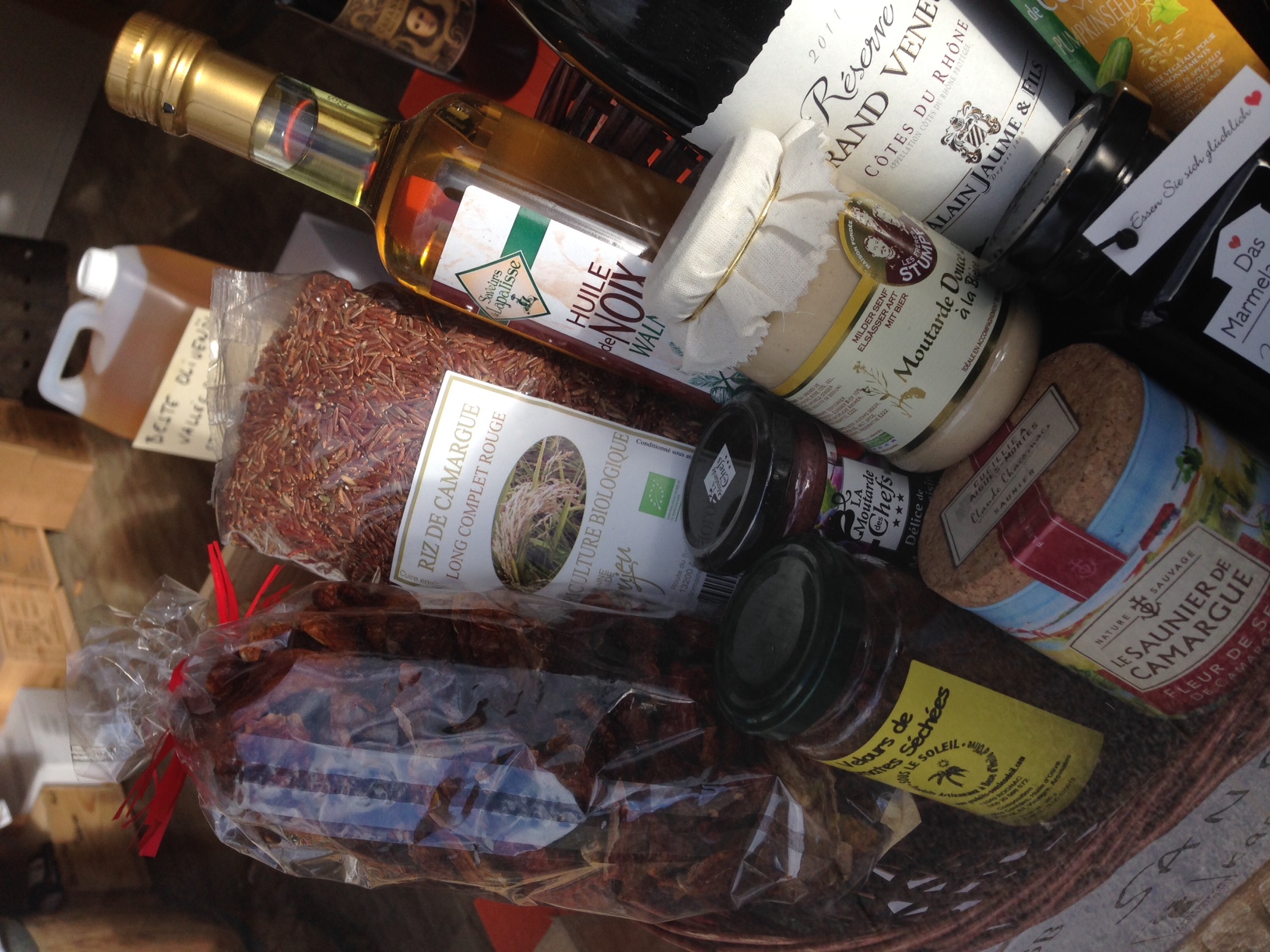 How far back into the mists of time, do you suppose, have the French versions of the fabled gnarled rustics of Sicily been nurturing the equally fabled red rice of the Camargue? The question occurred to me as I walked past a shop window in Bonn recently, and saw this delectable display of various products of that region, including said rice. Well, it turns out that although rice has been grown in the Camargue for centuries, this particular, trendily healthy variety is of somewhat more recent vintage.
A chance cross between the wild rice and a short grain rice was discovered in 1983 by a René Griotto (died 1989.) He found it growing at the foot of the Montmajor Abbey. Development of the cross was pursued in conjunction with the French “Institut national de la recherche agronomique” (INRA.) They’d grow plants, select seed from certain plants, then grow those, till finally they settled on the plant breed known today as Camargue Red Rice.
Wild rice? What wild rice grows in France? I asked my go-to guy for everything Oryza:
Must be weedy rice introduced with a crop. France is way outside the known limits of distribution of wild rice. 100 years ago a red rice introgression would have been rigorously weeded out. In the 1980s Europeans were becoming aware of the health benefits of non-white food. I wonder if they actually thought red rice = anti-oxidants = anti-cancer, which is today’s mantra.
Here’s some more from an FAO publication on weed management:
The seeds of most weedy biotypes of O. sativa and O. glaberrima have a pigmented pericarp resulting from the presence of a variable content of different antocyanins, cathekins and cathekolic tannins (Baldi, 1971).
The red pigmentation is a dominant character and is controlled by more than one gene (Leitao et al. 1972; Wirjahardja et al. 1983)
The red layer of the weed grains harvested with the crop should be removed with an extra milling but this operation results in broken grains and grade reduction (Smith, 1981; Diarra et al. 1985a, 1985b).
Weedy biotypes of O. sativa have been differentiated into indica or japonica types, on the basis of the morphological and physiological traits, isozymes, RFLP (Restriction Fragment Length Polymorphism), RAPD (Random Amplified Polymorphic DNA) and AFLP (Amplied Fragment Length Polymorphism) markers.
According to a study funded by the European Community, weeds collected in Mediterranean rice fields belonging to the japonica group and weeds from Brazil were close to the indica group (Ghesquière, 1999). In this study no specific allele of weeds were found which can serve as a diagnostic marker to easily determine the varietal origin of the weedy forms. Nevertheless, a great deal of evidence would seem to show that the primary origin of red rice can come from distant crosses between indica and japonica varieties.
Vaughan et al. (2001) pointed out that the several samples of weedy biotypes collected in the United States belong not only to the indica and japonica subspecies, but also to the O. rufipogon and O. nivara species.
Anyway, before you ask, I can’t find a reference to the red rice of the Camargue in any of the genebank databases that I know. It’s definitely not in IRRI. There’s no data at all on any rice collections in France on Eurisco, although other countries do have substantial collections of French rice, in particular Russia. WIEWS does list a number of important rice collections in France, but they seem to be international, with only some 9 samples from France itself. GRIN also has significant holdings of French rice, but nothing that I can see on Camargue Red Rice specifically, 1 at least going by passport information. We know INRA have been having trouble with their grape collection. Do they even have a collection of local rices? Or are they relying on those gnarled Camargue rustics, and clever niche marketing to hip, health-conscious foodies of course, 2 to keep them going?
Nibbles: Agroforestry slides, Sub1 slides, Fish slides, Fish in Neolithic, Silver bullets, Carbon credits, Camel domestication, Cuneiform barley
- All of the presentations from the World Congress on Agroforestry.
- Scuba rice in 13 slides.
- You got off easy on that last one. Here’s 55 slides on fish biodiversity and the food supply.
- Not much fish in the food supply of early farmers in Britain.
- New IFPRI book highlights technologies to beat hunger. Includes plant breeding. But no fish?
- Kenyan agroforestry organization gets C credits. Details sketchy though.
- The Bible got it wrong on camels. And that’s all I’m saying about that.
- Cuneiform tablets are so beautiful. Especially when they depict agricultural biodiversity. Via.
Another slice of tumminia bread
For those readers who were intrigued by Jacob’s somewhat enigmatic comment on tumminia wheat, but put off by having to download a huge PDF of an 1818 edition of the Memorias de Agricoltura y Artes, in Spanish, here’s the money quote:
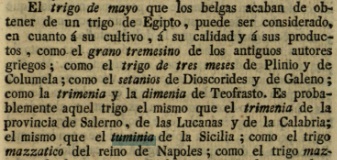
And here’s a quick translation:
The May wheat that the Belgians have recently obtained from an Egyptian wheat can be considered, based on its agronomy, its quality and its products, to be the same as the tremesino wheat of the ancient Greek authors; the three month wheat of Pliny and Columella; the setanio of Dioscorides and Galen; the trimenia and dimenia of Theophrastus. It is probably the trimenia of the province of Salerno, of Lucana and Calabria; the same as the tuminia of Sicily; the mazzatico wheat of the Kingdom of Naples; the mazzuolo wheat of the Tuscans.
People have been exchanging crop diversity, and been interdependent on each other for it, for a long time, I guess.
Jeremy has more on the etymology of tumminia in another comment.
Nibbles: Variety adoption data, Georgian biodiversity, Species migration, Agroforestry shindig, Perennial breeding, Pacific history, Livestock emissions, Dandelion rubber
- New database on the adoption of modern varieties. No doubt will eventually include the ones coming out of this shiny new rice regional hub in Burundi.
- Useful summary of what’s happening in agricultural biodiversity in Georgia. No mention of ITPGRFA ratification, alas. You can find previous editions of the newsletter of the CGIAR Regional Program for Sustainable Agricultural Development in Central Asia and the Caucasus here.
- CSIRO come up with map of where and how fast species will move due to climate change.
- And Google Earth now has the underlying climate data you need to do that kind of analysis.
- World Congress on Agroforestry off the ground. You can follow on Twitter, #WCA2014. Also, you can read the blog. Do you remember when this type of thing didn’t even have an RSS feed?
- Did we miss this thing of perennial grain breeding at the Land Institute when it came out a year ago?
- Nice long podcast and Q&A from the Bishop Museum on the footprint Hawaiians left on their islands before contact. Great stuff on GIS analysis of suitability of ancient landscapes for taro and sweet potato. And, coincidentally, an equally long video clip on Pacific island landscapes more generally, and how they shaped the culture (and agriculture) of the Polynesians.
- ILRI DG chides The Economist on article suggesting that the only way to decrease livestock emissions is to go industrial: “There simply is no moral equivalent between those making poor food choices and those with no food choices at all.”
- New EU project on Russian dandelion does not seem to include boffins who recently turned off the rapid polymerization gene. And will they use the right species? And do some ex situ conservation? I’m not holding my breath on that last one.