- Secretary of Agriculture tours Ft Collins genebank. With video goodness.
- Which genebank I’m sure follows the Genebank Standards for Plant Genetic Resources for Food and Agriculture. With video goodness.
- Prince of Wales sows organic rice. In white suit. With video goodness.
- The story of indigo. No video, but lots of photos.
- Sardinian blood soup. No video, but one photo. Which is more than enough.
- Wanna watch Seeds of Time? Here’s where. Includes much on Svalbard, of course. And a bit on USDA wild potato collecting. I plead the fifth.
- So there’s a second banana genome? Thankfully no video.
- “We are only using the tip of the iceberg.” Rice genetic resources, that is. Could easily have had a video.
- Face palm oil.
- Photo essay on the bazaars of Central Asia.
Nibbles: Panama disease, N2Africa, Trees and CC, CITES, Jordanian farmers and CC, ETC poster, Digitization, Wallace video, International Rice Genetics Symposium, Roots and tubers meet, Hybrid maize, Quinoa, Food Security, Israeli boars
- Panama comes to SE Asia. Banana people will understand. And will know what to do?
- Shucks, just missed the N2Africa project first phase results presentation shindig in Nairobi. All about the power and beauty of nitrogen-fixing legumes (geddit?). Jeremy wont let me link to the piece about the project that recently appeared on a well-known site, and he’s right, it’s largely content free. And you can find it if you really want to anyway.
- Climate change? Not a problem, for some plants (including wild relatives?), if there’s trees around. Well, kinda sorta. But it made you look, didn’t it? Are any of them on CITES? Consult the new handy dandy online thingy.
- Ah, but tell that to Abu Waleed and other Jordanian farmers.
- Who are the answer to etc Group’s question: Who will feed us?
- A botanical use for online gaming. Whatever next.
- Celebrating Alfred Wallace via animated video. And why not.
- You want more videos? Here’s a nice explanation of the difference between winter and spring wheat.
- Huge rice genetics meet is apparently a “hot bed of discussion”. For another couple of days. Let us know if you are party to any of that.
- No doubt the same could have been said about the recent 12th International Symposium of the International Society for Tropical Root Crops in Accra.
- Zambian families are better off nutritionally if they grow hybrid maize.
- A handy English translation of an all-consuming post about quinoa in Spanish. And check the photo of quinoa diversity!
- Gary Nabhan explains why “more biodiversity means more food security“.
- Israel’s wild boars are European. I’m biting right through my tongue here.
Cemeteries reveal the secrets of pre-agricultural prairie soil
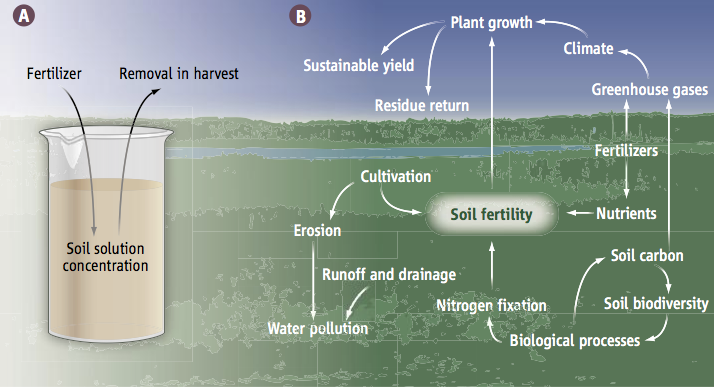
If a picture were worth a thousand words I would stop right now. But it isn’t, so I can’t. An explanation:
Exhibit A, on the left, caricatures, but only a bit, the worldview of many of those responsible for funding and carrying out research into agricultural productivity. Exhibit B, on the right, a slightly more nuanced view, lifted from an article by Mary C. Scholes and Robert J. Scholes in this week’s Science. 1 Scholes and Scholes are commenting on a paper by Noah Fierer and his colleagues in the same issue, which specifically addresses the little label in the lower right: “Soil biodiversity”.
Fierer’s paper 2 asks what the effect of agriculture might have been on the microbial diversity of soils in the tallgrass prairie of North America. There’s not that much left now, but they managed to sample 31 sites, “found primarily in cemeteries or nature preserves”. And they subjected DNA from the samples to some high-throughput DNA sequencing and analysis. The bottom line conclusion is that tallgrass prairie soils are very complex and that this complexity would be expected to affect all sorts of soil cycles, especially nitrogen and carbon.
Scholes and Scholes put those results into context, pointing out that
We have forgotten the lesson of the Dust Bowl: Even in advanced economies, human well-being depends on looking after the soil. An intact, self-restoring soil ecosystem is essential, especially in times of climate stress.
The diversity that Fierer and his team uncovered is strongly linked to functional diversity, independently measured. Prairie soils are particularly rich in Verrucomicrobia, “bacteria specialized for low-nutrient conditions, [which] are lost from the cultivated soils, making the soils less able to supply nutrients other than those provided as fertilizer”. And that’s the key to the bigger picture. Scholes and Scholes point out that:
[I]mproved technology—including the unsustainably high use of fertilizers, irrigation, and plowing—provides a false sense of security.
We need to stop thinking simplistically about the role of inorganic fertilisers and start to consider the soil in which our food grows.
An agricultural soil ecosystem that more closely approximates the close and efficient cycling in natural ecosystems, and that also benefits from the yield increases made possible by biotechnology and inorganic fertilizers, is needed to increase agricultural production to the levels that will be required while minimizing its adverse effects. Integration of the insights, innovation, and best practice from agronomy, ecology, soil biology, chemistry, physics, plant breeding, and natural resource governance is the only viable route to both feeding the world and keeping it habitable.
In other words, we have to do it, but it isn’t going to be simple. Knowing a bit more about what makes prairie soils both productive and self-sustaining may help the process of restoring degrading lands and preventing future degradation.
Nibbles: Archaeocuisine, Ag-fab, Onion shortage, Healthy sorghum, Organic soybeans, Tropaeolum, Fish in rice
- The Silk Road Gourmet talks about Reconstructing Cuisines And Recipes From The Ancient World.
- Colin Tudge splutters about The Founding Fables of Industrialised Agriculture.
- India’s ongoing onion crisis still a vale of tears.
- But India’s jowar (sorghum) still offers superficial health benefits.
- You know how all the US soybeans are being exported to China? Think again.
- How the nasturtium got its spur; not a just-so-story.
- California discovers the productive miracle of fish in rice paddies.
Nibbles: Frogs, Spuds, Apples, Cucumbers, Tosh?
- Take that, you cheese-eating surrender monkeys. England boasts oldest eaten anuran legs.
- Ban potatoes NOW! You know it makes sense.
- As American as industrially harvested, intellectually protected apples.
- Step aside Golden Rice; the Golden Cucumber is just over the horizon. That and much more from deep re-sequencing.
- Also just over the horizon, hordes of new, public domain banana varieties, although they don’t actually own the domain the video points to. Oops. h/t Bifurcated Carrots.