- Breeder of blight-resistant potatoes stands up for gardeners who grow blight-susceptible potatoes.
- Hungry for better ag statistics? FAO hears you.
- “Biofortification is an obstacle to food justice”. Just an opinion, obviously.
- And not necessarily one shared by the USDA: Breeding better fruits and veggies, including vitamin-A enriched potatoes.
- Women, gardens, community health … we’ve heard this all before. So why is it still news?
- Diana Buja shares tips on how to catch flying ants, and other goodies, the better to savour their deliciousness.
- A beginner’s guide to everything called pepper.
- A new test for cow’s milk in mozzarella di bufala, can also separate the sheep from the goats. Can I get a pocket version?
- The transition to agriculture in North America.
Nibbles: Agroforestry history, CBD COP, Social GCARD, Dog symbiosis, Indian databases, Beans means iron, Swedish climate change, Italian agrobiodiversity documentation
- Reminiscing at ICRAF about the history of (some of) the intellectual underpinnings of land sharing.
- The latest agrobiodiversity musings from Hyderabad.
- More reminiscing, this time from a GCARD2 social reporter.
- Dogs, the first domesticates?
- India links up its biodiversity databases. Including NBPGR’s?
- Iron-rich beans hit Rwanda. Rwanda reels from the impact. How long before someone thinks of dumping them into the ocean?
- “There will be no nice wine from Sweden this year.” Oh, dear.
- Documenting agricultural biodiversity. In Italian. Maybe Italy will now follow India (see above)?
Brainfood: Biodiversity surveys, Potato innovation, Wild sorghum, Bumblebee decline, Naked barley, Primate deterrents, Pastoralism, Mapping, Japanese forests, Aquaculture, Birds, Lentil mixtures, Eucalypt plantations, Seed adoption, Altai nomadism, Dung beetle diversity
- Systematic, large-scale national biodiversity surveys: NeoMaps as a model for tropical regions. The Neotropical Biodiversity Mapping Initiative (NeoMaps) provides good estimates of species richness, composition and relative abundance, in about 1 month of fieldwork per major taxonomic group and about US$ 1–8 per sq km. Now to do something similar for crop diversity.
- Insights into potato innovation systems in Bolivia, Ethiopia, Peru and Uganda. Rapid appraisal of potato innovation system by CIP et al. reveals differences among countries, but significant role of CIP across countries. Roles of farmer organizations and input supply companies limited everywhere.
- Population genetic structure of in situ wild Sorghum bicolor in its Ethiopian center of origin based on SSR markers. Significant differentiation among populations, despite long-distance seed movement and introgression.
- Assessing declines of North American bumble bees (Bombus spp.) using museum specimens. Half of the species are declining.
- Is naked barley an eastern or a western crop? The combined evidence of archaeobotany and genetics. Well, it used to be western too, up to the Bronze Age. Now mainly eastern.
- Crop protection and conflict mitigation: reducing the costs of living alongside non-human primates. A diversity of strategies for coping with malevolent biodiversity.
- Conserving biodiversity in a changing world: land use change and species richness in northern Tanzania. But, would you know it, pastoral grazing threatens other mammals.
- Mapping from heterogeneous biodiversity monitoring data sources. Could be interesting when folks get around to mapping agricultural biodiversity by smart phone.
- Sustainable management of planted landscapes: lessons from Japan. They planted trees, then neglected them because imports were cheaper, and now they’re paying some kind of price.
- Aquaculture: a newly emergent food production sector—and perspectives of its impacts on biodiversity and conservation. Mixed …
- Protection strategies for farmland birds in legume–grass leys as trade-offs between nature conservation and farmers’ needs. Cut high for succesful skylark nests with minimal impact on milk.
- Optimizing lentil-based mixed cropping with different companion crops and plant densities in terms of crop yield and weed control. Mixtures might be better, especially with wheat and barley.
- Role of eucalypt and other planted forests in biodiversity conservation and the provision of biodiversity-related ecosystem services. They can provide an opportunity for forest restoration, but it will take some rethinking. The mother-in-law will be pleased.
- Influence of Sources of Seed on Varietal Adoption Behavior of Wheat Farmers in Indo-Gangetic Plains of India. You need to get the message out if you want your improved varieties adopted. Can’t imagine you’d need a multinomial logit model to figure that out.
- Pastoral nomadism in the forest-steppe of the Mongolian Altai under a changing economy and a warming climate. As transport costs go up, and goat numbers increase because of cash from cashmere, mobility decreases and overgrazing results. A traditional way of life becoming unsustainable before your eyes.
- Species-rich dung beetle communities buffer ecosystem services in perturbed agro-ecosystems. Functional redundancy is not redundant after all.
Nibbles: 300, Linux seeds, Reef protection, Cold turkeys, Forest atlas, Perennials, Potato King, Apple art
- If you liked our piece of a couple years back on a remarkable Indian mango tree, you’ll love Bhuwon’s latest, fuller write-up.
- Open-source seeds? Isn’t that what the ITPGRFA was supposed to be ensuring?
- How fisherfolk in Indonesia protect the reef.
- Going wild turkey.
- Mapping Cameroon’s forests. Interactively, of course.
- A perennial roundup.
- Old Fritz and the potato. Maybe genebanks should take a leaf (or tuber) out of his book?
- “What constituted beauty, she wondered, in the scientist’s eye?”
Bean books bounty
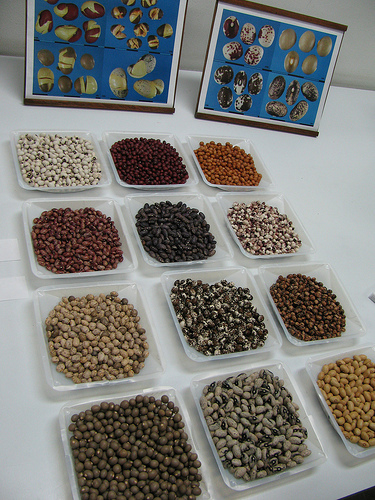 Nice coincidence to get notice of two separate books on beans on the same day. The Fundación Herdez A.C. has El Frijol available for download from its website. Looks very thorough; and free. But in Spanish. Probably on the more popular side, you can also buy Ken Albala’s Beans: A History. Though I’ve just noticed this was actually published a few years ago. Nevermind.