- Dalo chips! With illustrative goodness.
- Tree genomes! Whole journal-full.
- Seeds! From Kew’s Millennium Seed Bank, that is. In a database. Or two. Online.
- Japanese tubers! If anyone can find the actual video, I’d be very grateful. It’s not here yet. Or here. And I also want to find out more about the mythical Professor Sweet Potato.
- Best farmer awards in Ghana! “He cultivates diverse crops…” Ah but not everyone is happy. Via.
- An Omani genebank! Still “under process”? There was one of sorts 20 years ago when I worked there.
- Day of the Dead! Nuff said.
- Crop rotations! The NY Times plays catchup.
- John Innes Institute video! Explains a couple of papers in Current Biology on root-microbe interactions, where the microbes are both good and bad.
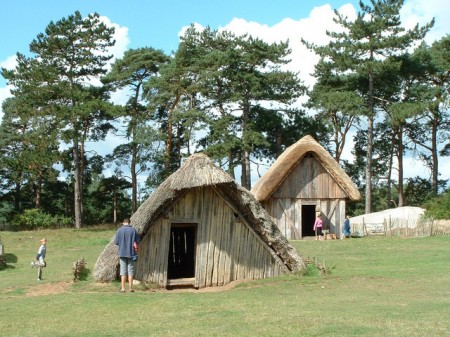
Anglo-Saxon smallholder development
Nibbles: Audacity of hops, Potato catalogues, Heirloom apples, Heirloom wheat, UK systematics, Millennial olives, CIAT celebrates, IITA in the news, Agrobiodiversity marketing awards, Insects in orchards, Quinoa
- U. of Minnesota has a poster of the pedigree of hop varieties which I covet.
- Cool catalogue of the native potatoes of a bit of Ecuador. Via Red Electronica de la Papa.
- Stark photos of a few heirloom apples, with descriptions.
- Meanwhile, Brockwell Bake sows some heritage wheats. With stark photo
- Report on the state of UK capacity in taxonomy. How many countries have reports on the state of their taxonomy? Anyway, here’s some of that capacity at work.
- Farrago on some old olives in Jerusalem.
- CIAT celebrates 45 years of existence.
- Meanwhile, IITA pushes soil fertility management and cassava.
- Arca-Deli Awards awarded.
- Defra’s latest Biodiversity News has stuff on the importance of insect biodiversity to pest control and pollination in orchards.
- The International Year of Quinoa, which is next year, has a website, and all sorts of associated social networking goodness. And here’s a nice little student video on the crop, for a somewhat different perspective.
Nibbles: ICRISAT genebanks, Agricultural history, Weeds, Gowda, Fruit symposium, Chaffey, Open pollinated seeds, Breeding institute, Ash dieback, Perennial grains, Marshall strawberry, Neanderthal cuisine, Colorado beetle control
- World Bank goes inside ICRISAT seed bank and finds in vitro plantlets.
- “Did mongrel grains serendipitously meld together and sprout from the sewage dumps of sedentary fishing tribes (a current theory), or was the domestication of wheat grasses, pomegranates, and fig trees a willful act of genius?” Scientific American excerpts a bit of purple prose from from Frederick Kaufman’s “Bet the Farm: How Food Stopped Being Food.”
- And a book on how (some) food (i.e. weeds) started being food.
- ICRISAT legume breeder bags award.
- One of the more interesting symposium titles I’ve come across: International Symposium on Fruit Culture and its Traditional Knowledge along Silk Road Countries.
- Plant Cuttings.
- And plant seeds. Of the open-pollinated sort.
- Donald Danforth Plant Science Center establishes Institute for International Crop Improvement (IICI). CGIAR unavailable for comment.
- CABI gets to grips with ash dieback.
- Perennial grains in practice.
- Recovered rare strawberries as art: Marshall Duchamp.
- Intrepid journo discovers secrets of Neanderthal cuisine.
- Crimson clover cover crop protects aubergines as well as insecticide against Colorado beetles.
Nibbles: Complementary conservation, Ash dieback, EUCARPIA meeting, AnGR, Green Revolution history, Fellowship, Canadienne cows, Sustainable intensification
- So apparently field genebanks are “monotonous orchards packed with tropical trees spanning as far as the eye can see.”
- Any ash genebanks, I wonder, field or otherwise?
- EUCARPIA pre-breeding pre-meeting.
- FAO moans about progress in conserving livestock.
- The Green Revolution deconstructed.
- Good news for procrastinators: the deadline for Vavilov-Frankel Fellowship applications has been extended to 18 November. Ignore the date of 11 November.
- Saving the endangered Canadienne cow. In other news, there’s a Canadienne cow.
- Friends of the Earth doesn’t think much of “sustainable intensification“.