- Probably way more than you ever need to know about FIGS. In one handy PowerPoint.
- The British love affair with the apple comes to a head. And goes over the top.
- 100 years of the Paddy Breeding Station. No, nothing to do with the Irish.
- Another damn app competition.
- Geographical Indications in Brazilian law deconstructed.
- Not too late for a cappuccino. But make mine a civet cat shit one.
- More rewriting of Amazon pre-history.
- Marianne North, botanical artist, in the Amazon and elsewhere, remembered.
- Starting now FAO Symposium: applying information on food and nutrition security to better decision making. There’s even a hashtag — #isfsi2012 — but nobody seems to be using it.
Contacting Trevor Williams
We have received a request from Roger Croston to post the following on the blog, and are happy to do so. Trevor Williams was the first director of the International Board for Plant Genetic Resources (now Bioversity International), and another significant figure in the early days of the PGR conservation movement.
After searching for many years I am now back in contact with Trevor
Williams — best known to many as “JT”.
He is now back in England at his Stockport address for those who have
it. I would also be more than happy to forward messages to him on
anyone’s behalf. Please give me your postal address and ‘phone numbers
so that he can reply. JT is currently not on email. He is most keen to
hear from friends and colleagues. (He had been in intensive care in
hospital with breathing difficulties but he is now home and is gradually
improving, I am pleased to say).
Email: rogerc “at” croston-engineering “dot” co “dot” uk
Erna Bennett papers
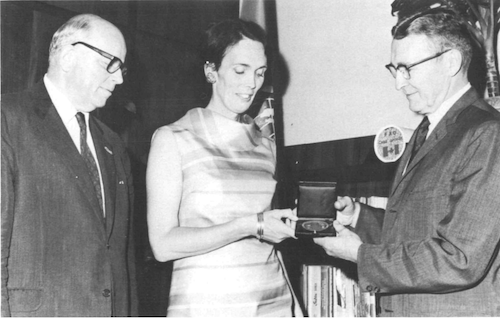
Thanks to Helmut Knüpffer of IPK Gatersleben, for his comment pointing to two important papers relating to Erna Bennett.
- Erna Bennett: Her Career and Convictions and An Interview with Erna Bennett by IS Cunningham provides an insight into some aspects of her personality and drive. (Diversity 5(2 & 3), 60-63, 1989. As with the Ceres article reprinted by The Ecologist, if you do download and skim through the whole issue, you might, like me, wonder what on Earth we’ve all been doing for the past 40 years.)
- Award of Meyer Memorial Medal to Erna Bennett of FAO, including Presentation by Dr. Ralph W. Phillips, Miss Erna Bennett’s Acceptance, and Statement by Dr. A. H. Boerma. 1971. (J. Heredity 62(5), 277-279. That one’s behind a paywall, although I reckon snagging the photo above constitutes fair use.)
Helmut also wrote: “I just went to the Mansfeld Library. There are 2292 reprints in the “Reprint Collection Erna Bennett” sorted alphabetically by author and then numbered 1-2292.” Good to know.
And a couple of other links. Grain, the NGO, published its own tribute. Grain’s archives contain a piercing essay from Erna on The Summit-to-Summit Merry-go-Round, which should be on the reading list of everyone with an interest in agricultural biodiversity and the context surrounding its conservation and use.
Erna Bennett: more on this unique person
Erna Bennett was unique. Well, not quite. There have been other Erna Bennetts, one of whom died almost exactly a year ago. Although I never met “our” Erna Bennett, I like to think that she would actually be tickled to have been confused with Erna Bennett of Richmond, VA in the United States. I say this because Erna seems to have taken some trouble not to be easily found, and a decoy would have been an appropriate ploy.
In the wake of her death last week, different people have drawn attention to her importance to the field of agricultural biodiversity and to the dearth of good biographical material. Although we were early pioneers in recent years, with the briefest possible post the day after her 83rd birthday, the hunt was taken up by our friend and colleague Danny Hunter, who also broke the news of her passing, at least to us.
Danny’s previous forays, like ours, drew forth some comments from people who had known Erna professionally and privately. Reading some of them, one longs to know more, and yet it would be sad also to think that only with her death will these things become known.
Hunting for more about Erna the person, I found a piece that The Ecologist magazine reprinted in 2010, 40 years after it first appeared. (Danny had found it first.) Two things are absolutely remarkable about this. First, it was reprinted from the FAO’s old journal CERES, which seems to have no recollection of it, and that alone encourages me to make it more widely available. Secondly, the arguments, not only from Erna but also from Otto Frankel and Jack Harlan Jr (and WK Agble), remain absolutely current. Apart from a slight quirkiness of language, you could read their answers to a modern audience and have them nodding sagely along. And you would be able to add a few more examples.
Bits of biography do exist, with tantalising hints that she may have been a pilot delivering planes in World War II, among other things. There is, however, so much more one could say, not least about the politics within FAO, and I hope that in time Danny is going to say it.
I haven’t been able to find either the Canadian film Fragile Harvest or the Youtube videos that people have mentioned, although I am sure I remember seeing some of that footage. If the material exists still, it should end up in Web of Stories, that’s for sure. Anyone know where those recordings might be?
Gregg Borschmann interviewed Erna on 21 November 1994 for an oral history project focusing on environmental awareness in Australia. The recordings and a corrected typescript of 89 pages are available from the National Library of Australia. While in Australia, Erna seems also to have been active in the Socialist Party of Australia, reporting on a meeting of the Central Committee (of which she was a member) that took place a month before the oral history interview. She wrote for organs of the Communist Party of Australia and served on the Editorial Board of the Australian Marxist Review. I wonder what she thought of Stalin’s persecution of the “bourgeois” science of genetics, and especially of the fate of NI Vavilov?
For her 83rd birthday, MS Swaminathan, another early pioneer of agrobiodiversity conservation, wrote:
Erna’s untiring efforts helped to create global awareness of the need for accelerated efforts in the area of genetic resources conservation and sustainable use. Her life and work will always remain a source of inspiration and guidance to all young scholars who wish to save plants for saving lives and livelihoods.
But Erna was having nothing of it:
I did what I had to do because I believed in it, just as you too believe in what you are doing. Your own work is as important as anything I have done, and students and workers trained and inspired by you are the army of the future, who will have to face battles even more difficult than those we faced in the past. I hope you agree, so let’s quietly drop ideas of pouring praise in my direction. The future will need not only the inspiration of past battles but also the toil and sweat of future struggles, greater — from the way things now seem to be developing — than any of our generation ever faced.
Brainfood: Climate change in Europe, Slow cheese in Portugal, Grapevine diversity in Spain, Noni in India, Farmers and pastoralists in Jordan, Stevia everywhere, Almond genes flow, Peanuts, Disease control
- Representing two centuries of past and future climate for assessing risks to biodiversity in Europe. Temperature up 3-6°C throughout Europe by end of century, rainfall down in south, up in north. Sounds lovely.
- Gourmandizing Poverty Food: The Serpa Cheese Slow Food Presidium. Trying to bring back a lost Portuguese cheese is romantic and elitist. Wish they’d just say what they really mean.
- Genetic diversity of wild grapevine populations in Spain and their genetic relationships with cultivated grapevines. If there’s a genetic contribution of wild grapevines to cultivated in Spain, it’s not great.
- Revisiting the origin of the domestication of noni (Morinda citrifolia L.). Let’s just say Pacific islanders won’t be pleased.
- The desert and the sown: Nomad–farmer interactions in the Wadi Faynan, southern Jordan. Changes from sedentarism to pastoralism are mainly due to chance.
- Stevia rebaudiana Bertoni, source of a high-potency natural sweetener: A comprehensive review on the biochemical, nutritional and functional aspects. Not just sweetness, folic acid, vitamin C and all of the indispensable amino acids except tryptophan too.
- Gene flow among wild and domesticated almond species: insights from chloroplast and nuclear markers. The main insight being that it happens a lot, in both directions.
- Agricultural Technology, Crop Income, and Poverty Alleviation in Uganda. New peanut varieties increase incomes and reduce poverty, but aren’t enough on their own.
- Plant diversity improves protection against soil-borne pathogens by fostering antagonistic bacterial communities. It sure does, at least in a long-term grassland.