- Haga Hideo’s 1950s photos of Fukushima farming rituals are now being used to revive them: ex situ conservation, but for culture.
- Long before photography, or “pre‑breeding” was a buzzword, Belgian pomologist Jean‑Baptiste Van Mons was running massive pear selection trials and gifting us Beurré Bosc and Doyenné Boussock.
- As Southern Africa’s miombo woodlands shrinks, scientists are cloning wild trees so the fruit — and food security — outlive the forest. Now for the pre-breeding.
- Greenpeace Africa’s Seed Project makes the case for indigenous seeds as a route to farmer independence. And you can help.
- And oh so coincidentally, a network of community seed banks in Kenya is rescuing indigenous seeds so the diversity is still around when opportunity (or crisis) knocks.
- Also in Kenya, the national genebank’s collectors are racing to secure opportunity crops.
- Nepal’s indigenous crops and landraces are at the same time more needed than ever, and under threat. So, much like in Kenya.
- The Alliance of Bioversity and CIAT says women are at the center of sustainable food systems; the fine print adds: “as they have always been.”
Joining the dots on food plant diversity
We have access to more kinds of food plants, yet the world’s diets and production systems have never been more alike. That is the paradox at the heart of Food plant diversity in a rapidly changing world, an unusually broad review by Colin Khoury (very much friend of the blog) and colleagues. It has all the latest data, but it also does several other things that make it more than a conventional state-of-the-art paper.
For one, it brings together diversity at several levels that are too often discussed separately: species, varieties and genes, of course, but also the diversity of diets, farming systems, foodways and the knowledge associated with them. It traces the movement of cultivated food plants over the past 12,000 years alongside the much more recent trend towards homogenisation. The result is the weird world we live in today: more kinds of crops available globally, but less difference between what people in different places eat.
Colin and friends also take a hard look at what we don’t know. We have surprisingly little evidence for how much food-plant diversity has actually been lost, how vulnerable today’s production systems are because of increasing uniformity, or what is happening to less visible forms of diversity, such as nutritional and chemical variation. The authors call for better monitoring, including an early-warning system for crop vulnerability. Now where have I heard that before?
And the paper connects the dots between conservation approaches that all too often live in isolation: genebanks, botanic gardens, community seed banks, on-farm initiatives, protected areas, breeding programmes and markets. Genebanks are all well and good, but diversity also needs to keep going in fields, landscapes, cuisines and communities. Again, not particularly new, but it’s good to have it repeated, brought up to date, and placed in the broadest possible context.
A couple of those dots are discussed in more detail in a companion opinion paper, Enhance food plant diversity conservation and use through greater coordination between genebanks and botanic gardens, which asks what might become possible if two of the world’s major plant conservation communities worked a bit more closely together. Which must be possible because they are nicely complementary, so neither should fear the other as a competitor.
The review paper maps the problem. The opinion piece explores a possible route towards a more joined-up conservation system. Which leaves us with its own small paradox: conserving food plant diversity requires flattening some of the differences within a remarkably diverse conservation community. Happy Crop Diversity Day 2026.
Nibbles: China genebank, China blueberries, PhilRice, Italy olive genebank, GIAHS, Mangelwurzel, Papaw, Bean AI
- China is building its germplasm collection at the National Frigid Zone Crop and Soybean Germplasm Resources Mid-term Bank in Harbin. Cool.
- Driscoll’s helped build China’s blueberry industry, then discovered that knowledge, infrastructure and genetics have a habit of escaping. Not so cool.
- Meanwhile, the Philippines wants its rice collection to hit 21,000 varieties by the end of the year. IRRI unavailable for comment.
- Italy is establishing a major global olive genebank. Unclear where it fits in with other major global olive genebanks, but some redundancy is good.
- FAO showcases Globally Important Agricultural Heritage Systems, where crops, landscapes and traditional knowledge have survived together. Like olives in Italy, I guess.
- The mangelwurzel is making a comeback, because apparently forgotten root vegetables just need better publicity, and not a fancy GIAHS.
- Ohio growers are trying to save the pawpaw just as Americans are discovering it, partly because of better publicity.
- BeanGPT is bringing AI to breeding and farming beans. Maybe it can help the mangelwurzel and pawpaw too?
Hope in Iraq
This made me happy. Seventeen years after we first blogged about the sad fate of the Iraqi national genebank at Abu Ghraib, it has re-opened.
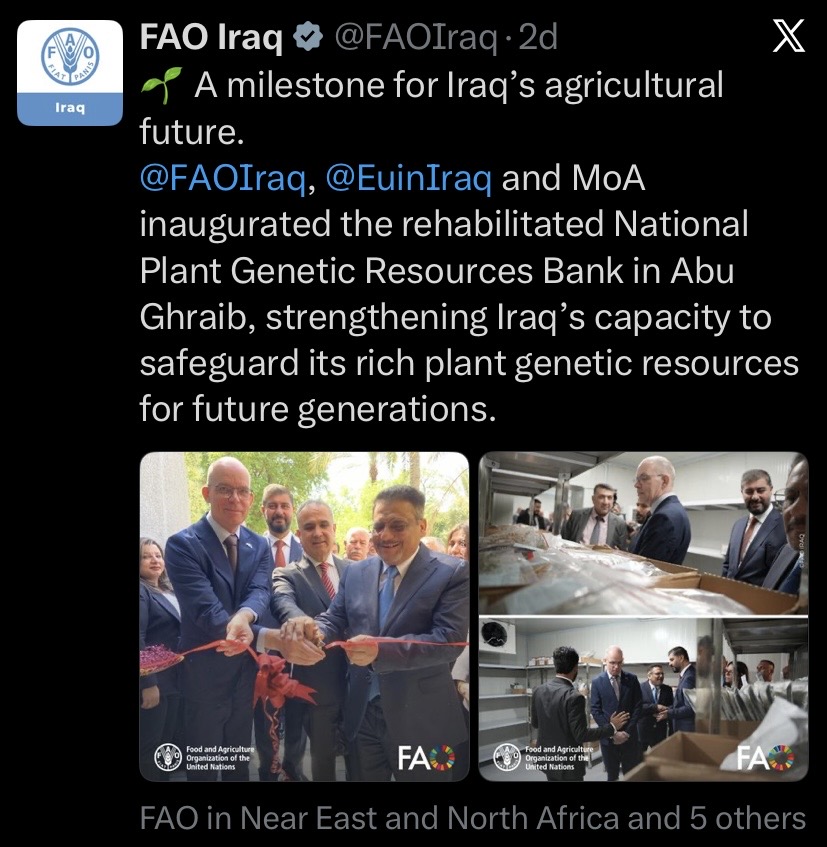
It goes together with one in Sulaymaniyah that was opened a few weeks back.
Until now, Iraq’s only conservation facility was the National Gene/Seed Bank in Abu Ghraib, established in 1977, which required rehabilitation to meet modern conservation standards for its collection of around 3,500 accessions. No comparable facility existed in the Kurdistan Region, despite being home to more than 70 percent of Iraq’s plant genetic resources.
The project therefore combined the rehabilitation of the National Seed Bank in Baghdad with the construction of a new Gene/Seed Bank in Sulaymaniyah, creating complementary facilities that together strengthen Iraq’s national capacity to conserve and sustainably use its invaluable plant genetic resources.
Nibbles: Pasiega cow, Goat-cow, Badri cow, Zimbabwe festival, Heirloom apples, South Korea genebank, Marmottier, Radiation breeding
- Cantabria is putting the Pasiega cow in the bank. Just in case.
- Spain’s “goat-cows” are fighting wildfires the old-fashioned way: by eating the fuel. I hope they’re in the bank too.
- India has made a Badri calf in a lab. Conservation meets IVF.
- Old apples are having a revival. Turns out forgotten apple varieties can taste pretty good. Well I never, is it that time of year already?
- Zimbabwe’s Mbire district celebrates seed, food and culture with a festival. What, no cows? Or apples?
- South Korea is looking for partners to save climate-resilient plants. A seed vault is better with friends.
- The marmottier can’t decide whether it’s a plum or an apricot. Botanists sympathise.
- In the atomic age, gardeners irradiated seeds and waited for something interesting to grow. Sometimes it did.