- Medieval monastery gardens deconstructed.
- Burbank’s plums decoded.
- The wild tomatoes of the Galapagos evaluated.
- Germplasm exchange expedited.
- Public sector plant breeding advocated.
- Farmer-saved seeds saved?
- Svalbard Global Seed Vault celebrated.
- Local flour milled.
- Potato chips (crisps) invented.
- Indigenous trees taken seriously. Very seriously.
Brainfood: Genebanks genomics, Improving forages, 3000 rices, Sweet potato dispersal, Diversity on farm double, Herbaria double, Phenotyping box, Invasives, Meta-meta-analysis, Rice domestication, Soil depth
- Role of genomics in promoting the utilization of plant genetic resources in genebanks. Genebanks don’t need to do genomics themselves to benefit from genomics.
- Improving the Yield and Nutritional Quality of Forage Crops. Case in point.
- Genomic variation in 3,010 diverse accessions of Asian cultivated rice. Case in point. Multiple independent domestications. Tomorrow, the world.
- Sweet potato dispersal or human transport? Maybe no evidence one way or another after all. Rebuttal of: Reconciling Conflicting Phylogenies in the Origin of Sweet Potato and Dispersal to Polynesia. And the counter to the rebuttal. This genomics stuff not so easy after all.
- Review: Meta-analysis of the association between production diversity, diets, and nutrition in smallholder farm households. It’s not always there. But that would have been a high bar.
- Agricultural diversification as an important strategy for achieving food security in Africa. Case in point. More diverse households and farming systems are more food secure, but only up to a point, and it depends on various factors. 43% of African cropland will be difficult to diversify.
- Using herbaria to study global environmental change. Have been used to monitor the effects of climate change, habitat change, pollution and invasives on plants.
- Green Digitization: Online Botanical Collections Data Answering Real‐World Questions. Gotta get the stuff digitized first though.
- The ‘PhenoBox’, a flexible, automated, open‐source plant phenotyping solution. Somebody mention digitizing?
- Dissecting the null model for biological invasions: A meta-analysis of the propagule pressure effect. The success of aliens is down to their numbers. Wonder if it works for pest and disease organisms too.
- Are systematic reviews and meta-analyses still useful research? We are not sure. All righty then. Scrap the above.
- Shattering or not shattering: that is the question in domestication of rice (Oryza sativa L.). From one of the authors, Debarati Chakraborty: Loss of shattering through sh4 is not a crucial step for rice domestication. Genetics, cultural anthropology and archaeology suggests that primitive agrarians were dependent on wild or semi-domesticated shattering rice.
- Rooting for food security in Sub-Saharan Africa. Sub-Saharan Africa probably hasn’t the rootable soil depth for monster maize yields.
Nibbles: Garlic history, Collecting, GMO course, Rice genebank, Mango diversity, Chilli diversity, Virtual plant breeding, Navel orange, LA tree, Cotton sustainability, Saudi agritourism
- Trying to promote a “poor person’s crop”? Try the garlic trick, ennobling.
- A Reference Manual for Expedition Plant Collectors, courtesy of the The Arnold Arboretum.
- Cornell runs a MOOC on GMOs. How about one on genebanks, eh?
- Maharashtra could maybe use it.
- You can never have too many mangoes.
- Or dried chillies.
- Next generation plant breeding.
- Riverside protects its famous citrus tree.
- But not all famous California trees are so lucky.
- Making cotton sustainable. Hard row to hoe.
- Saudi farm tourism. Even harder.
A Nibble big enough to choke on
Yeah, yeah, it’s been quiet here for the best part of a month. Work, you know. When you notice lack of action here, though, that doesn’t mean that I’m being completely idle. Not always, anyway. Check on Twitter and Facebook, if you dare, and you’ll see new stuff on a fairly regular basis, because that’s easier to do than a fully-fledged blog post. Anyway, what I’ll do here is a mega-Nibble hoovering up snippets from the past few weeks that I posted on social media but not here.
- Vegetable History 101.
- If you have a heirloom of one of the above to name, try this neural network approach.
- Just as long as the name doesn’t end up being racist.
- It’s too late for some German veggies. Though not, it seems, for German forests. What’s the difference?
- Not yet too late for Tanzanian wild veggies, but winter is coming. Maybe giving them cool names would help.
- And for some North American indigenous crops too, thanks to some committed people.
- And for beans in Mexico for that matter.
- Why all the above is important.
- And urgent.
- And this is the resulting problem if you ignore that lesson.
- You see, the Australians are on the case, with their bush tucker fixation.
- Mind you, it’s not all sweetness and light: the quinoa bubble bursts.
- Maybe we can make a game of this diversification lark. Oh, look, it seems we can.
- You can even breed for it.
- Wherein I pontificate about genebank data. Again.
- Maybe these guys will listen?
- These guys obviously did, and built a better peanut.
- Yeah, but can you see them from space?
- The cost of ending hunger. The cost of ensuring crop diversity conservation in genebanks seems, well, peanuts.
- The archaeology of gardens. Two of my favourite topics, combined. If only there was beer too. And peanuts.
- A banana is a banana is a banana. Not.
- All those bananas? You can help to map them.
- They’ll put them on Google Earth next, like Kew did for these beautiful natural areas, with all their crop wild relatives :)
- A Japanese agricultural encyclopaedia. Illustrated to boot.
- Or, for the more Euro-centric, food art at the Met…
- This cheese should probably be at the Met there too.
- And this weed strain may well soon be on sale in the gift shop.
- The sweet potato made it to Oceania on its own.
- Oh no it didn’t.
- On the other hand, livestock generally need to be accompanied.
- All the yeast belong China.
Lost rice found, again
First there was Carolina Gold. Now there is “upland red bearded” or “Moruga Hill” rice.
Mr. Dennis had heard about hill rice…through the culinary organization Slow Food USA and the Carolina Gold Rice Foundation, the group that brought back Carolina Gold in the early 2000s. He’d also heard stories about it from elderly cooks in his community. Like everyone else, he thought the hill rice of the African diaspora was lost forever.
But then, on a rainy morning in the Trinidad hills in December 2016, he walked past coconut trees and towering okra plants to the edge of a field with ripe stalks of rice, each grain covered in a reddish husk and sprouting spiky tufts.
“Here I am looking at this rice and I said: ‘Wow. Wait a minute. This is that rice that’s missing,’” he said.
It is hard to overstate how shocked the people who study rice were to learn that the long-lost American hill rice was alive and growing in the Caribbean. Horticulturists at the Smithsonian Institution want to grow it, rice geneticists at New York University are testing it and the United States Department of Agriculture is reviewing it. If all goes well, it may become a commercial crop in America, and a menu staple as diners develop a deeper appreciation for African-American food.
And no, they couldn’t have found it in genebanks. 1 This is what Genesys knows from the region. Trinidad is shown by the yellow marker, rice accessions in red. No rice accessions in Genesys from anywhere near Trinidad, alas.
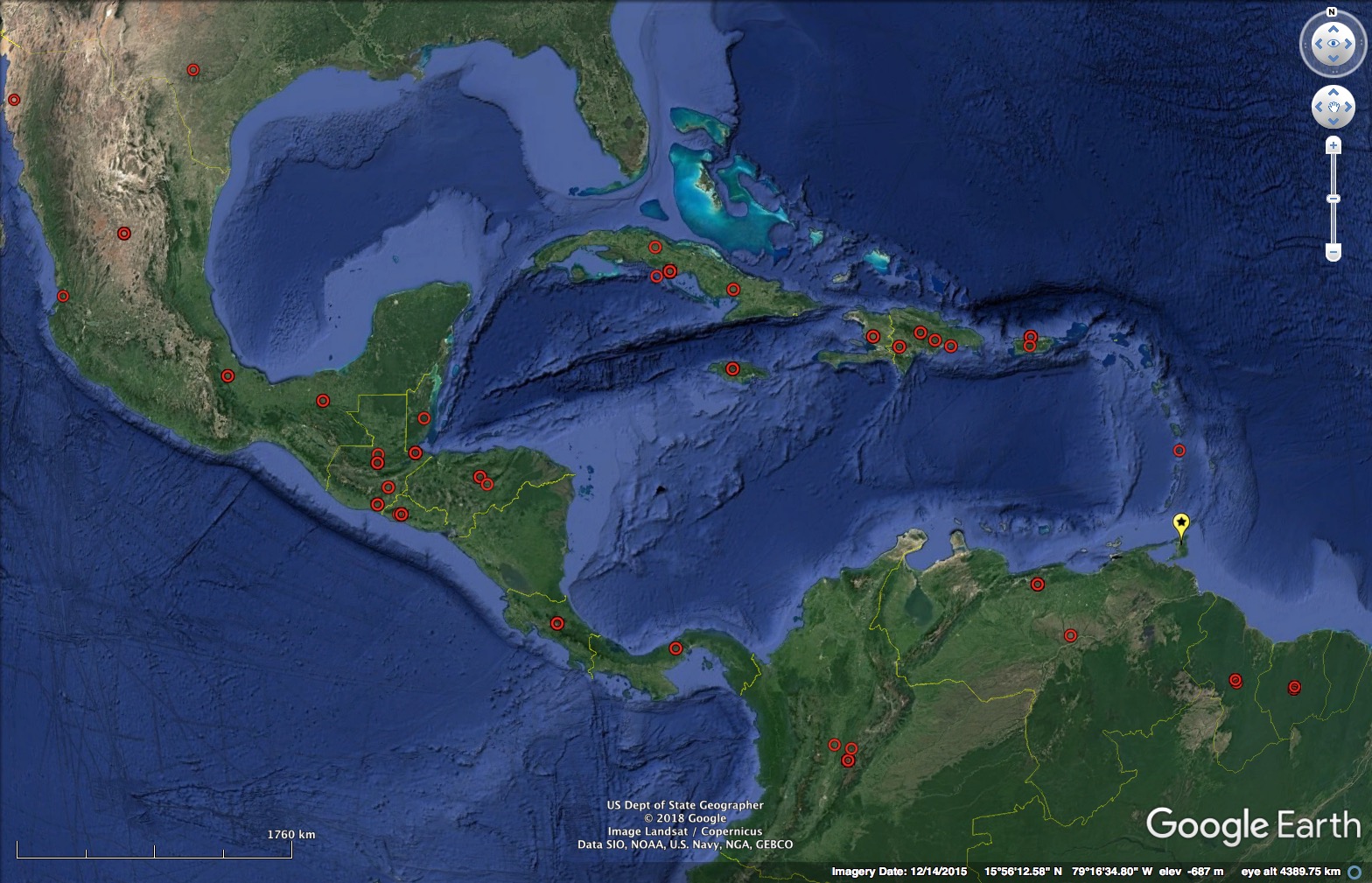
Someone should really have a systematic look at all those red dots, though.