- High-temperature stress during drying improves subsequent rice (Oryza sativa L.) seed longevity. Up to 45°C, because it triggers a stress protection mechanism.
- Agricultural diversification and dietary diversity: A feminist political ecology of the everyday experiences of landless and smallholder households in northern Ghana. Production diversity at the farm level is necessary for dietary diversity, but not sufficient.
- Critical review of the emerging research evidence on agricultural biodiversity, diet diversity, and nutritional status in low- and middle-income countries. Production diversity at the farm level has a small but consistent positive association with dietary diversity.
- Exploiting Genetic Diversity for Adaptation and Mitigation of Climate Change: A Case of Finger Millet in East Africa. Some varieties are good everywhere, others only good in some places.
- Ex situ conservation of plant diversity in the world’s botanic gardens. A third of all known plants, and half of endangered ones, are to be found in botanic gardens, but the tropics are under-represented.
- Prebreeding Using Wild Species for Genetic Enhancement of Grain Legumes at ICRISAT. It’s a drag, but someone has to do it.
- Wide crosses of durum wheat (Triticum durum Desf.) reveal good disease resistance, yield stability, and industrial quality across Mediterranean sites. Not such a drag after all.
- Quantifying airborne dispersal routes of pathogens over continents to safeguard global wheat supply. Incredibly fancy maths says Yemen is the key.
- Demographic history, selection and functional diversity of the canine genome. There’s a lot here, in particular the genes that were involved in early phenotypic differentiation from wolves, and evidence of continuous geneflow with wilds canids. But the thing that really got me is that humans and dogs show parallel evolution in the ability to process complex carbohydrates, associated with agriculture.
- Probabilistic viability calculations for cryopreserving vegetatively propagated collections in genebanks. One Excel spreadsheet to rule all cryo.
- Biodiversity effects in the wild are common and as strong as key drivers of productivity. Meta-analysis of observations in nature supports results of experimental work.
- Biodiversity promotes primary productivity and growing season lengthening at the landscape scale. “…a large species pool is important for adaption to climate change.” An example of the above.
- Considering connections between Hollywood and biodiversity conservation. Conservationists need to get out more.
Agricultural biodiversity wades into the mainstream at long last
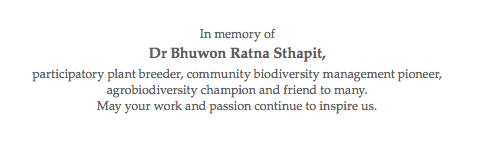
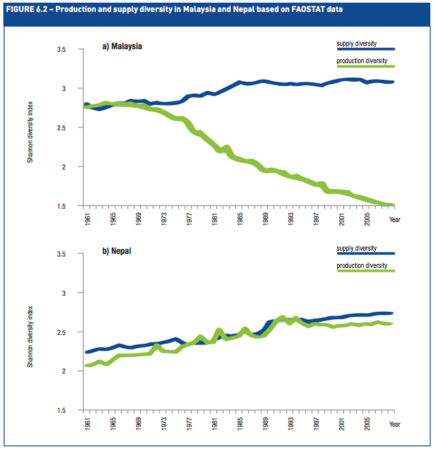
I really haven’t done sufficient justice to the new book from Bioversity, Mainstreaming Agrobiodiversity in Sustainable Food Systems: Scientific Foundations for an Agrobiodiversity Index, whose moving dedication I reproduce above. It’s a great review of the diverse reasons why agricultural diversity is important to us. But also of the complexities involved in translating diversity in farmers’ fields, let alone in genebanks, into development outcomes like better nutrition, as clearly shown by the diagram below.
Nibbles: Agrobiodiversity Index, PPB, Heirloom rice, CATIE genebank, Faberge potato, Val @CePaCT, Nigerian food, Ethnobotanical book, Hope Jahren quote
- Bioversity DG lobbies for the Agrobiodiversity Index.
- One of her staff lobbies for participatory plant breeding. And he’s not the only one.
- Maybe they could tackle Indian rice next?
- Protecting cacao at CATIE.
- Faberge had a potato, of all things, and it’s a beaut.
- Celebrating Valerie Tuia, until recently genebank manager at SPC. Faberge taro, anyone?
- The Nigeria food database includes taro, but only leaves.
- The Digital atlas of traditional agricultural practices and food processing weighs 10kg, but seems a stone-cold Faberge-level masterpiece. Not sure if it has much on taro, though.
- “Every replete tree was first a seed that waited.”
Nibbles: Millets galore, Human diversity & ag, Super farmers, Extinction is forever, Indian nutrition maps, Future Food competition, Banana viruses, Cassava in Brazil & Africa, Sugar book, Fairchild & Irma, Vegetable ROI, Embrapa beans, Certified coffee, Legal pot, Native American foods
- Today’s new genome is pearl millet. The most climate-smart of crops? Now, to process it more easily.
- Finger millet is not too bad either.
- Agriculture was good for human diversity, at least in Papua New Guinea. Elsewhere, maybe not so much.
- Julio Hancco Mamani grows 400 potato varieties up in the Andes (but how did it all start?). And Rahibai Soma Popere “15 varieties of rice, nine varieties of pigeon pea and sixty varieties of vegetables, besides many oil seeds” in Maharashtra.
- “West Bengal government encourages cultivation of extinct rice varieties.” Wait, what?
- Presumably not extinct like silphium.
- India’s first nutrition atlas will maybe tells us where more Rahibai Soma Poperes are most needed.
- Future Food includes seeds.
- Cleaning up bananas.
- Would love to have been on the “Brazilian Cassava Learning Journey.” Tanzania next?
- The bitter side of sugar.
- Fairchild Tropical Botanic Garden damaged by Irma.
- Research on vegetables really pays off, vegetable researchers say.
- Brazilian bean catalog launched.
- Certifying coffee seeds.
- Pot next?
- Closely followed by Navajo tea.
Brainfood: Eggplant germplasm, CC threat, Impact metrics, Drought & seeds, Burundi cattle, Wild chickpea, Banana collecting, Bambara groundnut diversity, CIP cryo, USA PGR policy, Australian forages, ILRI seed testing, Nepal intensification, Maize and CC
- World Vegetable Center Eggplant Collection: Origin, Composition, Seed Dissemination and Utilization in Breeding. 3,200 accessions from 90 countries, covering all 3 cultivated species, but not enough wild relatives.
- An integrated framework to identify wildlife populations under threat from climate change. Need to know about landscape connectivity, and genomic data would be useful too.
- Research impact: a narrative review. There are lots of methods, and the indirect ones are sometimes the best.
- Orthodox seeds and resurrection plants: two of a kind? Resurrection plants have reactivated the ancient seed drought tolerance program in vegetative tissues.
- Effect of genetic European taurine ancestry on milk yield of Ankole-Holstein crossbred dairy cattle in mixed smallholders system of Burundi highlands. European ancestry good for milk yield.
- First insights into the biochemical and molecular response to cold stress in Cicer microphyllum, a crop wild relative of chickpea (Cicer arietinum). High altitude Himalayan species found to have frost tolerance.
- Banana Collecting Mission in the Autonomous Region Of Bougainville (AROB), Papua New Guinea. 13 days, 61 accessions. Hard work.
- Morphological Characterisation of Selected African Accessions of Bambara Groundnut (Vigna subterranea (L.) Verdc.). 3 out of 300 out of 1973 have high yield potential. Hard work.
- A large-scale viability assessment of the potato cryobank at the International Potato Center (CIP). They’re getting better at it. Hard work.
- Deep Seeded Problems: A Look At Seed Bank Regulations. The USA should engage internationally on crop diversity conservation. Hard work.
- Australian Pastures Genebank – Temperate Species Regeneration. Hard work.
- Medium-term seed storage of 50 genera of forage legumes and evidence-based genebank monitoring intervals. Hard seeds are hard work.
- Agricultural Land Use Intensity and Determinants in Different Agroecological Regions in Central Nepal Himalaya. Location, location, location.
- Maize Diversity and Climate Change. To investigate the local adaptation of landraces, which you need for adaptation to climate change, you need the synergy that comes from genomics and phenomics in coordinated fashion.