- What the Pacific islands need to do about climate change. What, nothing about conserving and using crop diversity? My friends at CePaCT will be pissed.
- What West African farmers are doing about climate change.
- Yeah, I guess it’s not always and only about crop diversity. But would it kill them to mention it?
- And if you’re interested where the Pacific (and West Africa, and everywhere else) gets its food from…
- Peruvian black mint is a thing. But not a relative of coriander.
- Yaupon is also a thing. Though it won’t go far with that scientific name.
- Recreating a Renaissance herb garden. Because we can. Where’s the Peruvian black mint, though?
- Eat rare breeds to conserve them. Not rare advice.
- No wall can keep out landrace maize.
- Ethiopian beer gets a boost.
Brainfood: Agricultural heritage, Unique maize, B4N, Flax core evaluation, Oca conservation, Ag expansion, Rose wild relative, Quinoa evaluation, Nepal seed systems, Amazonian domestication, Analysing germplasm data
- Agricultural Heritage Systems: A Bridge between Urban and Rural Development. “…agricultural heritage systems can take full advantage of abundant funds…” Really?
- Multi cob-bearing popcorn (Puakzo) maize: a unique landrace of Mizoram, North East, India. Would be nice to know how unique globally.
- Enabled or disabled: Is the environment right for using biodiversity to improve nutrition? Maybe, in some places.
- Orbitide Composition of Flax Core Collection (FCC). In other news, Canada has a flax core collection.
- Farmer Perspectives on OCA (Oxalis tuberosa; Oxalidaceae) Diversity Conservation: Values and Threats. It’s the cultural value, stupid. And weevils.
- The expansion of modern agriculture and global biodiversity decline: an integrated assessment. Fancy maths shows that if you assume that unabated agricultural expansion is bad in a particular way, you can come up with a model which spares land at a modest cost to per capita consumption, given decent investment in research.
- Nuclear genetic variation of Rosa odorata var. gigantea (Rosaceae): population structure and conservation implications. Wild relative of domesticated rose shows lots of diversity and two distinct populations either side of a fault zone in China.
- Worldwide Evaluation of Quinoa: Preliminary Results from Post International Year of Quinoa FAO Projects in 9 Countries. 19 sites, 21 genotypes, a few winners. But the real story is how difficult it was to get hold of the material in the first place.
- Shaping Seed Regulation in Nepal: The Role of Networks, Community and Informality. The formal needs to recognize the informal. And vice versa.
- Crop domestication in the upper Madeira River basin. Nice, brief review of evidence of domestication for a number of crops along one branch of the Amazon.
- Analysing genebank collections using “R”: Making trait information widely available to users. NordGen takes genebank data analysis to the masses. And about time too.
Pomegranate symbolism through the ages
Those of you that remember us agonizing about the minutae of agrobiodiversity iconography, to the extent of wondering if this
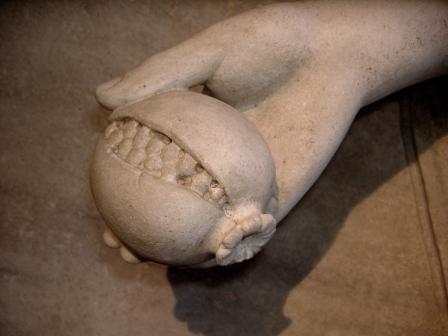
was indeed what it seemed to be, will rejoice with us that, with regards to pomegranates at least, we seem to have found the motherlode.

LATER: And then some.
LATER STILL: And then some more.
Brainfood: Yam protection, Gleditsia distribution, Seed systems, Conservation narratives, Roselle diversity, Hassawi extinction, Apple GWAS, Dog domestication
- Disease risk perception and diversity of management strategies by farmers: The case of anthracnose caused by Colletotrichum gloeosporioides on water yams (Dioscorea alata) in Guadeloupe. Farmers gauge the disease pretty much the way scientists do, and use a diversity of mitigation measures, including diversity.
- Ghosts of Cultivation Past – Native American Dispersal Legacy Persists in Tree Distribution. “In the southern Appalachian region, honey locust distributions are more a reflection of Native American cultural practices.”
- Good year, bad year: changing strategies, changing networks? A two-year study on seed acquisition in northern Cameroon. In bad years, women call on extended networks.
- Conservation narratives in Peru: envisioning biodiversity in sustainable development. In terms of the relationship between conservation and development, there are biodiversity protectionists, traditionalists, localists, pragmatists, and capitalists.
- Diversity analysis based on agro-morphological traits and microsatellite based markers in global germplasm collections of roselle (Hibiscus sabdariffa L.). Nicely complementary datasets show that fibre type more diverse than calyx type.
- Extinction probabilities of Hassawi cattle from Saudi Arabia using Population Viability Analysis. Fancy maths gives it 20 years.
- Genome to Phenome Mapping in Apple Using Historical Data. Going back to old phenotype data in GRIN allowed identification of SNPs for color, fruit firmness, and harvest time.
- Genomic and archaeological evidence suggest a dual origin of domestic dogs. Independent domestications from different wolf populations in East Asia and in Western Europe, with the latter partially displacing the former.
With our own award
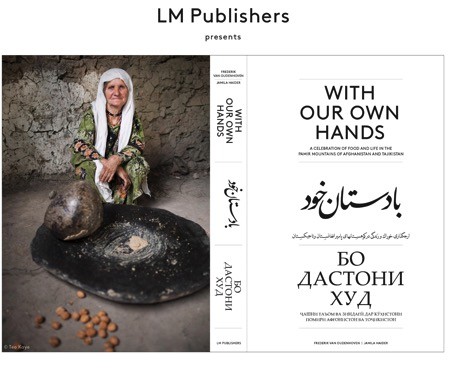
You remember this book, right? We enthused about it over a year ago when it first came out.
An old friend, Frederik van Oudenhoven, and his friend and colleague Jamila Haider, are deep in the proofs of what looks to be a wonderful book. With Our Own Hands “tells, for the first time, the cultural and agricultural history of the Afghan and Tajik Pamirs, one of the world’s least known and most isolated civilisations”. Should be a great read, with stunning photographs to accompany the local recipes, essays, stories and poetry. Better yet, generous donors are allowing 1800 copies to travel back to the Pamirs to be given to communities, schools, cooks and libraries.
Well, Fred and Jamila have now won the 2016 Gourmand World Cookbook Award, the Oscars of the cookbook world. You can see photos on the book’s Facebook page. And all without mentioning superfoods. Congratulations!
And by the way, you can listen to Fred talk about the book with Jeremy on Eat This Podcast.