- Fishing in the gene pool, a presentation from that Eucarpia meeting.
- The Maine Law Review publishes a whole bunch of papers on food systems in the US and elsewhere.
- While Ensia publishes just one: food rethought.
- Conservation Magazine points to a nifty idea from Australia: Fluker posts. Citizen science for monitoring landscape change. Can we get some agricultural ones?
- Speaking of citizens: new book on farmers’ rights.
- Indians told to eat their (native) vegetables.
Nibbles: Indigenous conservation, Rice and conservation, Amazon medicines, Organic products, Sustainable oysters, Cherfas at Seed Savers, Calestous Juma, Cassava website, Israeli agritech, Fragaria breeding, Catacol whitebeam, Weather sensors, FAO Commission & Conference, Amartya Sen
- A toolkit to help indigenous communities do conservation. Should they need one.
- On the other hand… Half of Japan’s endangered species hotspots are found in satoyama, which are under pressure. Compare and contrast with rice farming in Thailand.
- Learn all about some medicinal plants of the Amazon, minus their scientific names. Not including runa tea. Lots of other opportunities out there, though.
- Maybe even including oysters.
- Jeremy no doubt to feast on the mollusc after spilling the beans on the EU seed regulations at the Seed Savers jamboree.
- Wonder what Calestous Juma thinks of those regulations.
- But I bet he (and his father, who introduced the crop to his region of Kenya) would like this cassava website to rule them all.
- The Volcani Institute‘s gifts to the world…
- …probably include new strawberries, but not this one.
- Scientists straining, failing to find plant to meaningfully compare to the giant panda.
- Bioversity does up its iButtons.
- And gets a namecheck in a paean to the FAO Commission on GRFA on its 30th birthday. All this FAO stuff is because its Conference is on this week. I don’t suppose any of it will be more important than Amartya Sen’s speech.
Nibbles: Tree domestication, Sacred groves, Solomons aquaculture, Bees and diversity
- Cultivate medicinal trees to save them. Oh, and provide medicines.
- Or you could harvest them sustainably from sacred forests?
- Reef fished out? Aquaculture to the rescue. Sounds a bit like the aquatic equivalent of the above, no? But do they have sea cucumbers and their poop in those inland ponds?
- Growing diverse crops good for bees, good for crops. Buckwheat diverse enough for ya?
Nibbles: Pretty, Peak soil, Wine history, Ancient foodways, Offal, Durian, Exotic plant foods, Cassava, Mozzarella, Nutrition report, Superfoods
- Jules Pretty meditates on the impermanence of things.
- Like soil. And bumblebees.
- Ah, well, let’s not get maudlin. Pass the bottle. Well looky here. The French got wine from the Italians. I feel better already.
- And Canadians had clam gardens a thousand years ago. Probably still do, actually.
- Along with offal, no doubt. Which did not, however, seem to play any role in a recent Mesolithic dinner. Though French wine did. Which is weird.
- The best fruit in the world gets the Kew treatment.
- And is included in a weird list of the 100 weirdest food plants.
- Cassava‘s pretty weird too.
- The best cheese in the world is not French either.
- All of which foods no doubt feature in FAO’s new report on nutrition. Which is really important, so don’t let the flippancy fool ya. The Lancet agrees. And you can do your bit too.
- Ah, but does quinoa feature in that FAO report? The backlash continues…
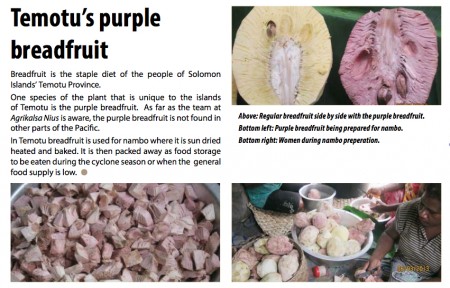
The purple breadfruit of Tamotu
I really hope the Ministry of Agriculture and Livestock of the Solomon Islands won’t mind me reproducing this snippet on a cool breadfruit variety from the province of Temotu, courtesy of the April issue of their monthly electronic newsletter, Agrikalsa Nius. 1