- Cool infographics on food, trade and, well, a particular sort of trade. And how to make your own.
- Soil would be a cool place to start.
- The bananas of your grandchildren and the carrots of your grandparents. Plus a funny peculiar idea about how to keep seed of such stuff for 50 years.
- Which you don’t need to do anyway because “[r]eplacing traditional seeds with commercial varieties is not an official government policy,” at least in South Africa. Unlike in the EU, I guess. Oooooh, did I just say that? Such a naughty muppet.
- Ok, let me make up for that with some thoughts on breeding for the sorts of places where those traditional seeds might be found, in Africa and in Europe.
- Of course, in such places, you have to know your aphids. Before they go and eat a bacteria and change their DNA. Tricky to breed for resistance to that, I would guess.
- Oh, but here are also the views of someone in Europe who would rather not have anything to do with traditional seeds and their accompanying aphids at all. Why can’t we just get along?
- Why, for example, can we all not get to love mboga za watu wa Pwani. You heard me. And no, residing far from the Swahili Coast is no excuse. Jeremy unavailable for comment.
- He did, however, point out that “[t]he value of male prostitutes exceeds that of farmlands.” Yep, Robigalia time again.
- Meanwhile, not far from the Swahili Coast, some people are thinking that man does not live by mboga alone… No, he must have nyama too.
- And speaking of which: giving sausages a name. On this, I am with Bismarck. No such porky nonsense from the French.
- “Nine thousand years of Mexican agriculture” online. And five hundred on the stove.
- Pollinating date palms just got a whole lot easier. And no, this doesn’t have anything to do with any of the other nibbles, but I thought it was cool.
Nibbles: Plant data, Wild relatives, Citizen science, Danish pig breed, Fruit names, Genebanks big and small, Taxonomy, Seaweed, Weather data, IPR training, Caribbean & Pacific, Potato research at Birmingham, Taro training in PNG, BioAreas
- Latest Plant Press has interesting stuff on botanical data of various forms. Always worth a skim.
- CSA pamphlet on the importance of crop wild relatives. Why does this feel like a bandwagon? And how long to the backlash?
- And talking of bandwagons, here’s the latest from the one on citizen botany. Does indigenous tree knowledge count as citizen science? How about indigenous weed knowledge?
- And how about using your pet pig to reinvigorate a breed?
- Interesting take on fruit variety names. Can we crowdsource an answer?
- Everything about the opening of that new Mexican mega-genebank. Including the speeches. Nice-looking building, I must say. And from IRRI an example of a genebank from the other end of the scale in the Philippines. And similar, but different, from
CanadaColorado. - Biodiversity bigshots beg for naming blitz. Better hurry. And don’t forget the soil.
- Sargasso Sea coming ashore in Ghana is bad news for fisherfolk. Can they not eat it? Is it bad to ask that?
- How to find your way around weather data.
- Swedes to provide IPR training for PGR types.
- Island nations from opposite sides of the world brought together by agrobiodiversity. Full disclosure: I’ve worked with both regional PGR networks and want to again.
- Brits who worked on spuds.
- And Wontoks who worked on taro.
- Privatizing conservation.
Brainfood: Pollinator threats, Predicting drought tolerance, Markets and conservation, Groundnut oil composition diversity, European wheat landraces, Dung beetles, Livelihoods, Phenology
- Impact of landscape alteration and invasions on pollinators: a meta-analysis. Habitat alteration and invasions equally bad on visitation rates, invasive animals more bad than invasive plants, and disturbance of the matrix more than fragment size. But there are some differences among vegetation types.
- The determinants of leaf turgor loss point and prediction of drought tolerance of species and biomes: a global meta-analysis. Osmotic potential at full turgor could be used to predict drought tolerance across species. Cut a long story short, that simplifies down to salty cell sap, give or take. Good for choosing crop wild relatives to use in breeding for drought tolerance?
- Market-based instruments for biodiversity and ecosystem services: A lexicon. If you want to tell your tradable permits from your reverse auctions. And really, who doesn’t?
- Phenotypic and molecular dissection of ICRISAT mini core collection of peanut (Arachis hypogaea L.) for high oleic acid. Much diversity in oleic acid (O) to low linoleic acid (L) ratio found. Breeders alerted.
- Phenotypic diversity and evolution of farmer varieties of bread wheat on organic farms in Europe. There wasn’t much of it, over 3 years.
- A Comparison of Dung Beetle (Coleoptera: Scarabaeidae) Attraction to Native and Exotic Mammal Dung. They really know their shit.
- Small-scale farming in semi-arid areas: Livelihood dynamics between 1997 and 2010 in Laikipia, Kenya. Life continues to be a bitch, there’s no other way to say it. But when will the people who measure livelihoods measure the diversity of people’s assets as well as their size?
- Climate-associated phenological advances in bee pollinators and bee-pollinated plants. About 10 days over the past 130 years, most of the change since 1970, and bee plants keeping pace with bees.
Nibbles: All singing and dancing, FAO meets Big Data, Clone this, Patent nonsense, Frozen fish
- Fisherfolk of the Amazon landed on film. But do they sing about it? (And it’s not just an Amazon thing, this dancing and singing about agrobiodiversity. Not by any means.) And should they be doing more slashing-and-burning?
- FAO to put all its data in one basket. But including AnGR? WIEWS? One asks more in hope than expectation.
- One of the many challenges of vegetatively propagated crops (like potatoes): rapid multiplication. (Well, they could always do an SNP-based tetraploid map of the damn things, couldn’t they.) No such problems with seeds, of course.
- There’s been a rapid increase in the patenting of adaptation-related traits, and the private sector in industrialized countries is mainly responsible. Well there’s a surprise. But was that discussed at the CCAFS meeting on breeding objectives for Africa? And it’s just as well to remember that it’s not just breeding that’s needed. Oh, but by the way, you better grab those adaptations while you can…
- Regional SE Asian fish genebank proposed. That I’d love to see. Maybe they could share germplasm with, I dunno, Chicago? And not just.
Multidisciplinary taro book on the way
The National Museum of Ethnology in Osaka has just announced the publication of what promises to be a fascinating book on taro:
M. Spriggs, D. Addison and P. J. Matthews (eds) (2012) Irrigated Taro (Colocasia esculenta) in the Indo-Pacific: Biological, Social and Historical Perspectives (Senri Ethnological Studies 78). Osaka: National Museum of Ethnology. 363 pp., with index.
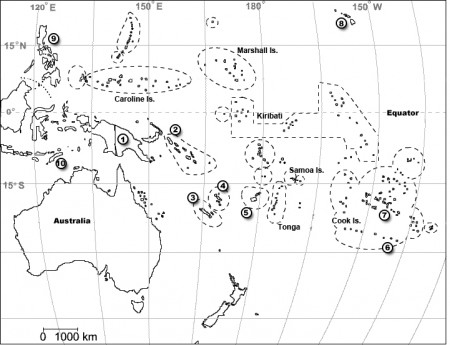
According to one of the authors, “[t]his map from the preface shows main geographical coverage (areas 1 – 10) of the volume (there is also some extension to China and mainland SE Asia).”
All the chapters will soon be available on the Museum’s website, so keep a lookout.