- Qataris work out how to sex date palms.
- The National Heirloom Exposition revs its engine.
- World Camel Day is coming up. No, really.
- Latin Americans planning their next congress on the biodiversity of domestic animals. Cuy, anyone?
- The Art of Coconut Craft. Wonderfully kitschy.
- So, you want to breed Alocasia, do you?
- Sweden stops oppressing its main minority.
- High Nature Value farming in Serbia.
- Non-wood forest products are all very well, but…
- Yes, yes, Feidherbia will solve all the problems of the Sahel, now can I go back to sleep?
The 8th annual Great Lakes Indigenous Farming Conference passes us by
…Caroline [Chartrand] and about 100 other indigenous farmers and gardeners—along with students and community members—gathered in March on the White Earth reservation in Northern Minnesota to share knowledge, stories, and, of course, seeds.
Don’t know how we missed this from yes! magazine a couple of weeks back. In particular as one of the stories was about Pawnee corn, a topic we have covered here a number of times.
Brainfood: Cabbages, Crops in Darfur, Sowing dates, People and biodiversity, Honeybees, Rhizobium, Figs, Urban ag, Wild olives, Ancient textiles, Ducks, Wheat introgression, Food citizenship, Crop models, Trifolium, Variety choice
- Genetic diversity of Brassica oleracea var. capitata gene bank accessions assessed by AFLP. Czech genebank; subgroups reflected place of origin.
- Optimizing the cropping mix in North Darfur State, Sudan. A study of Umkdada district. “…the results of the model were different from the real practices of the farmers.” Oh dear. To improve the fit, schoolboys should work in the fields more. And crops should fetch more. The dismal science indeed.
- Climate-driven simulation of global crop sowing dates. Ok, this model works. You can predict sowing dates under rainfed conditions for various annual crops from climatic conditions. Not entirely sure why you would want to, though.
- Exploring some of the myths of land use change: Can rural to urban migration drive declines in biodiversity? Yes, counter-intuitively, at least in the forests of Mexico’s southwestern highlands. More from Conservation Magazine.
- Pollination services in the UK: How important are honeybees? Quite a bit, but maybe not as much as previously thought. It’s the wild bees, stupid!
- Genetic diversity and symbiotic effectiveness of rhizobia isolated from root nodules of Phaseolus vulgaris L. grown in soils of Iran. It is high, and it varies, respectively.
- Interspecific hybridization of fig (Ficus carica L.) and Ficus erecta Thunb., a source of Ceratocystis canker resistance. It’s a breakthrough!
- Exploring the diversity of urban and peri-urban agricultural systems in Sudano-Sahelian West Africa: An attempt towards a regional typology. There are 6 types. Not 5; not 7. On this one, the journey is more interesting than the destination.
- Variability of wild olives (Olea europaea subsp. europaea var. sylvestris) analyzed by agro-morphological traits and SSR markers. There’s a lot of variabzzzzzzzzzz…
- Hemp in ancient rope and fabric from the Christmas Cave in Israel: Talmudic background and DNA sequence identification. Mainly flax, but some hemp, from both Roman and Chalcolithic periods. But can you smoke it?
- Modelling the distribution of domestic ducks in Monsoon Asia. Low resolution data, plus fancy modelling, can be used to get pretty good high resolution predictions.
- Gene flow between wheat and wild relatives: empirical evidence from Aegilops geniculata, Ae. neglecta and Ae. triuncialis. It happens, a lot.
- Toward food system sustainability through school food system change: Think&EatGreen@School and the making of a community-university research alliance. Food citizenship?
- Simulation of winter wheat yield and its variability in different climates of Europe: A comparison of eight crop growth models. Big differences among models, so best thing to do is to use the mean of all of them.
- The potential of plant viruses to promote genotypic diversity via genotype × environment interactions. The negative effect of White Clover Mosaic Virus (WCMV) infection on performance differs from white clover genotype to genotypes, which means differential selection, which means negative frequency-dependent selection in host populations, which means diversity. Via.
- Amplifying the benefits of agroecology by using the right cultivars. Why should we summarize, when an author has already done so?
Nibbles: Genebank, Sweet wheat, Participatory Research, Land “grab”, Yampah, Vegetables, Tea, Chilling, Rainforest products, Asses, Climate proofing, Natural products
- A look inside the big USDA genebank at Fort Collins. Whatever next?
- Sweet wheat. Whatever next?
- Farmers must participate in agricultural research in Europe. Whatever next?
- “Come and farm our virgin lands, Ethiopia tells India.” Whatever.
- “You may already know that yampah (Perideridia gairdneri) is a North American umbellifer.” Er, no. Tell me more.
- After cloves, vegetables? Zanzibar’s farmers increase productivity.
- More news for Luigi’s MIL: Future Climate Scenarios for Kenya’s Tea Growing Areas.
- Is this the end of trail mix?
- Body Shop uses wins award for using Cameroonian rainforest honey and wax from CIFOR-supported beekeeping project.
- Fancy a glass of ass’s milk? Totally SFW.
- Everybody is climate-proofing crops.
- The BBC looks at medicinal plants.
What is and is not going to happen with antimalarial trees
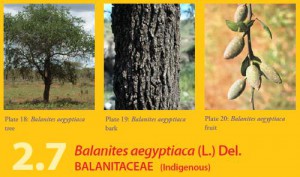 ICRAF’s project and publication on trees with antimalarial properties has made it into the prestigious medical journal The Lancet. Kudos indeed.
 UnLike that article, fortunately, the ICRAF publication is not behind a paywall. The project has been much in the news, and rightly so, but at least one report is inaccurate in suggesting that ICRAF are planning a major effort on ex situ conservation of antimalarial trees. This is how The Star entitled its article when the book was launched: “ICRAF starts trees gene bank project in Nairobi.” And this was their lede:
A project to document genetic properties of more than 3,000 forest trees across the continent has started in Nairobi.
In fact, ICRAF already has a genebank, of about 200 species, and there are no plans to either expand that to 3000 species or specifically focus on collecting antimalarials in the future. According to our sources, The Star correspondent may simply have conflated the malaria book project with the results of a recent meeting at ICRAF on the State of the World’s Forest Genetic Resources.
LATER: My sincere apologies to The Lancet. That paper is NOT behind a paywall. You just need to register. Which takes a bit of time and effort but does not involve the exchange of currency. Sorry!