- Identification of zucchini varieties in commercial food products by DNA typing. You can trace zucchini varieties in food products despite various kinds of processing.
- Anaerobic microorganisms in astrobiological analogue environments: from field site to culture collection. Practicing to collect genetic resources on Mars.
- Genetic diversity and population structure in the narrow endemic Chinese walnut Juglans hopeiensis Hu: implications for conservation. It’s in trouble.
- Do traditional sheep breeders perform conscious selection? An example from a participatory breeding program of Morada Nova sheep. Breeders of purebreds use different criteria to those of crossbreds.
- Characterization of common bean wild populations for their in situ conservation in Northwestern Argentina. Some populations should be conserved because they’re pure wild, the rest because they’re not pure wild.
- Quality Management System for Research Biobanks: a Tool to Incentivize Public-Private Partnerships. ISO developing a QMS specifically for biobanks. Full text in Google Books.
- Cryopreservation of fruit germplasm. Elements of a strategy for Germany.
- Implications of Seed Policies for On-Farm Agro-Biodiversity in Ethiopia and Uganda. 117 provisions in 21 national seed policies in coded for implications for availability and accessibility of improved, quality-controlled and genetically diverse local seed in both the formal and informal seed systems. Ok, now what?
- Measuring the financial sustainability of vine landraces for better conservation programmes of Mediterranean agro-biodiversity. Landraces are not worth it, because of low yields.
- Traditional People, Collectors of Diversity. ‘Nuff said.
- Changes in human skull morphology across the agricultural transition are consistent with softer diets in preindustrial farming groups. Cheese changed your skull shape.
Nibbles: Jumping genes, Lebanese winemaking, Ag data, Ag & soil C, Citrus routes, Breeding peas, Heritage cattle
- Pinning down transposable elements across the whole maize genome.
- Wine and weed in Lebanon. Not as mellow as it sounds.
- Yields and Land Use in Agriculture: The Website.
- The effect of all those yields times 12,000 years on C sequestration is about as much as that of deforestation.
- Ancient Roman 1% responsible for introducing the citron and lemon to the Mediterranean.
- Flowering duration and pod numbers are they keys to heat tolerance in peas.
- 94% of US dairy cows are Holsteins. How boring is that?
Nibbles: Genomic taxonomy, AI taxonomy, Apple history, Polo on sago, Quinoa cooking, Super-crap, Funding conservation, Coffee conservation
- Boffins sequence plant in field for real-time identification.
- Boffins decide machines do identification better.
- Boffins trace apple domestication to Silk Road.
- Famous Silk Road traveller on sago.
- Thinking up fun ways of cooking another pretty tasteless staple.
- Did someone mention super-foodszzzzzzz.
- Mongabay: Africa needs creative conservation funding approaches.
- Emily Garthwaite: Hold my latte.
When do people search for coconut?
Or any other food, for that matter, at least in the US. Well, now there’s The Rhythm of Food for all the answers, in nice visualizations to boot.
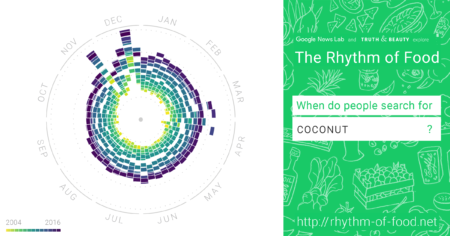
And if anyone knows why Americans do more searching for coconut during the winter holidays, and then again in spring, do tell us.
Brainfood: Temperate maize, Pre-Neolithic Revolution, Social media, European maize
- Genomic estimation of complex traits reveals ancient maize adaptation to temperate North America. “The diversity needed for high altitudes was there, but getting it in the right combination took 2,000 years,” says ancient maize DNA.
- The deep human prehistory of global tropical forests and its relevance for modern conservation. There were “garden cities” in the tropical forests of equatorial Africa, South Asia, and Southeast Asia starting 45,000 years ago.
- An Introduction to Social Media for Scientists. Choose wisely.
- Is there an optimum level of diversity in utilization of genetic resources? It depends.