- Grow what the market wants, African veggie growers told.
- Develop the markets for what you grow, Vietnamese farmers told.
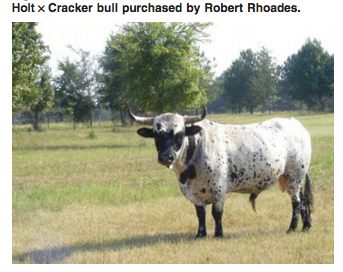
- You need diverse animal breeds to graze on diverse landscapes shock.
- Why, then, are pastoralists abandoning pastoralism?
- The Micronutrient Forum is being revived with a gabfest in Addis, 2-6 June. Be still my beating heart.
- They’re obviously not going to be too worried about scurvy.
- It’s cannabis, Jim, but not as we know it. Hemp Is Coming Back As A Farm Crop. Oh yeah it is.
- Whatever, I just hope the seed goes to Svalbard.
A tale of two CGIAR centres’ media presence
It’s a bit of a cheat, but bear with me for a minute and have a look at a couple of quotes from recent articles in the mainstream media. The first one is from the NY Times. Don’t look at the original piece until you’ve read both quotes:
Drought-resistant X is now providing a better livelihood for some 20 million people. The organization aims to double that reach by the end of next year. The drought-tolerant varieties do as well as or better than traditional X when the rains are good, and when they are bad they will save a farmer from ruin.
And here’s something which came out in The Guardian the day before the previous piece:
The … drought-tolerant varieties developed by Y require a high amount of input of chemical fertiliser and pesticides that are not affordable by the majority of poor farmers. Methods like … organic farming are attractive because they are available and affordable and give a better net income.
Just your normal, fundamental disagreement about what works, and what doesn’t, in agricultural development? Well, maybe. But X in the first quote is CIMMYT’s maize in Africa, and Y in the second quote is IRRI’s rice in the Philippines, so there could be other things at work too. Maize is not rice. Africa is not Asia. And, just maybe, CIMMYT’s media relations are not IRRI’s.
That last possibility only really came to mind because of another recent piece, this one from USAID’s Frontlines newletter:
In partnership with international research institutes and with support from USAID, the Bangladesh Rice Research Institute developed flood- and saline-tolerant varieties of rice that produce higher yields. Rice plants grown using these improved seeds can survive between 12 and 14 days when completely submerged underwater, compared with traditional rice varieties that can only endure three or four days of submersion. For the most vulnerable country in the world to cyclones and sixth-most prone to flooding, these appear to be the perfect seeds to plant.
Now, when I read that, I assumed that one of those “international research institutes” must be IRRI, but that is not specified anywhere in the article. Discrete enquiries with people who should know revealed that IRRI’s Stress-Tolerant Rice for Africa and South Asia (STRASA) team was indeed closely involved in this work. STRASA has contributed directly to the release of 7 salt-tolerant varieties in Bangladesh and 4 submergence tolerant varieties (BR11-Sub1, Swarna-Sub1, Ciherang-Sub1 and IR64-Sub1), with additional breeding lines combining both traits in the pipeline.
Why would USAID not mention that? Why is IRRI’s message not getting across?
Nibbles: Borlaug, Wheat history, Plant breeding, Nepali tomato
- The Borlaug 100 conference programme now has links to many of the presentations.
- Including a link to Rachel Laudan’s history of Wheat: the grain at the center of civilization.
- Oh boy. A new edition of FAO’s Plant Breeding & Genetics Newdsletter.
- Video on “Reviving Nepal with hybrid tomatoes“. So many questions, so few answers.
Brainfood: By-the-numbers Indian edition, with a touch of Bangladesh
- SGDB: A Sugarcane Germplasm Database. Cool, but only 131 accessions? One would have thought there’d be more.
- Essential Oil Composition of Bothriochloa bladhii (Retz.) S.T. Blake: An Introduction from Tropical Region of Western Ghats of India. It’s a widespread neotropical grass. There are about 200 accessions in the world’s genebanks. I wonder if this lot will end up there too.
- Conservation of agricultural biodiversity – an experience in the Chotonagpur plateau region. By the Indian Statistical Institute, Giridih. 40 horsegrams collected, among other things. Does NBPGR know? Is there a database?
- Genome Classification of Musa cultivars from Northeast India as Revealed by ITS and IRAP Markers. 36 out of 38 cultivars had been correctly identified on morphology. Relationship to the national banana collection unclear.
- Correlation and Path Coefficient Analysis of Quantitative Characters in Spine Gourd (Momordica dioica Roxb.). Now we know what to select for. 50 accessions used.
- Population structure and genetic diversity analysis of Indian and exotic rice (Oryza sativa L.) accessions using SSR markers. Microsat study of 82 Asian genotypes, including some from India, identifies a few markers of use in breeding. Wheel successfully re-invented.
- Livelihood and Revenue: Role of rattans among Mongoloid tribes and settlers of Andaman and Nicobar Islands, India. Sources of food, building materials and money (via export trade), but only if harvesting is sustainable, which it doesn’t look like it is. Need a plan, including better silviculture and rotational harvesting. Oh, and get rid of the middlemen.
- Bioprospecting, biopiracy and food security in India: The emerging sides of neoliberalism. All of the above are potential neoliberal stooges.
- Comparative karyomorphological studies of three edible locally important species of Allium from India. A chive is not a chive is not a chive. But it’s hard work to tell them apart.
- Crop diversification, crop and energy productivity under raised and sunken beds: results from a seven-year study in a high rainfall organic production system. Rotations including vegetables all round better than rice monocropping. Nothing neoliberal about that. But who does nothing but rice monocropping? I guess these guys could tell you…
Nibbles: Rice intensification, Community genebank, Biodiversity & poverty, Borlaug, Deconstructing recipes, Biofortification conference, IPCC, Kenyan agricultural changes, Collecting wild chickpeas, African peanuts, Insurance for herders, Old fields, Millet fairs & diseases, GDP and malnutrition, Yeast evolution
- From SRI to SARI. Rice has never had it so good.
- Look there’s even a guy in Orisha who grows 920 varieties.
- Biodiversity conservation and poverty reduction: Unproven. Doesn’t sound like they looked at agricultural biodiversity though.
- Contrary take on the Borlaug legacy.
- From Map Your Recipe to Compare Your Recipe. h/t Rachel Laudan.
- Follow that biofortification conference in Kigali. Maybe they’ll talk about recipes.
- Guardian Environment blogger breaks down the agricultural bits of the IPCC report for you. Lots of that going around.
- No conceivable reason for growing jatropha in Kenya. One of those times when you wonder whether anyone had predicted this would happen at the time.
- So does anyone know now whether switching from coffee to banana might be a bad idea in the long run? This is your chance.
- Wild chickpea to the rescue.
- The ups and downs of groundnut research in Africa.
- Islamic insurance for herders. Demand, meet supply.
- Celtic fields can still be seen, if you know what to look for.
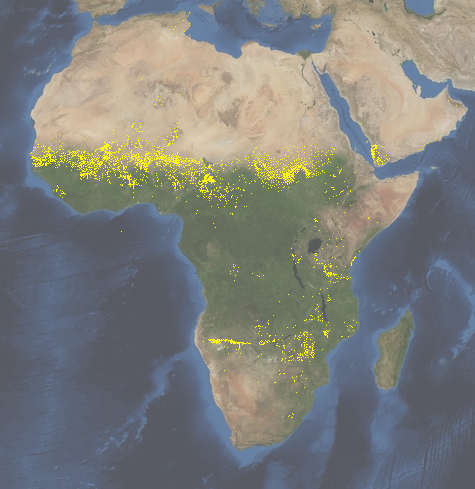
- Seed fair in Senegal exchanges pearl millet. Could usefully do the same in Namibia, it looks like.
- Does economic growth help in reducing child malnutrition? It depends on whether you plot % malnutrition against GDP per capita or annual change of the first against annual change in the latter.
- The complicated story of yeast, unravelled.