- Farming cobia off Panama. Look it up.
- Gene editing is the future. But is it GM?
- More on the CIMMYT genebank from the Australian press. Get a room already.
- Fancy machine can tell fancy Yemeni coffee from lesser stuff. No, not DNA. Producers of lesser stuff unavailable for comment.
- Some of them may end up being photographed by National Geographic though.
- Before being forced off their land.
- Different sort of land grab in the Gran Chaco. Pity those poor wild Arachis. And here’s a meta-analysis of the drivers of the problem.
- Feeling left out, herders get fancy photos too.
- “The data indicates a broad distribution of this clone from Spain to Russia and Scotland to Cypress.” Good grief. Potato blight, if you’re still interested.
- From household survey data to food security assessment: The software.
- The bubbleberry is increasingly a thing.
South Pacific genebank overture
Can’t resist posting this video from my old colleagues at SPC. It ends a bit abruptly, but Centre for Pacific Crops and Trees, and a nice overview of its work.
LATER: This is the full version of the video, without that weird abrupt ending. Some problem with the uploading, apparently.
Nibbles: New plant journal, Randomized trials under fire, WB to the rescue, Spirit in the sky, Please sir may I have some more, Flour powerless, Tom Payneless, Collecting for CIP, Regen redux, Cultivating my garden, Animal Crackers, Ethnomycology
- Nature has new Plants journal. With blog.
- More from the randomized trials backlash frontlines.
- World Bank sets up internal task force on climate smart agriculture. Oh good.
- No word on whether spiritual values on agenda.
- Hacking the school lunch.
- Indian flour mills winding down. Implications for crop diversity unknown.
- Big Australian writeup of CIMMYT genebank.
- Big CIP writeup of CIP genebank. And other collections, to be fair.
- It’s the regeneration, stupid.
- Gardens save plants.
- Sustainable diets defined to within an inch of their lives. Common factor is less animal products. But, as Susan McMillan of ILRI points out, for whom, and where?
- Traditional Maori use of weird fungus.
Protecting apple images
I really like this diagram of the family tree of the Jazz apple, A New Zealand-bred favourite.
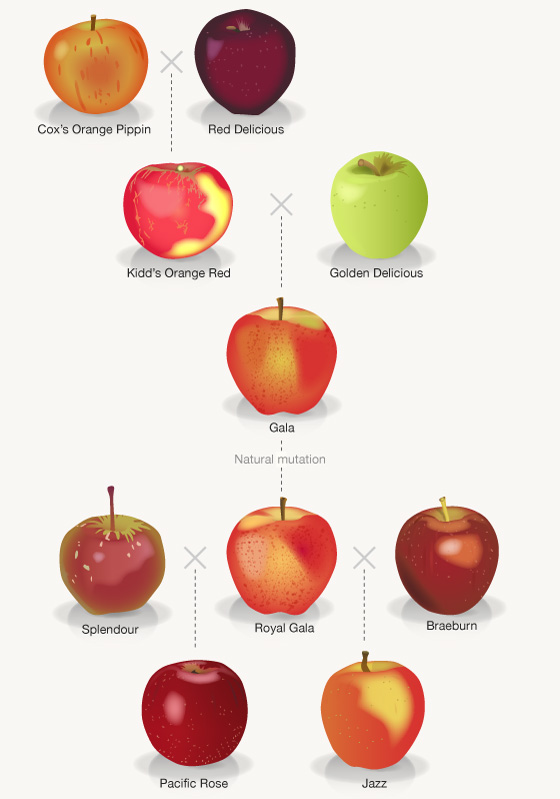
Problem is, I may be breaking some sort of law reproducing it here. The website where I found it, Te Ara, or the Encyclopedia of New Zealand, says, at the bottom of each page, that:
All text licensed under the Creative Commons Attribution-NonCommercial 3.0 New Zealand Licence unless otherwise stated. Commercial re-use may be allowed on request. All non-text content is subject to specific conditions. © Crown Copyright.
Well, I don’t really want to use the text, certainly not commercially, so that means specific conditions apply. What might they they?
This item has been provided for private study purposes (such as school projects, family and local history research) and any published reproduction (print or electronic) may infringe copyright law. It is the responsibility of the user of any material to obtain clearance from the copyright holder.
It also gives an indication of how to cite the item, which I am happy to do: Ross Galbreath. ‘Agricultural and horticultural research — Advances in plant science’, Te Ara — the Encyclopedia of New Zealand, updated 14-Nov-12 URL.
I left comments on the item on two occasions, asking for permission to use the image. No reply. I then emailed the general address provided on the About page. No reply. So, having waited a decent interval, I’m going for it. Let’s see what happens. I hope someone wanting permission to use the apple for breeding purposes finds it more straightforward than accessing the image in which it features.
Historical crop videos online
Alerted by a tweet from Pat Heslop-Harrison, I delved into British Pathé’s new Youtube archive of 85,000 historical films. The following little gem turned up when I searched for wheat.
I shared it with my go-to guy on wheat genetic resources, and he had this to say:
Multi-branched spikes have been investigated by a number of researchers (including Cal Qualset from whom we have germplasm he developed). It’s interesting to see farmers harvesting a variety with the trait. It seems an obvious way to increase yield (make the wheat spike into a sorghum-like inflorescence) but results have not been as encouraging as the morphology suggests.
Have fun searching for your favourite crops.