- Panama comes to SE Asia. Banana people will understand. And will know what to do?
- Shucks, just missed the N2Africa project first phase results presentation shindig in Nairobi. All about the power and beauty of nitrogen-fixing legumes (geddit?). Jeremy wont let me link to the piece about the project that recently appeared on a well-known site, and he’s right, it’s largely content free. And you can find it if you really want to anyway.
- Climate change? Not a problem, for some plants (including wild relatives?), if there’s trees around. Well, kinda sorta. But it made you look, didn’t it? Are any of them on CITES? Consult the new handy dandy online thingy.
- Ah, but tell that to Abu Waleed and other Jordanian farmers.
- Who are the answer to etc Group’s question: Who will feed us?
- A botanical use for online gaming. Whatever next.
- Celebrating Alfred Wallace via animated video. And why not.
- You want more videos? Here’s a nice explanation of the difference between winter and spring wheat.
- Huge rice genetics meet is apparently a “hot bed of discussion”. For another couple of days. Let us know if you are party to any of that.
- No doubt the same could have been said about the recent 12th International Symposium of the International Society for Tropical Root Crops in Accra.
- Zambian families are better off nutritionally if they grow hybrid maize.
- A handy English translation of an all-consuming post about quinoa in Spanish. And check the photo of quinoa diversity!
- Gary Nabhan explains why “more biodiversity means more food security“.
- Israel’s wild boars are European. I’m biting right through my tongue here.
An agroforestry database to rule them all
During my recent visit to Nairobi, the reason for my lack of blogging during the past couple of weeks, I briefly ran into Dr Roeland Kindt, one of the people behind the various ICRAF databases I have occasionally written about here. And guess what? He warned me there’d be another ICRAF database coming out imminently. Of course, by now the Agroforestry Species Switchboard 1.0 has been announced all over the place and my scoop has evaporated. Anyway, no matter, better late than never. I haven’t had a chance to go into the Switchboard in detail, but hope to very soon, and will blog about it when I do. It certainly sounds useful. Here’s what Roeland had to say about it in the ICRAF press release:
Before the Switchboard, you had to search for a particular species one database at a time. But now, multiple databases that list information on a particular species can be accessed in one go. Because listings of species in databases only partially overlap, it is common to find little or no information on a particular species in one database, but plenty of it in a second or third database. So it makes sense to query multiple trusted sources of data on one web interface.
It sure does. Maybe this will spell the end of factsheets?
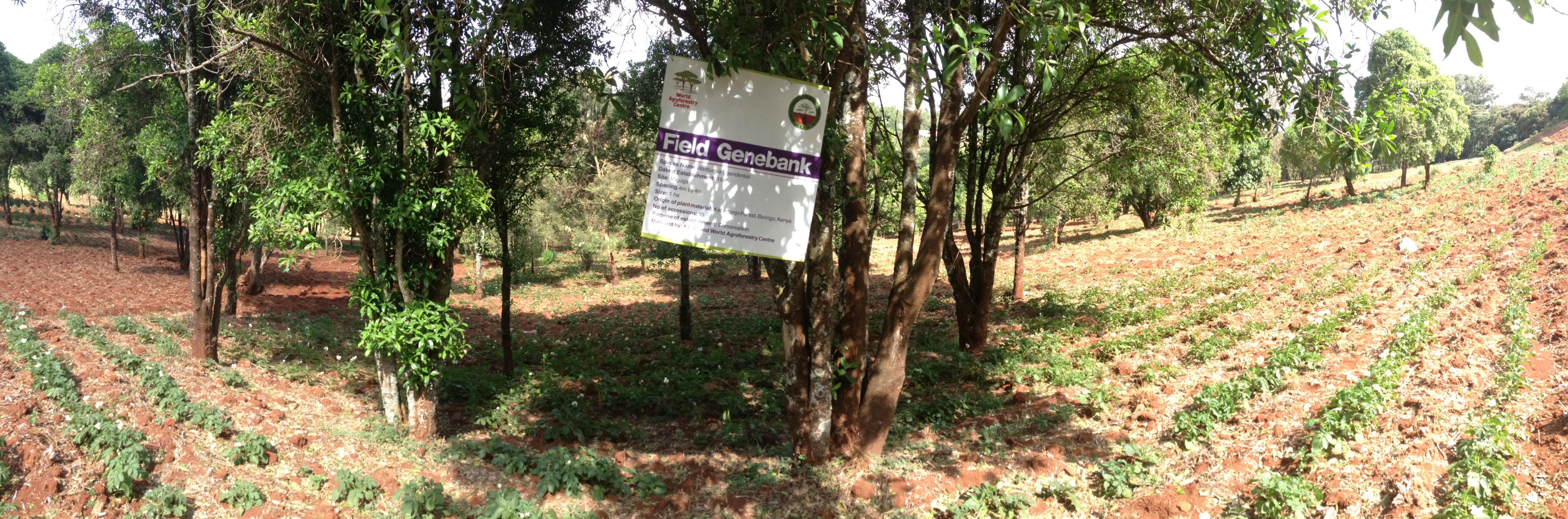
Oh, and that’s a totally gratuitous panorama shot of ICRAF’s Warburgia field genebank at Muguga, Kenya. Well, not so gratuitous maybe. Because it allows me to say that if the Switchboard had permalinks to search results, such as for things like Warburgia, I would have been able to link to them, which would have been cool(er).
Nibbles: Soil testing kit, Sustainable farming, Coffee and climate change, BGI genebank, Bamboo genebank, Genebank management, India’s malnutrition, Phenotyping conference, CIP genebank video, CG impact, Feed the World
Luigi went on a three-week trip, and all he came back with was this:
- A new soil testing kit? Really?
- Ok, how about a SciDev Spotlight featurette on sustainable farming? No? Well, can I tempt you with the British Ecological Society on agroecology then?
- Oh, I bet this thing on coffee and climate change will hit home.
- I’m pretty sure news of yet another Chinese genebank (of sorts) won’t.
- Pssst. Got room for a new bamboo genebank too?
- They’ll need a genebank management system, won’t they? GRIN and bear it.
- News too of hunger and malnutrition in India, by Indians, for … er …
- Phenotyping conference, anyone? Anyone at all? Some EU breeders will no doubt be there. And some of them at least will find a new map of water risk useful in their work.
- And to end with, Al Jazeera on the CIP potato genebank. You heard me.
- As you were, there’s the CGIAR Knowledge Day too, all about delivery and impact. I wonder if the genebanks will feature…
- Not so fast, there’s also a live webcast of the conference Feeding the World without Consuming the Planet that awaits you.
Nibbles: Book, Sorghum, Plant breeding, Quinoa, Herbal medicines, Compensation, New varieties, Beers
Here’s a bunch of better-late-than-never links, some of which will be good this time next year.
- A new book on Plant Genetic Resources and Climate Change.
- I expect it covers sorghum, which NPR calls the “camel of crops”.
- Wonder whether they’ll cover sorghum at the Tucson Plant Breeding Institute course in January 2014. h/t Crops for the Future.
- Last week’s International Congress on Quinoa. Pretty sure our invitation got lost in the mail.
- As was our invitation to Kew’s one-day symposium on herbal medicines and food supplements.
- Annals of Botany explains how compensation may underly the benefits of genetic diversity – in Arabidopsis. (And thanks for the shout-out.)
- ICRISAT struts its stuff in Nigeria with new varieties of groundnut and millet. As ever, we ask: who’s looking after the old varieties?
- Diverse beers for Halloween – one to cut out and keep.
Seed Savers (online) Exchange
Having given pickacarrot.com a brief Nibble, I feel duty bound to report at greater length on the new online exchange of Seed Savers Exchange. The arrival of the SSE Yearbook, with its hundreds of pages of densely printed listings, heralds, for many, a winter of wondering, speculating, dreaming and, occasionally, frustration. It lists all the varieties offered by members of SSE, from whom you request seed directly. If you are after lots of different seeds, from lots of different members, that means lots of different requests.
The online exchange, while probably not as comfortable to curl up with in front of a fire (I haven’t tried it on a tablet computer) is equally enticing and a lot easier to use. At least, I think it is. In the old days, you actually had to write to someone asking for seed, and if you were doing so from outside the US, as I was, you had to find International Reply Coupons and all that stuff. The online exchange has a wishlist to which you can add your requests, so to test it I thought I’d look for Cherokee Purple, a tomato I’ve grown successfully in the past and that might amuse my Italian neighbours.
I found it easily enough, and then had to choose a member to ask for it. I decided on Neil Lockhart, in Illinois, for no good reason. Then I pressed the button to complete my order, and nothing happened. I’m not sure how I’m supposed to pay the $3 handling fee (plus, I hope, a little more to account for additional postage to me), or what happens next. Perhaps that’s because the online exchange is still in beta test. Perhaps nothing is supposed to happen. Of course, had I read all the details in advance, I would have learned that the online exchange is actually just streamlining the process of requesting seeds, by sending an automatic email from me to Neil. Now it is up to us mutually to sort out delivery and payment. It also streamlines the whole business of listing seeds members may have to offer, which is probably going to be very helpful too.
All in all, SSE’s online exchange has, I think, enormous potential. One of the most interesting and diverting aspects is the Seed Stories, which give a glimpse into the personal histories behind some of the varieties, and to which SSE is adding all the time. The online exchange has some glitches still to be ironed out, and I’m sure they will be. There might even be ways in which it could be improved but that would take inordinate amounts of human time. For now, though, especially if you are in the US, it seems like a wonderful gateway to a wealth of agricultural biodiversity.
Of course, you do have to be a member of SSE, but that’s no bad thing.