- On farm conservation; Bioversity is really good at it. (And I sometimes make a linking mistake; mea maxima culpa.)
- Economics of plant genetic resource management for adaptation to climate change. What’s the bottom line? No idea.
- Something else Bioversity is really good at: newsletters.
- Using GIS to help communities map vegetable production and marketing in Bangkok. I like the acronym: V-GIS.
- The variety of non-chile peppers.
- Older fruits better. Quentin Crisp unavailable for comment.
Nibbles: Farmer Assisted Natural Regeneration, Fungal apocalypse, Fertilizer platitudes, Sahel Restoration, Forest Restoration, Innovation, Phosphate bioavailability, Katniss, Ecoagriculture, Intensification
- Bunch of presentations from ICRAF’s #BeatingFamine shindig in Nairobi online.
- Humungous fungus threat.
- Fertilizers good for yields. Say what?
- A study on land restoration in Burkina Faso. Just in time.
- Speaking of restoration, chocolate can restore tropical forests. Universal panacea, obviously.
- Farming First welcomes the World Bank’s guide to investing in agricultural innovation systems. Buy low, sell high?
- A Cisgenic Approach for Improving the Bioavailability of Phosphate in the Barley Grain. That’ll please the folks who are scared of transgenics.
- I’ve missed out on the whole Hunger Games thing, but I have grown Katniss. I called it wapato.
- Israel’s Ministry of Agriculture creates a Department of Ecoagriculture. Sign of the times?
- New dossier from Spore, on sustainable intensification. No time to digest it yet.
A glass vial of beans is worth a thousand database entries
Check out one of the illustrations in Brainpicking’s review of a recent book on the Academy of Natural Sciences of Philadelphia (“which stands today as the oldest natural history museum in the Western Hemisphere,” and just celebrated its 200th anniversary). It’s the one labelled “Agricultural seed samples collected by Charles F. Kuenne, 1948,” towards the bottom of the page. I’m trying to find out who Mr Kuenne was. Or is. He’s not mentioned in GRIN, alas. But what I wanted to talk about was the sort of glass jars that he — and many others — used to store and display his seeds.
I always thought they were pretty useless, as you can virtually guarantee that the seeds will be dead in short order stored like that. Of course keeping them alive was not the point, and you can now extract DNA from much worse samples. But the fact of the matter is it that during last week’s trip to the CIAT genebank I saw bean breeders look at the assembled ranks of little grain-filled vials on display there so longingly, and lovingly, I cannot but revise my opinion.
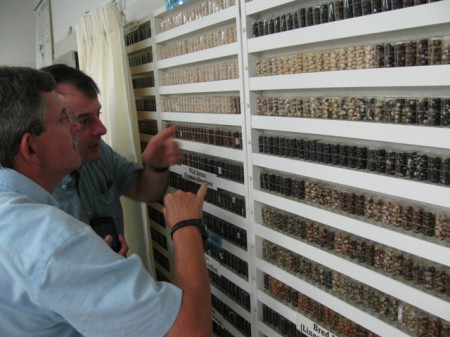
Who needs fancy databases when you can just run your eyes past thousands of different bean samples in a few seconds? Having said that, if you search the CIAT database you will find the varieties Red Valentine (G07707) and Rust Proof Golden Wax (G09523) collected by Kuenne — though not his actual samples, of course. They’re in Philadelphia.
Nibbles: Genomic data, Seed porn, Ancient Amazonian ag, Genebanks Down Under, Climate data porn, Fiber in Maine, REDD+ at the CBD, Colony Collapse Disorder, Chili porn, Seed systems
- GBIF makes its move.
- Homaging the seed.
- Learning sustainability from old Amazonian farmers. Really old. Really, really old.
- Yet another Aussie genebank. Or maybe the same one, I’ve lost track. And interest.
- Where climate data comes from.
- Maine’s fiber community, what, exposed? Unveiled? Uncovered? And similar from Bolivia.
- REDD+ will save us all.
- Don’t crack open the mead to celebrate the solution to colony collapse disorder just yet.
- All things Capsicum on one handy website.
- Whole bunch of policy briefs on African seed systems. Don’t know if I’ll ever have the time to read through the lot, but cursory perusal suggests the following bottom line: the market can’t do it all by itself.
Nibbles: Baby ginger, Livestock, Teaching, Organic seeds, Pawpaw, Citrus, Ethiopia
- Baby ginger, if you can offer tropical conditions and want to make money.
- ILRI beefs about the lack of interest in livestock in the run-up to Rio+20.
- Teachers! A resource! What Are Seed Gene Banks and How Do They Work?
- Farmer unthreatened by GMOs grows organic seed for others.
- Botanist documents flowers of (one kind of) pawpaw.
- Woman takes a trip down memory lane during visit to citrus field genebank.
- Ethiopians improve their food security with roots and tubers. Wot, no bananas?