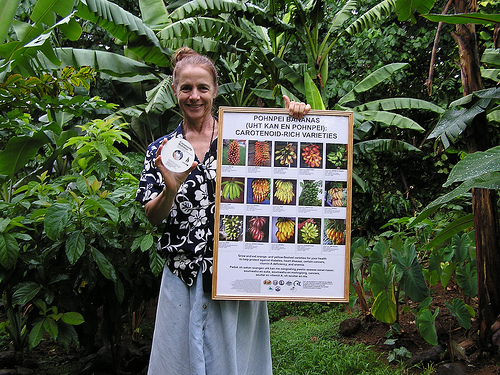
 We should have pointed out way before now that our friends at ProMusa have put together a wiki dedicated to Lois Englberger’s pioneering work. We’ve blogged about Lois on a number of occasions. She’s “a nutritionist and advocate of local food who changed the way people look at bananas, or at least their colour.” A great scientist and teacher. A passionate campaigner. And a friend.
Nibbles: Gardens, Food/nutrition jargon, Photos, Pacific livestock, Durian descriptors, Oysters, Thai breeders, Meat-reducing, Gender, Chinese fortification, G20
- Community veggie gardens in Cape Town.
- BNSP? WTF?
- AoB adds botanical picture search. Will nothing stop these guys? And meanwhile… Sheesh, is there something in the air today?
- How can Pacific livestock adapt to climate change? And don’t say they should learn to swim.
- How NOT to describe a durian.
- The continuously imminent demise of the Chesapeake Bay oyster.
- Plant breeders go on the rampage in Thailand.
- Hugh Fearnley-Whittingstall turns out not to be a made-up name. Pity.
- Kenya’s agriculture increasingly depends on women. MIL unavailable for comment.
- “…because our idea of “adding more” has shaped the way we treat micronutrient deficiencies through food fortification globally, trying to integrate this in China is turning out to be problematic.” I bet it is.
- Montpellier G20 meeting looking for “effective and innovative research partnerships for development and better impact of research from the Consultative Group on International Agricultural Research.” I hope they brought their pyjamas.
Nibbles: Mexican avocado prices, Marijuana in Central Asia, CWR in USA, Royal garden, Iraqi dates
- Mexicans can’t afford avocados.
- “Vostok — delo tonkoe, Petrukha!“
- New blog on crop wild relatives in the US, courtesy of our friend Colin.
- Royal villa has nice garden shock.
- “Three-quarters of date palm trees in Iraq right now … are of just one variety.”
Nibbles: Blé tendre, Colloquium, Kenyan veg, Sharing vs Sparing, Rice, Tomatillos, Walnuts
- Attention, francophones! Quels indicateurs pour suivre la diversité génétique des plantes cultivées? Le cas du blé tendre cultivé en France depuis un siècle.
- Et un colloque on how genetic resources respond to new environmental, economic and societal issues.
- Award for Kenyan vegetable enthusiast Prof. Mary Abukutsa.
- An in-depth look at land-sharing versus land sparing.
- “The age of the ‘mega-varieties’ [of rice] may be over.” Say it isn’t so, Joe!
- What to do with tomatillos, apart from salsa, that is.
- What to do with ancient walnuts, or rather, walnut tree forests. Save them, obviously.
Home of the potato


Home of the potato, a set by PRI’s The World on Flickr.
Today’s PRI piece on how an old potato is helping Andean farmers cope with climate change also points to some fun spud photos (see above) which are in fact all of potatoes, unlike in the recent NatGeo disaster. And to a great video of CIP Director General Pamela Anderson eating chips (crisps), which she really shouldn’t do because they’re not very healthy (the chips, not the potatoes), but what the hell.