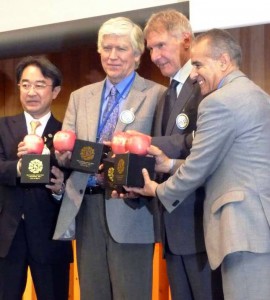
- German donor examines food and security, notes “the fast loss of biodiversity”.
- Food carts are successful oases in at least one food “desert”.
- Yesterday’s Botany Photo of the Day was American cotton.
- Good news, everyone: “Hardcore farmers prefer lowkey rituals.” Obviously the memo didn’t reach the children of the corn.
- Photosynthesis and climate change: it’s complicated.
- Native Americans try to reclaim control of their foodways. And their waists.
- “…every district should have a community-controlled seed centre with a gene bank for traditional seeds.” Of course it should. “The local available seed diversity needs to be protected and conserved at any cost.” Of course it must.
- “Right now, all over the world, projects are underway to store seeds…“
- Dark earths not just in Amazon, Africa too.
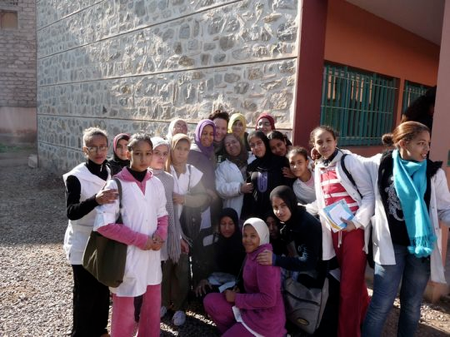
- Presentation on IFAD project on cultivating wild aromatic etc. species for money in Morocco.
Food and Security: diverse views agree
The timing on the E. coli outbreak in Europe is perfect: right on the heels of the "periphery" debt crises, you’ve got the same countries (Spain, etc.) squared off against the same "victims" (Germany foots the bailout bill disproportionally and now suffers disproportionally on this tainted food outbreak). Bottom line: you – Mr. Terrorist – have created tons of enmity, economic loss, and discombobulating fear. If I’m al Qaeda, I’m claiming this one on principle.
Thomas Barnett’s take on the ways in which food impacts our future security are disconcerting, interesting, scary, and in a warped way rather entertaining.
And then there’s this, from a commentary on the G8‘s recent meeting in Deauville:
[T]he world is now better able to feed itself. But the same economic stimuli that underpin higher food output also lead to supply problems, a decline in living standards, and massive social strains, especially in urban centers.
This is important to bear in mind, because rising food prices have historically been the trigger for political revolutions. The three revolutions that made the modern world, in France, Russia, and China, all had their immediate origins in food shortages, fear of hunger, and disputes about food pricing.
Luckily I know better than to quote ancient Chinese proverbs.
Will the real PI 198758 please stand up
An über-narrative that pulses at the heart of the “conservation for use” genetic resources body is the one about the accession that saved the planet. Some sample, preferably of an unprepossessing, weedy individual that otherwise wouldn’t merit more than a glance, turns out to have the gene that confers resistance to a disease, or boosts the content of something or other. Breeders, after a long search and an almighty struggle, transfer the gene into suitably modern varieties which are unleashed on a grateful world just in time to avoid certain disaster. It helps if the saviour sample can boast a biographical tidbit, such as saved by a nonagenarian grannie, or identified while the collector cast his eye about during a yak butter tea break in the Hindu Kush.
We’ve got a million of them, from Hessian flies to tomato solids to dwarfing genes to double-low canola to non-bitter cucumbers to [insert your favourite here].
And then there’s the one about nematode resistance in beets, mostly sugar beets, a new one on me. I was recently tasked to find out more about this particular story, with very little to go on beyond the taskmaster’s hazy memory of the standard über-narrative. A little inspired Googling led me to Pre-breeding for nematode resistance in beet, by W. Lange and Th. S.M. De Bock, who helpfully relate that:
Resistant plant materials originated from the annual accession PI 198758 of B. vulgaris subsp_ maritima, which had been collected in Le Pouliguen, Brittany, France.
Paydirt! And the inclusion of a PI number suggests that this came from the USDA’s genebank system, to which I hurried for more information. 1
However, and this is where it gets complicated, a search for PI 198758 at USDA’s GRIN says that it was collected by G. Coons, of the USDA Tobacco and Sugar Crops Research Branch, at Coimbra in Portugal some time between 1946 and 1951. (It is also not currently available, but that’s a separate story). But — more paydirt! — PI 198759, the very next accession, was indeed collected by Coons at Le Pouliguen in France.
Further Googling took me to the Sugarbeet Research Unit at Fort Collins, who were kind enough to answer my questions about which accession — 198758 or 198759 — should star in the narrative.
“In 1987 I received from IRS, Bergen op Zoom, 2 a packet of seed that was labelled Le Pouliguen Group 2, Pi 198758-59. I also tried to figure this number out and have concluded that its meaning is different from PI as used by GRIN. I think it was a code used by IRS meaning 1987 seed lots 58 and 59.”
Well, maybe … but that really does seem like way too much of a coincidence, that a sample harvested in The Netherlands in 1987, and that came from Le Pouliguen, or has an accession from Le Pouliguen in its pedigree, should happen to end up with the same number as one collected at Le Pouliguen between 1946 and 1951. I mean, it’s possible, but …
Something weird has happened along the way, I suspect. Other evidence from the beet breeders at Fort Collins suggests that Le Pouliguen is the correct location, because other accessions that showed partial resistance to nematodes came from the Loire estuary. Did Lange and De Bock make a mistake in their number? Did GRIN record the wrong collection location for PI 198758? Who knows?
And a final question: am I going to let any of this truth-seeking have any impact on my narrative?
No. But it sure was fun, and it isn’t often you get to say that about trips into GBDBH.
Not-so-close banana relatives found in Alaska shock
Welcome to all who landed here from Berry-go-Round, and thanks to Matt Goff for hosting the botanical carnival this month at Sitka Nature.
Nibbles: Royal genebank, Fish collection, Plant health, USDA wheat breeding project, Afghanistan, Breadfruit Art, Pests and Diseases, Idaho, Plant breeding, Gates, Panax quinquefolius, Natives
- Thai king has crop genebank on palace grounds.
- Fish in jars.
- Planning Plant Clinics.
- Plant Breeding for Drought Stress: The Project.
- Wait, the Nebraska National Guard has an agribusiness development team? Maybe they should talk to the people responsible for the previous bullet point?
- Kids! (And adults!) An Art Contest to celebrate ‘Ulu. Breadfruit, that is.
- Use of Agrobiodiversity for Pest and Disease Management. A slide show from Carlo Fadda at Bioversity.
- 3rd Annual Biodiversity Working for Farmers Tour in Idaho. 23rd June, you have been warned.
- Huge New York Times story on plant breeding and climate change.
- Bill Gates hails creativity for small farmers challenge.
- American ginseng: use it or lose it.
- Do you live in Ann Arbour? Do you want native plants for your garden? Yeah but how about American ginseng?