- Yemen saves local varieties, adapts local agriculture.
- Not all small livestock enterprises guarantee success. Beware.
- Hot new book: Chasing Chilies.
- Another list of really important questions. Answers? Can’t get the original, yet.
- New World Bank blog on impact assessment. Assess this.
- In the market for huckleberry market information?
- CocoaLink off the ground. Maybe not in Cote d’Ivoire yet, though, alas.
- PhilRice genebank in the Philnews.
To Serve and Conserve abstracts
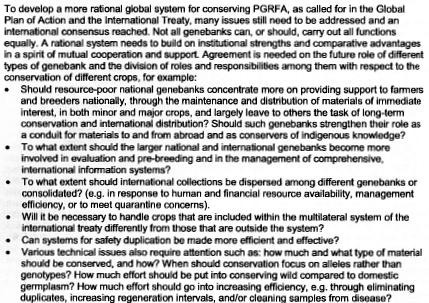
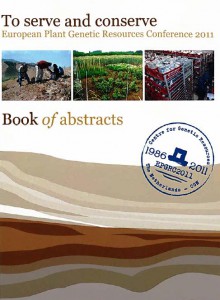 We’ve managed to get our sweaty little hands on the volume of abstracts 1 of the Eucarpia To Serve and Conserve conference, which has just ended in Wageningen. No time to digest the contents fully yet, but to stimulate your appetite, here’s part of the abstract of Geoff Hawtin’s paper, which asked: “Whither Genebanks?” Some provocative questions in there.
VIR’s Pavlovsk Research Station in the snow


VIR’s Pavlovsk Research Station, a set on Flickr.
Still all to play for at Pavlovsk.
Plantwise Knowledge Bank: The Video
The Plantwise knowledge bank will be a comprehensive global resource bringing together the best worldwide knowledge on crops, pests, diseases and weeds.
Well, it’s not exactly the citizen science advocated by some of our readers, 2 but this is an interesting exercise in a sort of crowdsourcing. One hopes that variety-level information on the crop will be recorded at the same time as all that pest and disease stuff. And that the whole lot won’t be behind some paywall.
http://www.youtube.com/watch?v=NfEfxLcgHk4&feature=player_embeddedSpoiled by choice: Food crisis or malnutrition?
Cancel any plans you may have for Thursday and Friday next week.
Starting at noon GMT on Thursday 14 April, the World Bank hosts a “global chat forum about the food crisis.” A quarter of an hour later, a hop, skip and jump away at the International Food Policy Research Institute, there’s a seminar on Prospects for Golden Rice under the rubric Leveraging Agriculture to Improve Human Nutrition. You can watch the IFPRI seminar as a live webcast, which should end at 17:45 GMT. Luckily the global chat forum is, at least as far as I can tell, scheduled to continue for 24 hours, so you may not miss too much. (You can always follow the Twitter hashtags #foodcrisis and #wblive.) And if you’re not too exhausted, there’ll be a live webcast of World Bank assembled experts discussing ideas submitted by the public starting at 14:00 GMT on Friday 15 April.