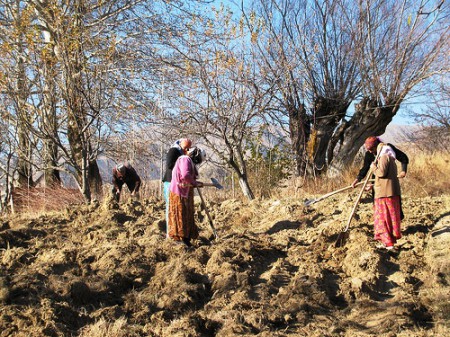
I’m not sure why I like old photographs of markets so much, but one reason may be because at the back of my mind is the thought that maybe photos such as the one from Uzbekistan in the 1950s at left and similar ones from 1920s Egypt could be used to gauge genetic erosion. Too bad the metadata for the stock imagery at National Geographic (where the Egypt photographs came from) doesn’t include date. Anyway, speaking of agrobiodiversity photographs from Egypt, the wonderful Saudi Aramco World also has some in its latest issue.
Potato seeds or seed potatoes
It’s a curse, knowing (and caring) too much. Last week, we dutifully nibbled a Spanish-language report that seeds from Peru’s Potato Park were on their way to the Bóveda Global de Semillas de Svalbard. The BBC, equally dutifully, seems to have retailed the same story. But hang on. Are those true potato seeds, in which case I’ll just relax and go home? Or are they potato seed tubers, capable of safeguarding actual varieties, rather than merely a diverse sample of potato DNA? The BBC certainly suggests the former, by specifically mentioning one of the varieties by name.
I had always thought that named potato varieties do not breed true from true seed. so if seeds are being stored, then why bang on about varieties? And if it is seed potato tubers, which do preserve variety characteristics, why are they being stored at Svalbard, where they’ll die pretty quickly?
Someone put me out of my misery.
A greater curse is the curse of unreliable technology. This post was supposed to magically appear three weeks ago. It didn’t. I don’t know why. And I was on the road at the time. No wonder it evoked no response …
Nibbles: Cloves in Zanzibar, Invasive species, Fingerprinting genebanks, Seed ownership, Pollinator photography, Columbids
- Clovefield.
- They Eat Invasives, Don’t They?
- The Wrong Seeds.
- Seeds of One’s Own.
- Bee Photographs.
- Clay Pigeons.
Nibbles: UG99, Synsepalum dulciforum
- Slim pickings 1: “Rust never sleeps.”
- Slim pickings 2: silly idea for solving world hunger.
Great ethnobotanical collection online
Another great find from the recent issue of The Plant Press I blogged about yesterday is the Smithsonian’s website on Edward Palmer:
Edward Palmer (1831-1911), often regarded as “the father of ethnobotany,” gathered extensive natural history collections in North and South America during the late nineteenth century and established standards for plant collecting and reporting, particularly for plants useful to people. His scientific framework is still used today. This new Botany website, Edward Palmer Collections provides a window into the Palmer Collection to communities where Palmer originally collected, as well as to scientists and the general public.
Palmer held posts both as ethnologist for the Smithsonian and as USDA plant collector, and the connections between his botanical and anthropological materials are fascinating, and nicely highlighted on the website. Now, is anyone going to try to get DNA out of his corncob?