- Executive Director of CBD perpetuates myth that we have lost 75% of crop diversity, at high-level meeting, no less.
- 670 agroforestry trees in a database, courtesy of ICRAF.
- Last Rice Today of this year, the 50th anniversary of the International Rice Research Institute (IRRI), summarized.
- Soil community helps maintain species and genetic diversity.
- Good news for some UK bumblebees.
- On the agricultural frontier in South America. Any crop wild relatives there?
- Global Network of National Geoparks expands. Any crop wild relatives there?
Who to believe?
RSS feeds can be pretty unforgiving, capturing those momentary lapses that not even the fastest fingers can recover. Take, for example, Exhibit A, pictured below. (Click to embiggen.)

Someone clearly thought better about the “fact” that a genetically modified cowpea (“actually a bean”) could generate US$1 billion for small farmers. So it got downgraded to a claim by scientists 1 that will still deliver US$1 billion … without specifying to whom exactly.
The story? Oh, you don’t want to bother with that.
FAO puts crop calendars online
An interesting new feature from FAO’s seeds group:
The Crop Calendar provides information about sowing and planting seasons and agronomic practices of the crops grown by farmers in a particular agro-ecological zone. It is a tool developed to assist farmers, extension workers, civil society and the private sector to be able to access and make available quality seeds of specific crop varieties for a particular agro-ecological zone at the appropriate sowing/planting season. It can be used by development-aid workers in the planning and implementation of seed relief and rehabilitation activities following natural or human-led disasters. Furthermore, the Crop Calendar can serve as a quick reference tool in selecting crop varieties to adapt to changing weather patterns accelerated by climate change.
The Crop Calendar database is being maintained at a regional level and is based on inputs from member countries. The Crop Calendar database currently covers 43 African countries and contains information on more than 130 crops, located in 283 agro-ecological zones.
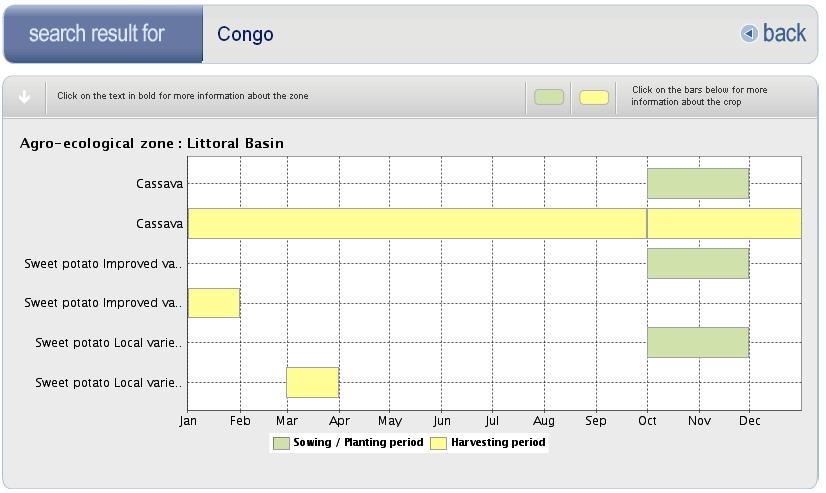 I hope member countries will be encouraged to do what Congo did for sweet potato, which is to record the calendar data separately for improved and local varieties.
Nibbles: IPRs, UN, AE&E
- Useful background to patents on life.
- UN General Assembly mentions “crop diversification” schock.
- You have two weeks to send a 5000 word paper on “agrobiodiversity related issues in Africa” to the journal Agriculture, Ecosystems & Environment. So what are you waiting for?
Cowpeas make the news
On the occasion of the World Cowpea Conference 2010 in Dakar, which is going on now and has resulted in some press interest, IITA have published an interview with the manager of their genebank. Which of course maintains the world’s largest cowpea collection on behalf of us all. Many of the points she makes are addressed in the global strategy for conservation and use of cowpea genetic resources, which I believe she’ll be presenting in Dakar. Dominique doesn’t mention core collections, but another IITA article does. We even have the results of a gap analysis for wild Vigna in Africa. And finally, also doing the rounds is a summary of the results of a survey of users of the collection. Though I wouldn’t bet the farm on those cost numbers turning out to be accurate. Do we have any readers in Dakar who’d like to tell us what’s going on?