- Fine memoir of Sir Bent Skovmand. Thanks Dag.
- Rice yields falling — and not just in experimental stations. The paper.
- In all the eulogies to the inventor of the Cheez Doodle, a note of truth.
- You could buy the Pavlovsk genebank site for just USD3.3 million, it says here. Is that even doable?
- Meanwhile, over in England, Researchers Rush to Fill Noah’s Ark Seed Bank While Politicians Bicker.
- Meanwhile, in Australia, worries about declines in livestock diversity.
- EUCARPIA’s meetings calendar. Handy.
Nibbles: Deregulation, Grapes, Bananas
- As with beer, so with beef. Gary argues for deregulation.
- Bring grapevines back to England, as ornamentals for the time being.
- Bacteria boost banana productivity.
Farming and schoolchildren
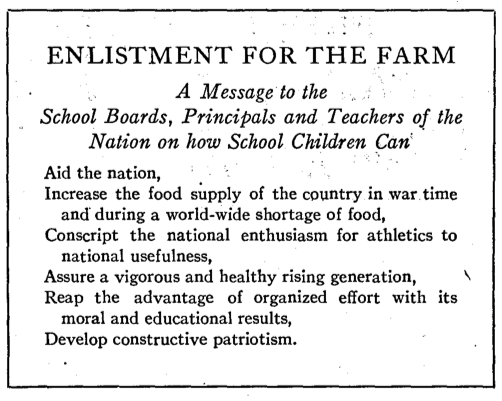 I had really hoped to find something strikingly modern in a pamphlet linked by Marion Nestle, so that I could challenge you all to guess when it was written. Alas, it is too steeped in the language and context of its time. In 1917 John Dewey, the noted psychologist, educator and general all-around thinker, was urging the schools of America to encourage pupils to garden.
There will be better results from training drills with the spade and the hoe than from parading America’s youngsters up and down the school yard. 1
He adduces many convincing arguments which could, with a minor rewrite, be deployed today. Indeed, Nestle makes the connection between child nutrition bills “languishing in [the US] Congress” and Dewey’s exhortations. My question is: did they work then? A quick search reveals that Dewey’s ideas about experiential learning influenced at least a few current school gardens. However, there’s no easily-unearthed evidence that American schools took up farming and garden in 1917-18. Now if only Dewey had had an impact pathway.
Nibbles: Iron beans, Tomatoes, Fruit, Africa college
- Learn about iron beans from a HarvestPlus video, maybe.
- Learn about the tomato in Ghana, more than you might need to know if you read all the reports.
- Learn how Andy Jarvis spoke truth to ex-power, about fruit data gathering project prospects.
- Learn how the Africa College, based at Leeds University in the UK, is working on a range of agricultural problems.
How would you promote agricultural biodiversity?
Here’s the scenario: the civic authorities have decided to install a home garden somewhere in the centre of the city. This is in a country with a very conservative attitude to its food culture, where tradition runs deep (although not as deep as to recognize that several staples of the cuisine arrived as interlopers from other lands, roughly 500 years ago.) And because your organization is based in that same city, and has a reputation for knowing about agricultural biodiversity and home gardens, the authorities have asked you to contribute in some way.
You don’t exactly know why the civic authorities are constructing the garden, although you suspect it has something to do with being seen to be green, to care about food and about diversity. And you don’t know what they want, either, or what kind of experience they are planning to offer the visiting public. A gawp at vegetables in the ground rather than in plastic? Surely not. The country hasn’t lost its agrarian roots that completely. Edumacashun? Yeah, but what is the message? You also don’t know what they want. Advice? Expertise? Something to give to visitors?
So you decide to offer them plants that might be found in a home garden far away, specifically, the nutritious African leafy vegetables that you’ve been promoting for better health, incomes and environmental sustainability. But you fear that the civic authorities might not be too keen. You fear they are likely to say something like: “Why should we plant your strange African vegetables in a garden here? What’s the point?”
What one, killer argument would you offer to persuade them?