The BBC has a nice slide show on the Earthwatch Institute’s medicinal plants project with a Samburu community in Kenya.
Extension services cancelled
We were kind of sorry this morning, taking a glance at the IFPRI website this morning, to see our worst fears about the collapse of agricultural extension systems confirmed.
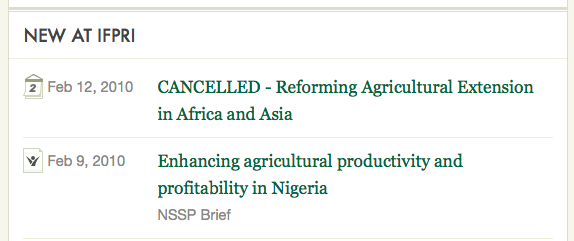
Of course it’s a cheap shot, but what’s the point of owning and operating a global web publishing empire if you can’t take the odd cheap shot?
Nibbles: Chocolate, Cucurbit, Molecular genetics, CGIAR breeding
- “The mysterious extract soon worked its neurotransmitter magic. We gazed enraptured into each others now-blazing eyes, and fell madly in love.”
- Identifying Darwin’s gourd. Both via.
- When are genetic methods useful for estimating contemporary abundance and detecting population trends?
- CGIAR going to evaluate the impact of their varieties. Again.
Science does food security
You’ll remember Jeremy waxing lyrical a few days back about a Science paper on “the challenge of feeding 9 billion people.” That paper now finds itself part of a special issue on food security. 1
In the 12 February 2010 issue, Science examines the obstacles to achieving global food security and some promising solutions. News articles introduce farmers and researchers who are finding ways to boost harvests, especially in the developing world. Reviews, Perspectives, and an audio interview provide a broader context for the causes and effects of food insecurity and point to paths to ending hunger. A special podcast includes interviews about measuring food insecurity, rethinking agriculture, and reducing meat consumption.
A lot of it is behind a paywall, but something that isn’t is Radically Rethinking Agriculture for the 21st Century. That radical rethink, in case you’re wondering, consists of using more biotechnology and saline water. Right.
Witnesses to agricultural adaptation

I think we may have already blogged about WWF’s Climate Witness programme, and if not we should have. It’s a very “effective way to illustrate the impacts of climate change on real people in many different locations around the world, and the action they are taking to address the issues.” Several of the stories involve agriculture, of course. For example, Joseph Kones from Bomet in Kenya says that drought has been increasing in his area over the past 20 years, and that his farm is part of a pilot adaptation project involving tree planting and the building of terraces. It would be nice to extract all the agrobiodiversity-relevant examples of changes and adaptation to them. Perhaps a job for the Platform on Agrobiodiversity Research? Which incidentally we have just added to our blogroll. See what I did there?