We had an email from Yvonna Tan alerting us to the Ashoka Changemakers competition for innovative solutions to improve nutrition. Yvonna wanted us to recommend her project to our readers, but we’re uncomfortable doing that. There are lots of great-sounding projects in the list, from fake goats to vegetable gardens. So while we’re greatful to Yvonna for poking us, we’ll leave you to choose the projects you want to support. You have to register, and that requires responding to an email, so it is a bit time-consuming. But the winning project gets $5000 so you might consider it time well spent. You have till 8 February.
Three good ideas
I think I have already pointed out that Nigel Chaffey does an entertaining round-up of botanically themed items from the world’s media on every issue of Annals of Botany. The latest one has three stories — on training, innovation and information — of great relevance to some of our recurring obsessions here at the Agricultural Biodiversity Weblog.
- “Teaching Tools in Plant Biology is a new, online feature of The Plant Cell consisting of materials to help instructors teach plant biology courses. Each topic includes a short essay introducing the topic, with suggested further readings, and a PowerPoint lecture with handouts. The materials are peer reviewed by leaders in the field to ensure accuracy, like all material in The Plant Cell.” Anyone want to volunteer to do one on agrobiodiversity conservation?
- InnoCentive, the global innovation marketplace, “where creative minds solve some of the world’s most important problems for cash awards up to $1 million,” is to tackle the problem of the European corn borer, though the solvers of this one get only $20,000, and must relinquish all intellectual property rights. Will be interesting to see if anyone bites. The deadline for submission just passed.
- Annals of Botany is going to take part in a project “to establish whether content in various formats from disparate sources (e.g. literature from publishers and data from public databases) can be delivered to a central ‘knowledge brokering service’, which then makes the content machine-readable and allows key pieces of information to be extracted by data-mining approaches.” I really like this idea as a way of aggregating information on germplasm accessions, data from databases but also published results from papers etc.
USDA’s special documents collections online
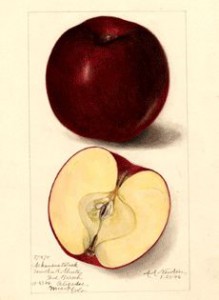
The USDA’s National Agricultural Library has a bunch of “special collections” which are really just that — special. For example, check out the USDA Pomological Watercolor Collection. Here’s a taster, the Arkansas Black.
CGIAR responds to climate challenge, launches Challenge Program
This just in from the Theme Leader on the Global Challenge Program for Climate Change and Food Security, based in Cali, Colombia, aka Andy Jarvis:
The official launch for the Challenge Program on Climate Change, Agriculture and Food Security (CCAFS) will take place on May 4th in Nairobi, Kenya.
Be there (and report it for us?) or be square.
Nibbles: Kew web, Turkeys, Sugar, Climate, Law
- RBG Kew launches new website. Busy, busy, busy.
- Turkeys domesticated twice, neither time in Turkey. Gobble, gobble.
- Warmer-than-expected weather hits Thai sugar production. Sweet.
- Climate shocks hit poor countries’ exports. Shocked. h/t Cecilia.
- Biodiversity law could stymie research,” and that’s all I know, because the rest is behind a paywall. Access and benefit share THIS!