Following that piece a few days back about how social networking can help taro breeding, I posted a note on GIPB‘s Plant Breeding Forum in a thread about the usefulness or otherwise of producing a directory of plant breeders. I suggested that rather than a conventional directory some kind of social network might be called for. After a certain amount of toing and froing it emerged that there is in fact a Plant Breeding and Genetics Network on Linkedin. It was set up by David Feldman of Monsanto last year. Interesting enough, but what I was really thinking of was something more specifically focused on exchanging information on germplasm, rather than on breeders, as a way to move beyond germplasm databases 1. Any examples of that out there?
Photographs of Old Hawaii and its taros see light of day
John Cho — he of the leaf blight-tolerant hybrids — has just posted some wonderful archive photographs of old Hawaiian taro culture to his Facebook page. He kindly agreed to us featuring one of them.
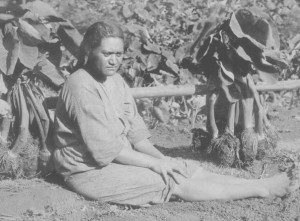
Here’s the backstory.
The images are from photographs archived in the State Archives that I selected and had them scanned by a third party. Sure would have been nice and less costly if the Archives digitized all the images that they have and allow the public to download them. But that is not the case and I had to hire a professional photographer contracted by the Archives to photograph then scan black and white negative images of taro photos that I had selected from the collection. I had planned to eventually put together a taro publication summarizing taro production and culture in Old Hawaii but have not quite gotten off the ground as yet. I decided to at least share some of the images on Facebook for the public to see and hopefully some day I would get off my duff and put the publication together. I also have several scans of taro culture from the Bishop Museum but require their permission to post their images on Facebook.
Nibbles: City fish, Phylogenetics course, Andy got a brand new blog, Leather value-adding, Cod, Monastery gardens, Microbial collections, Cassava, Animal genebank, Biofuel
- Learn urban aquaculture.
- Learn phylogenetics online.
- Learn about the CGIAR’s manifesto for agriculture and climate change from Andy’s new blog.
- Learn about the importance of hide processing in East Africa.
- Learn about the latest blow to British cooking.
- Learn about monastic gardening.
- Learn about the USDA’s microbial collections. They’re agrobiodiversity too.
- Learn what is the latest crop to get its genome sequenced.
- Learn about a private livestock genebank in the US.
- Learn about the effect of biofuel crop diversity on insect diversity.
Bill Gates on genebanks and their databases
From Bill Gates’ annual letter on the work of his foundation:
There are three things that modern agrotechnology brings to this seed improvement process. The first is simply the ability to gather plant samples from all over the world and use databases to keep track of thousands of plants grown under different conditions.
The second is sequencing and the third is transgenics, in case you were wondering. One of these days, I’d like to take Mr Gates down into Genebank Database Hell. But hey, we’re working on it. And the Foundation is helping.
Keeping up to date with taxonomy made easier
Yesterday I was invited to submit one of my photos to the Flickr pool on Systematic Botany. Yes, I know. The media ought to be alerted. But I point this out less to draw attention to my photographic prowess than to highlight the fact that there is in fact a Flickr pool on Systematic Botany, and that it is a lot of fun. Exploring the discussion forum led me to an old news item about staff at the National Museum Cardiff and Kew naming a whole bunch of new Sorbus species, and not from some isolated corner of the world either, but England and Wales.
Some of these trees have probably developed recently and are examples of on-going evolution of new species. Others are older types which have been known for some time but are only now described as ‘species’ thanks to modern DNA methods.
Some Sorbus species have economic uses, and the taxonomy is made horrendously complicated by rampant hybridization and apomixis.
Coincidentally, IIALD had a piece on a new scheme “supporting and promoting the development of persistent and openly accessible digital taxonomic literature.” I wonder whether making photographs of plants available through Flickr or some other image sharing site might contribute to this worthy cause.