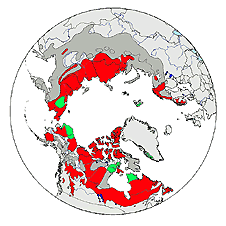
USDA had a nice press release out yesterday about the importance of conserving crop diversity. The example used is the Russian wheat aphid threat to the United States back in 1986. But why do this just now? In preparation for the Third Session of the Governing Body of the International Treaty on Plant Genetic Resources for Food and Agriculture? But that’s two weeks away. Maybe for the International Day of Biodiversity? That’s still a week away, though. I don’t get it. I like it: the time is always right to bang on about plant genetic resources conservation. But I don’t get it.
Agricultural biodiversity weblogger awarded prize
Our friend, colleague and occasional contributor Andy Jarvis has just won GBIF’s prestigious Ebbe Nielsen Prize for 2009 for “combining biosystematics and biodiversity informatics research in an exciting and novel way”. A lot of his work has been on the spatial analysis of the geographic distributions of crop wild relatives, with a view to developing strategies and priorities for their conservation, in particular in the context of climate change. A lot, but far from all: Andy is nothing if not versatile, and his interests extend to the whole of agrobiodiversity. A recent interview with Andy, and others, tries to answer the question “why maps?”. Congratulations to Andy!
VIR at war
I’m going to have to take back what I said about English Russia. Just a couple of days after it featured old photos of Russian agriculture, today there’s more of agrobiodiversity interest. Sergei Larenkov mashes up images of modern St Petersburg with photos taken during the siege. Below is one of St Isaac’s Square. There are several others. It was a cabbage patch during the war. The building in the middle is — and was — part of the Vavilov Institute.

Compare it with the picture I took recently.
Opposing the Egyptian pig cull
I posted my recent little note about the imminent disappearance of the Egyptian pig landrace called Baladi to DAD-Net, and it has generated quite a bit of feedback. The gist is that nobody thinks the cull is justified, and that conservation measures are urgently needed (freezing sperm and keeping it in liquid nitrogen and freezing or vitrifying embryos at the time of slaughter were mentioned). Especially since, surprisingly, the breed has never been properly characterized. An Egyptian researchers lamented this by saying that
characterization needs commitment and funds which are not readily available even for more economically important livestock species.
So that’s not unlike the case with crops, then. You can sign up to a petition to stop the cull.
Another international day coming up
Don’t make any plans for 18 September: it’s World Bamboo Day. And it’s the climax of the VIII World Bamboo Congress in Thailand, which goes under the title of Bamboo, the Environment and Climate Change this year. If you don’t think bamboo is particularly important, read about the plight of a Bhutanese village. Via the INBAR website, via the new NWFP newsletter.