- “No a la droga, si al caucho y al cacao.”
- Spotting banana Xanthomonas wilt (BXW) with biochemical tests.
- The tree that owns itself. Take that, lawyers!
- “The old Chinese gardener in ragged blue coat and trousers with a wispy white beard who potters around smoking one of these long pipes with a tiny bowl — and a mongol cap, periodically performing elaborate grafting techniques on the plum tree.”
- Mexican coffee growers protect surrounding forest. Nepal forest community moving in similar direction?
- Mapping the competition between soy and forest in Brazil.
- Weird agrobiodiversity corner: pseudomonad bacteria help maize take up nutrients.
- Using herbicides to help prairie establishment (including sunflower wild relative).
- Stop press: “Agricultural genetics is one of the easier parts of the solution.”
- “…wildcats preferred resting sites in shelter structures near forest edges.”
- Video on Greek yogurt. Jeremy comments: “I’m going back to Crete.”
The Human Toll of Climate Change mapped
Science Progress has a great interactive map on the effects of climate change on different aspects of human life, including health and agriculture.
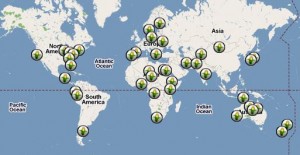
Clicking on the pin takes you to the original source of the information. And you can add your own pins. This is just the kind of model that we could use in developing our platform for an early warning system for genetic erosion.
When did you last see your common ancestor?
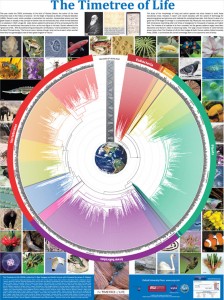
Just came across a truly amazing website called TimeTree. You give it the names of two organisms and it goes away and looks at its database of published literature on molecular clock studies and calculates the time when they diverged.
I put in Oryza sativa and Oryza meridionalis and it returned a figure of 2 million years ago (Mya) based on a recent paper. Asian rice and maize diverged about 36.25 Mya. And Homo sapiens and rice last shared a common ancestor 1,397.06 Mya, in case you were wondering. The sheep and goat diverged about 9 Mya.
So much fun one could have… I hope they put in a lot more crop wild relative data, though.
Nibbles: Byssus, Crops for the Future, African horticulture, Swine, Seeds, Soils, Phosphorus
- Jeremy gets all etymological about fibres. I guess he got fed up of experimenting with fermentation. And with questioning the Wisdom of the Sachs.
- Did we mention Crops for the Future has a cool new website? Subscribe!
- “Inside Africa’s First Global Horticulture Congress“
- We missed the 5th World Congress of Dry-cured Hams. Who knew? Time did.
- In Hawaii? Got seeds to swap? Go to the Amy B. H. Greenwell Ethnobotanical Garden in Captain Cook.
- In Australia? Want better soil? Listen to Maarten Stapper. Via.
- Phosphorus redux. You pays your money …
Drugs on the tube
I’ve been alerted to the existence of a new television series from the BBC of definite agrobiodiversity interest, called “Grow your own drugs.” It is presented by James Wong, a young ethnobotanist who trained at Kew and now lectures at Kent University. There’s a book that goes with the series. James “passionately believes that safe, natural remedies can be made from the everyday plants you find in hedgerows, the back garden or local garden centres.”
”Nowadays we think of plants as pretty objects, as soft furnishings in an outdoor room,” he says. “But just two generations ago they were your hardware store and chemist all rolled into one.” In Malaysia, where Wong grew up, everyone treated themselves with natural remedies. Food, too, was used as medicine – not only herbs, but ginger, chilli and garlic to ward off the symptoms of a cold. “My grandmother had a tiny patch of garden,” says Wong, “which to anyone else would just look like a bunch of flowers, but she could make soup, or a face pack, or something to treat insect bites, in a matter of minutes. It was magical – real Harry Potter stuff.”
Sounds intriguing. Has anyone seen it? Drop us a line. And thanks to Tom for the tip.
LATER: Of course, traditional medicine is going mainstream in some places.