- Building a better Hayward kiwi.
- Adapting to Nagoya.
- But if the Treaty works, maybe you wont need to. And that includes farmers’ rights, of course.
- The Caucasian Spinach is a new one on me, but I’d try it.
- Eating insects is safe. But I suspect that was never the issue.
- What have patents ever done for us?
- Europe’s forests are in a state. See what I did there?
- Yes, it’s time for this year’s seasonal “wild rice” story.
- The non-meat future of protein.
- Does bread even have a future?
- Well, how would you describe an apple? Maybe by use? In the meantime, Tom “The Appleman” Adams is taking the next step.
- Dog domestication explained.
- Nice map of what climate change will do to crops. Spoiler alert: it’s not good.
- The beauty of seeds.
Brainfood: Pigeonpea gaps, Indian rice diversity, Brazilian melons, Ifugao terraces, Collard greens, Climate analogues, Brachiaria diversity, Philosophy of genebanks, Wild barley & drought, Pepper valuation
- Identification of Gaps in Pigeonpea Germplasm from East and Southern Africa Conserved at the ICRISAT Genebank. Lots of collecting work to do.
- Rice Diversity – The Genetic Resource Grid of North-East India. 10,000 cultivars?
- Diversity of Melon Accessions from Northeastern Brazil and Their Relationships with Germplasms of Diverse Origins. Have come from all over.
- Disentangling Values in the Interrelations between Cultural Ecosystem Services and Landscape Conservation—A Case Study of the Ifugao Rice Terraces in the Philippines. They may be beautiful, but they need to be profitable.
- Genetic Diversity and Population Structure of Collard Landraces and their Relationship to Other Brassica oleracea Crops. Collard can be used as a source of diversity for other brassicas.
- Climate Analogues for agricultural impact projection and adaptation – a reliability test. Fail.
- Genetic Diversity and Structure of Ruzigrass Germplasm Collected in Africa and Brazil. The move from Africa to Brazil did not too adversely affect the diversity of this important forage Brachiaria.
- Saving the gene pool for the future: Seed banks as archives. “Decisions about how to salvage the past are always, necessarily, about how we value the future.”
- Response of Cultivated and Wild Barley Germplasm to Drought Stress at Different Developmental Stages. The wild is better.
- Screening Genetic Resources of Capsicum Peppers in Their Primary Center of Diversity in Bolivia and Peru. Different entrepreneurs in different countries value local peppers differently.
Brainfood: Forage diversity, Chinese cherry, Meta-diversity, Sunflower ecogeography, Lima bean domestication, Dog breeding, Goat ethnogenetics, Pigs vs chickens
- Complementary effects of species and genetic diversity on productivity and stability of sown grasslands. Species diversity good for total production, genetic diversity good for regular production throughout the year, regardless of water. And more, and more.
- Genetic Diversity and Population Structure Patterns in Chinese Cherry (Prunus pseudocerasus Lindl) Landraces. Perhaps 2 domestication sites.
- Inter-individual variation promotes ecological success of populations and species: evidence from experimental and comparative studies. More diverse populations are less vulnerable to environmental changes, more stable in population size, less extinction prone, have better establishment success and larger ranges, especially under stress.
- Ecogeography and utility to plant breeding of the crop wild relatives of sunflower (Helianthus annuus L.). Many close relatives of the crop in extreme environments.
- Domestication of small-seeded lima bean (Phaseolus lunatus L.) landraces in Mesoamerica: evidence from microsatellite markers. Two domestications events. Maybe.
- Trends in genetic diversity for all Kennel Club registered pedigree dog breeds. Popular sires have made for a lot of inbreeding, but this has been getting better of late.
- The N’Dama dilemma: ethnogenetics and small ruminant breed dynamics in the tsetse zone, The Gambia. Saving the name is not enough.
- The Pig and the Chicken in the Middle East: Modeling Human Subsistence Behavior in the Archaeological Record Using Historical and Animal Husbandry Data. Chickens replaced pigs in the first millennium Middle East because they were smaller and more efficient. Oh, and eggs.
Brainfood: Wild wheat breeding, Global pea breeding, Old Swedish peas, Prolific Chinese pigs, Genomics & CC, Veggies & food security, Agrobiodiversity use, Land use double, Agrobiodiversity use
- Genealogical analysis of the use of aegilops (Aegilops L.) genetic material in wheat (Triticum aestivum L.). 1350 varieties in 50 years, involving mainly 3 wild species, the proportion of total releases using wilds steadily growing. But many pedigrees may be wrong. Not to mention the taxonomy.
- Pea. In the Grain Legumes volume of the Handbook of Plant Breeding, that is. Two cultivated species, >70,000 accessions, 28+ national and international collections, yield gains of 2% per year over past 15 years, plus good progress in lodging, disease resistance and seed visual quality and modest improvement in abiotic (heat, frost, salinity and herbicide resistance) stress resistance. Genome on the way.
- Diversity in local cultivars of Pisum sativum collected from home gardens in Sweden. Add about 70 to that number of genebank accessions.
- Genetic diversity and population structure of six Chinese indigenous pig breeds in the Taihu Lake region revealed by sequencing data. They are indeed pretty much 6 breeds. The most prolific in the world too, apparently.
- Global agricultural intensification during climate change: a role for genomics. ‘Course there is.
- The Role of Vegetables and Legumes in Assuring Food, Nutrition, and Income Security for Vulnerable Groups in Sub-Saharan Africa. ‘Course there is.
- Drivers for global agricultural land use change: The nexus of diet, population, yield and bioenergy. Livestock, in a word.
- Resolving Conflicts between Agriculture and the Natural Environment. You need “policies dedicating high-quality habitat towards nature conservation, while encouraging intensive production on existing farmland with stringent limits on environmental impacts.” But see above; although they do say in the previous paper that the trend has been slowing lately.
- Using our agrobiodiversity: plant-based solutions to feed the world. “…the preservation and development of existing agrobiodiversity has not been given sufficient attention in the current scientific and political debates concerning the best strategy to keep pace with global population growth and increasing demand for food.”
Pocket pigs are back, and this time they’re for real
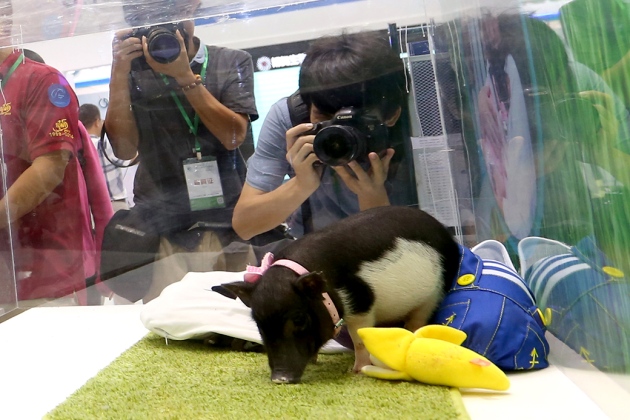
It’s one way to fund cutting-edge research: BGI, the Chinese genomics institute, is offering its micro-pigs for sale as pets.
[T]he institute quoted a price tag of 10,000 yuan (US$1,600) for the micropigs, but that was just to “help us better evaluate the market”, says Yong Li, technical director of BGI’s animal-science platform. In future, customers will be offered pigs with different coat colours and patterns, which BGI says it can also set through gene editing.
This website is known for its devotion to pocket pigs, but please, if you want one, don’t call us. Call Nature, which has all the details.
You’ll need pockets both large and deep:
The animals weigh about 15 kilograms when mature, or about the same as a medium-sized dog.