- Ok here goes, there’s a week’s work of Nibbles we’ve got to catch up on.
- World running out of chocolate! Tell that to Cologne.
- Yeah well I prefer tea to cocoa.
- Greenpeace: “Smart breeding” will save us, not GMOs. Breeders: All breeding is smart.
- Guess the world’s biggest cash crop. Yeah, that one.
- Alas, it’s not included in the recent strategy for conserving medicinal plants. Not that it would need conserving.
- The domestication of the world’s biggest crop, period. Deconstructed. And if you want to drill down.
- And of the world’s biggest fruit.
- And of the world’s biggest pet.
- And of the world’s most difficult to eat vegetable.
- Root “vegetables” made simple. Because winter.
- And why you must eat your veggies, including the difficult ones.
- Videos on Kew’s monocot database and on the renovation of another famous herbarium.
- The real Johnny Appleseed.
- But you too can save seeds, just like Johnny.
- But don’t forget to safety duplicate, like CIP has done, at Embrapa.
- And this shows you what those seeds can look like.
- You don’t necessarily need seeds to save plants, though.
- Mapping fallen fruit. Because we can.
- Road trip!
- Boat trip!
- Selected Techniques in the Art of Agriculture. From French to Turkish to Arabic. One of many nifty agriculture-related resources in the World Digital Library.
- Oh yeah, the IUCN World Parks Congress has been on and its all over the intertubes. Including with neat visualizations, natch.
- How many of the species in the COMPADRE database of plant demography information are in protected areas? How many are crop wild relatives? I need an intern.
Brainfood: Basil resistance, Maize quality & drought, Benin sorghum, Swedish farm size, E European grapevives, Lebanese olives, Brazilian sheep, Sudanese cattle, Egyptian bean rhizobia, Barley origins, Intercropping
- Selecting basil genotypes with resistance against downy mildew. Only the exotic basils were any good. I will resist the temptation to make Fawlty Towers jokes.
- High grain quality accessions within a maize drought tolerant core collection. Not so much a core collection, rather a set of local and exotic drought-tolerant varieties put together in the former Yugoslavia. Some of which turn out to have decent quality too.
- Diversity, genetic erosion and farmer’s preference of sorghum varieties [Sorghum bicolor (L.) Moench] in North-Eastern Benin. Climate change, poor soils and striga are the main problems, according to farmers, and none of their current varieties will help much, apparently, which is why they are disappearing.
- Effects of Farm Size and On-Farm Landscape Heterogeneity on Biodiversity—Case-Study of Twelve Farms in a Swedish Landscape. Small farms = heterogeneous farms = biodiversity-rich farms.
- Identification and characterization of grapevine genetic resources maintained in Eastern European colletions. SSR revealed that of 1098 mainly Vitis vinifera accessions, 997 were indigenous to E. Europe, 101 were Western European cultivars, hybrids, rootstocks and new crosses; the 997 accessions were actually 658 unique cultivars, 54% of which were maintained in the countries of origin only.
- Extent of the genetic diversity in Lebanese olive (Olea europaea L.) trees: a mixture of an ancient germplasm with recently introduced varieties. Three genetic groups around the Mediterranean, most Lebanese material typical of the eastern group; monumental trees similar to Cypriot varieties. In other news, there’s a World Olive Germplasm Bank of Marrakech.
- Application of microsatellite markers for breeding and genetic conservation of herds of Pantaneiro sheep. Evidence of inbreeding means a proper genetic management scheme needs to be designed and implemented.
- Historical demographic profiles and genetic variation of the East African Butana and Kenana indigenous dairy zebu cattle. The only indigenous African dairy breeds, apparently, but with distinct genetic histories despite their similar distribution in Sudan and dairy use.
- Phylogenetic multilocus sequence analysis of native rhizobia nodulating faba bean (Vicia faba L.) in Egypt. Three species, and evidence of horizontal gene movement among them.
- Transcriptome profiling reveals mosaic genomic origins of modern cultivated barley. The Fertile Crescent and Tibet.
- Improving intercropping: a synthesis of research in agronomy, plant physiology and ecology. You can breed for it. Among other things.
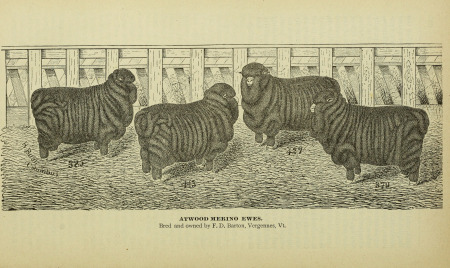
Lots of old book illustrations now online
A Yahoo research fellow at Georgetown University, Kalev Leetaru, extracted over 14 million images from 2 million Internet Archive public domain eBooks that span over 500 years of content. Because we have OCR’d the books, we have now been able to attach about 500 words before and after each image. This means you can now see, click and read about each image in the collection. Think full-text search of images!
Very cool. Interested in sheep breeds, say? Go crazy.
Nibbles: Prof Brian Cox is cool, GRAIN vs Gates, Fragaria law suit, Central Asian fruits, Ecoagriculture, Forage breeding risk, WPC 2014, Nutrition trifecta, MSB funding, European seedsters support IT
- Final Human Universe episode features Svalbard Global seed Vault.
- GRAIN objects to where Gates Foundation spends its money. Nobody much cares.
- Latest on that UC Davis strawberry breeding programme debacle.
- Yes, bears do shit (apple seeds) in the woods. And some context.
- A conference for the hippy in all of us.
- The dark side of pasture breeding. Super-weed, I am your father!
- World Parks Congress on soon too.
- No access to healthy food? Use your mobile! Watch a video! Grow traditional crops!
- Toyota funds the Millennium Seed Bank.
- ESA supports the ITPGRFA. Speak Up For Seed!
Nibbles: Easy Eleusine, Ethical down, Bison pix, Svalbard pix, Salinity costs, Nutrition conference, Veggies for nutrition
- Finger millet is the future in Zimbabwe.
- Conventional down has a problem. I do prefer unconventional down myself.
- They had National Bison Day and nobody told us.
- Epic’s Excellent Svalbard Adventure.
- Start planning for next year’s cucurbit conference.
- Soil salinity sucks.
- On the other hand, this nutrition conference is in only a couple of weeks. And there will be radio.
- Not that these Indonesian ladies will need that.